
Famously, the slogan “All the News That’s Fit to Print” graces the front page of every New York Times edition. The slogan was coined at the end of the 19th century by the paper’s publisher, Adolph Ochs. Of course, in today’s hyper-globalized world, the slogan is wishful thinking. No paper could realistically cover all the important news stories of the day.
Still, it would be hard to argue that outlets like The New York Times, The Washington Post, CNN, and others adequately cover even those stories they do print. They often devote precious space to emotive or opinionated claims, while omitting highly material and relevant information that sheds important new light.
Provided below are three important, but underreported, stories from the week bearing on Israel and the Middle East that media consumers should know.
1) Justice for American Victims of the Second Intifada
In 2004, five injured Americans and five families of Americans killed in the Second Intifada filed a lawsuit (Sokolow, et al. v. PLO) against the Palestine Liberation Organization (PLO) and Palestinian Authority (PA). The Second Intifada was a years-long wave of Palestinian terror attacks in Israel which resulted in the death of between 1,000 and 1,100 Israelis.
Citing the Anti-Terrorism Act of 1992, the plaintiffs argued that the PLO and PA financed and orchestrated seven separate terror attacks between January 2001 and February 2004. Later, Congress passed the Promoting Security and Justice for Victims of Terrorism Act (PSJVTA). The PSJVTA enables entities like the Palestinian Authority, that financially reward terrorists who kill (“Pay-t0-Slay”) Americans, to be sued in the United States.
The case has finally come to a conclusion.
The plaintiffs’ $655.5 million verdict is a big win, and now the plaintiffs will have to take steps in Israeli courts to secure payment from the Palestinian defendants.
While it remains to be seen if this kind of liability will persuade the PA to change its ways and stop “Pay-to-Slay,” having one more tool to dissuade terror is certainly a positive development. Major media did not report on this most recent development, though the story could be found on a few Jewish/Israeli media and law websites.
2) Pakistani Defense Minister Calls Israel Evil While Pakistan Mediates U.S.-Iran Ceasefire
With all the talk of Pakistan negotiating a ceasefire between the U.S., Israel and Iran, Pakistani Defense Minister Khawaja Asif was determined to stand out.
On Apr. 9, 2026, Asif accumulated 2.4 million views in 9 hours after he posted on the social media platform X, “Israel is evil and a curse for humanity.” He described it as a “cancerous state” created to rid Europe of its Jews. The post was deleted a little less than 11 hours after it was first posted.
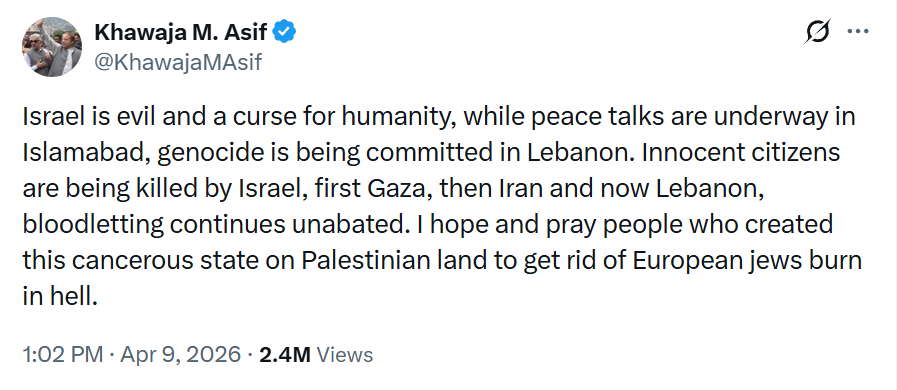
As The Jerusalem Post rightly noted, the Minister’s “language went far beyond standard diplomatic criticism and amounted to one of the most incendiary anti-Israel statements by a serving Pakistani official.” Numerous Israeli officials condemned the post in strong terms. The only American politician who remarked on it before it was deleted was New Jersey Rep. Josh Gottheimer, who described it as hateful rhetoric “beyond unacceptable and unproductive.” As of this writing, no non-Israeli lawmakers had condemned the post except for Gottheimer.
Asif previously (Mar. 2) posted that Zionism was a “threat to humanity,” controlled the world’s economic system for a century, and was holding major global powers hostage. Also, on X he said the U.S.-Israel attacks on Iran were part of a “Zionist agenda” that sought to extend Israel’s influence up to Pakistan’s borders and surround the country with hostile forces.
Asif’s hatefulness rivals a later-removed post by Pakistani Senator Afnan Ullah Khan just a few weeks after Oct. 7, 2023. Khan seemed to justify the Holocaust and killing of Jews when he wrote, alongside a photo of Hitler, “At least now the world know [sic], why he did, what he did” with the hashtag “Gaza Genocide.”
Referring to a Tel Aviv University survey last year, researcher Ratnadeep Chakraborty wrote, “Pakistan is not just an antisemitic state – it is a factory exporting antisemitism to the entire world.” Chakraborty says antisemitism is official government policy and that textbooks teach Pakistani children that Jews are corrupt and deserve death. Chakraborty also explains that the nine million Pakistanis living abroad “carry this hatred with them to Europe, America and the Middle East – and sometimes act on it.”
The Asif story was covered by The Jerusalem Post and Times of Israel, and that’s about it.
3) Candidate for University of Michigan Regent Praised Hezbollah Leaders
In mid-March, Hezbollah-inspired terrorist Ayman Ghazali tried to murder 140 preschoolers at Temple Israel in West Bloomfield, Michigan. Less than one month later, Michiganders learned that a University of Michigan candidate for the Board of Regents deleted social media posts exposing him as both a Hezbollah and IRGC supporter and a run-of-the-mill Jew-hater.
The Detroit News reported that attorney and Regent candidate Amir Makled “reposted, and later deleted, praise for Hezbollah and antisemitic remarks on his social media account.” Makled praised “martyr” Nasrallah (former Hezbollah leader) and now-deceased Hezbollah official Abu Ali Khalil. He also reposted and deleted praise for now-deceased Qasem Soleimani, assassinated by the U.S. in 2020.
While Makled is considered a progressive, running as a Democrat for the Board of Regents race, he found common cause with far-right, antisemitic podcaster Candace Owens. Makled reposted a disgusting post by Owens that referred to Israelis as “demons” and Israel as “demonic.”
Makled previously represented, pro bono, several students who were arrested as a result of encampments on campus in the aftermath of Hamas’ Oct. 7, 2023, massacre. He is challenging two regents, including Jewish Regent Jordan Acker, whose office was vandalized in June 2024.
No national media covered this story, despite University of Michigan having made national news when, together with 60 other higher education institutions, it came under federal investigation last spring for the outsized uptick of antisemitism on its campus.