
What happens when the “paper of record” disavows its own record? The New York Times admitted it made an error in 2012. Nearly 14 years later, it refuses to correct the same one.
On Dec. 2, 2012, The New York Times’ Jodi Rudoren reported on a “contentious 4.6-square-mile area, known as E1, where there are many more goats than people” adjacent to Jerusalem, and Israel’s announcement that it planned to move ahead with preparations for development. In the initial report, Rudoren falsely wrote that the construction plans would effectively cut the West Bank in two.
The article also stated that E1 would threaten contiguity of a possible future Palestinian state.
At the time, The Times issued two CAMERA-prompted corrections for the same story. The second correction acknowledged that E1 development would not divide the West Bank in two and “would not technically make a contiguous Palestinian state impossible.”
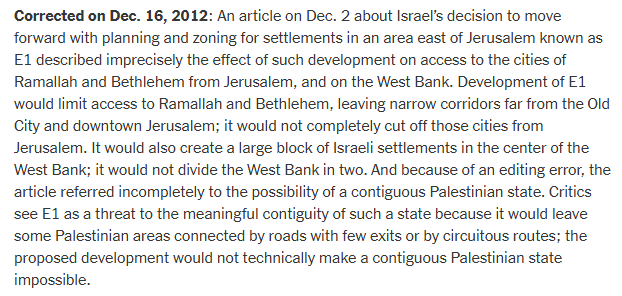
More than 13 years and 9 months later, Isabel Kershner’s Sept. 17, 2026, article “What Is E1, Where Israel is Pushing a Disputed Settlement Plan?” repeats the same errors Rudoren first made. The article falsely states that construction in E1 “would largely sever the northern half of the West Bank from the southern half, complicating the prospect of a viable, contiguous Palestinian heartland.”
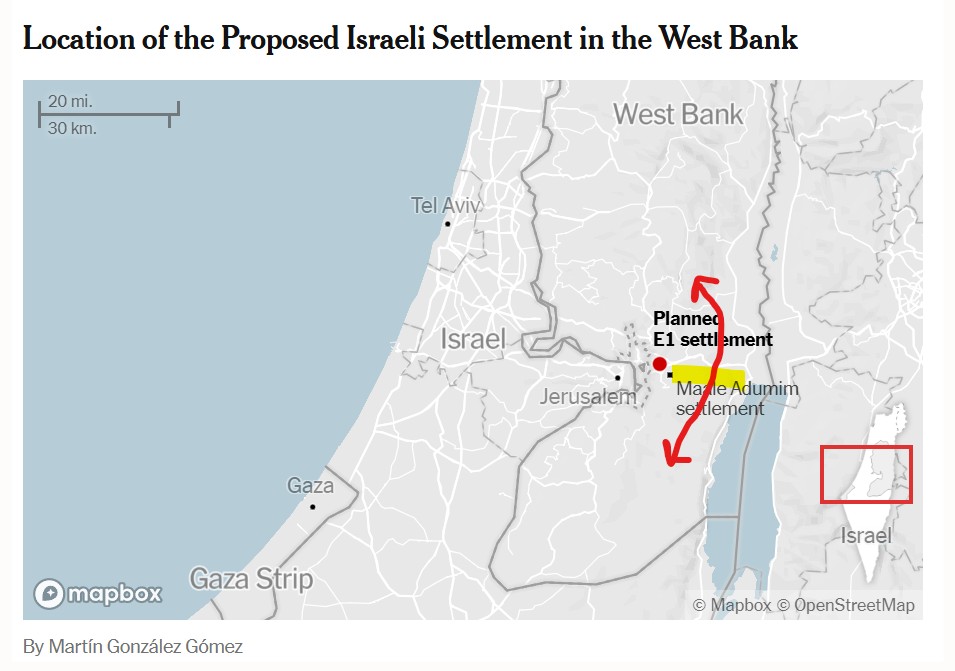
Once again, CAMERA contacted The Times, reminding editors of the earlier corrections and requesting clarification again that E1 does not prevent Palestinian contiguity nor does it cut the West Bank in half. CAMERA advised The Times that the northern and southern parts of the West Bank (still) remain connected by a land corridor east of Ma’ale Adumim that is approximately 15 km wide at its narrowest point. E1 does not physically sever north-south territorial contiguity – and the use of the qualifier “largely” before “sever” does not make the claim true. Even the map accompanying the article makes clear that the planned construction in no way severs north from south. (CAMERA annotated The Times’ map, with the yellow highlighted portion being the narrowest point and the red arrow showing contiguity.)
This time, however, The Times rejected CAMERA’s request for correction, stating it was comfortable with Kershner’s language.
Institutional memory at a major media outlet like The New York Times, which dubs itself “the paper of record,” is supposed to safeguard journalistic standards, ensuring that past mistakes are not repeated. Instead, The Times has actively disavowed its own record. By ignoring clear geographical realities and its own prior correction(s), it is both failing its readers and damaging the credibility it claims to maintain.