
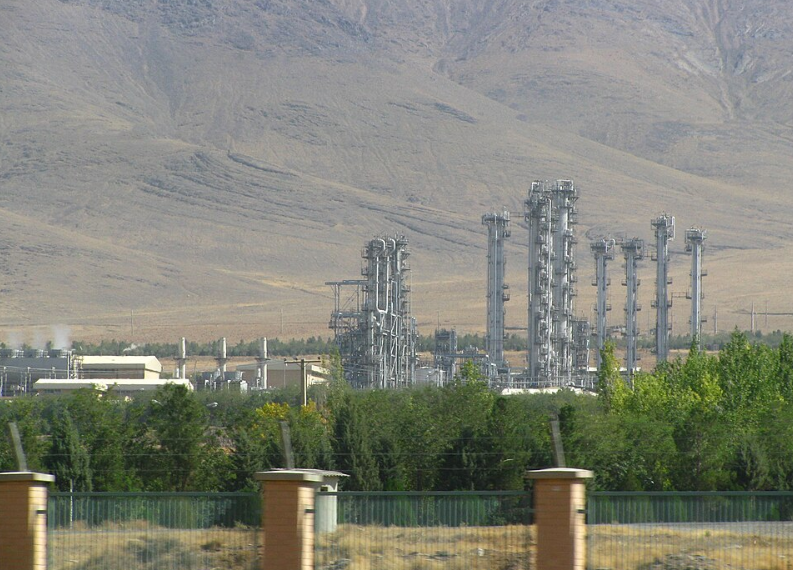
The Arak heavy water reactor near Khondab, Iran in 2012 (Photo by Nanking2012, CC BY-SA 3.0, via Wikimedia Commons)
The Islamic Republic of Iran, which promises its subjects that the dream to wipe Israel off the face of the earth “is just the beginning of the story,” insists to the rest of the world that its nuclear program is entirely peaceful. While the regime’s motives for disguising the true nature of its nuclear program are obvious, what possible rationale is there for Western media outlets to cover up the Iranian nuclear threat? On what suicidal impulse have major news agencies, one after another, erased the existential threats posed by the Islamic Republic of Iran?
In 2018, the Associated Press infamously fabricated that “Iran has never threatened to attack Israel.” In 2022, weeks after the United Nations chief warned that “humanity is just one misunderstanding, one miscalculation away from nuclear annihilation,” Reuters falsely depicted the looming Iranian threat as nothing more than unverified and belligerent Israeli claims.
This week, as U.S.-Iranian ceasefire talks broke down in part over Iran’s refusal to give up its nuclear weapons program, Agence France Presse is the latest to earn the ignoble distinction of covering up — rather than covering — the Iranian nuclear threat. Its April 12 article, “Vance says talks failed to reach deal with Iran on ending Mideast war” (2:27 am GMT, still available on some secondary news sites), grossly misleads: “the UN nuclear watchdog reported no imminent threat of Tehran going nuclear.”
Contrary to the article’s reporting, the International Atomic Energy Agency (IAEA) has hardly ruled out that the Iranian nuclear program is a threat. Indeed, as AFP itself reported on Feb. 27, 2026 (“IAEA stresses ‘urgency’ to verify Iran’s nuclear material“):
The UN nuclear watchdog stressed on Friday the “utmost urgency” of its request to verify all nuclear material in Iran, according to a confidential report seen by AFP.. . .
Tehran suspended some cooperation with the IAEA and restricted the watchdog’s inspectors from accessing sites bombed by Israel and the United States, accusing the UN body of bias and of failing to condemn the strikes.
“Within the group of affected facilities, it is a matter of increasing concern that Iran has never provided the agency with access to its fourth declared enrichment facility since it was first declared by Iran in June last year,” the IAEA said in the report.
The agency does not know the precise location of the Isfahan Fuel Enrichment Plant, it said in a second report.
It said it had observed through commercially available satellite imagery, “regular vehicular activity” around the entrance to the tunnel complex at Isfahan, in which uranium enriched up to 20 percent and 60 percent was stored.
Activities were also conducted at other affected nuclear facilities, including the enrichment facilities at Natanz and Fordow, it added.
“Without access to these facilities it is not possible for the agency to confirm the nature and purpose of the activities,” it said.
In addition, on June 12, 2025, AFP reported (“UN nuclear watchdog slams Iran’s ‘non-compliance‘”):
The UN nuclear watchdog on Thursday adopted a resolution condemning Iran’s “non-compliance” with its obligations in a new warning before a possible referral of the case to the United Nations. . . .
The resolution adopted Thursday calls on Iran “to urgently remedy its non-compliance” with its commitments under the Non-Proliferation Treaty (NPT).
It also “deeply regrets” that Tehran “despite repeated calls from the Board and many opportunities offered… has failed to cooperate fully with the Agency”.
IAEA’s “inability … to provide assurance that Iran’s nuclear programme is exclusively peaceful gives rise to questions that are within the competence of the United Nations Security Council (UNSC)”, which can draw up sanctions, the resolution said.
For years, the IAEA has been trying to obtain clarification on nuclear material and equipment found at undeclared sites and resulting from undeclared activities carried out until the early 2000s.
Tehran has also accelerated production of near-weapons-grade uranium in recent months.
Furthermore, AFP reported June 28, 2025 (“Iran could again enrich uranium in ‘matter of months’: IAEA chief“):
UN nuclear watchdog chief Rafael Grossi says Iran likely will be able to begin to produce enriched uranium “in a matter of months, “despite damage to several nuclear facilities from US and Israeli attacks, CBS News said Saturday. …
The uranium in question is enriched to 60 percent — above levels for civilian usage but still below weapons grade. That material, if further refined, would theoretically be sufficient to produce more than nine nuclear bombs.