
Famously, the slogan “All the News That’s Fit to Print” graces the front page of every New York Times edition. The slogan was coined at the end of the 19th century by the paper’s publisher, Adolph Ochs. Of course, in today’s hyper-globalized world, the slogan is wishful thinking. No paper could realistically cover all the important news stories of the day.
Still, it would be hard to argue that outlets like the New York Times, the Washington Post, CNN, and others adequately cover even those stories they do print. They often devote precious space to emotive or opinionated claims, while omitting highly material and relevant information that sheds important new light.
Provided below are three important, but underreported, stories from the week bearing on Israel and the Middle East that media consumers should know.
1) The Gaza Water Shutdown
Gaza’s water was shut off this week—but not by Israel. Despite widespread assumptions, Israel has never supplied most of Gaza’s water. It has, however, continued repairing and even building new water pipelines into the territory.
The actual shutdown came from the Abdul Salam Yassin Company, a Gaza-based water utility whose services reach more than one million residents—roughly half the population. The company halted service to protest Hamas’s detention of one of its employees. Neither Hamas nor the company has explained the detention.
The staff member was released on Wednesday. The company apologized for a “misunderstanding” that supposedly led to the detention, and restored water service the same day.
Despite obvious humanitarian and human rights implications, the story received almost no international coverage—appearing mainly in Reuters dispatches and a handful of Israeli and Jewish news outlets.
2) The UN Finally Takes a Stand Against Hamas

Patrick Gruban, cropped and downsampled by Pine, CC BY-SA 2.0 <https://creativecommons.org/licenses/by-sa/2.0>, via Wikimedia Commons
On Nov. 17, the UN Security Council adopted Resolution 2803, endorsing President Trump’s “20-Point Plan” to end the Israel-Hamas war that began with Hamas’s Oct. 7, 2023 massacre. The resolution is striking on several fronts, but for present purposes, Hamas’s reaction is the most revealing.
For decades, the UN has obsessively condemned Israel—even for actions such as arresting Nazi war criminal Adolf Eichmann or building disabled access to cultural sites—while barely acknowledging Hamas’s terrorism. The UN General Assembly could not even condemn Hamas for the Oct. 7 atrocities. Previous attempts at condemnation were similarly blocked.
The UN’s rosy attitude toward the terrorist organization has not gone unappreciated by the latter. Since murdering, raping, torturing, and kidnapping over 1,400 Israelis on Oct. 7, 2023, Hamas has on multiple occasions expressed its gratitude toward the UN – which had never demanded Hamas’s disarmament nor sanctioned the terrorist group.
That era may now be over. Resolution 2803 explicitly requires Hamas’s disarmament, the demilitarization of Gaza, and the removal of Hamas’s “government” from power. In response, Hamas “rejected” the resolution and falsely asserted a “legitimate right” to wage terrorism. Israel welcomed the move, with Prime Minister Netanyahu declaring the plan “will lead to peace and prosperity.”
Many outlets reported the resolution’s adoption. Almost none highlighted what it represents: a historic shift in the UN’s posture toward Hamas.
3) Media Darling and Gazan “Doctor” Is a Hamas Operative
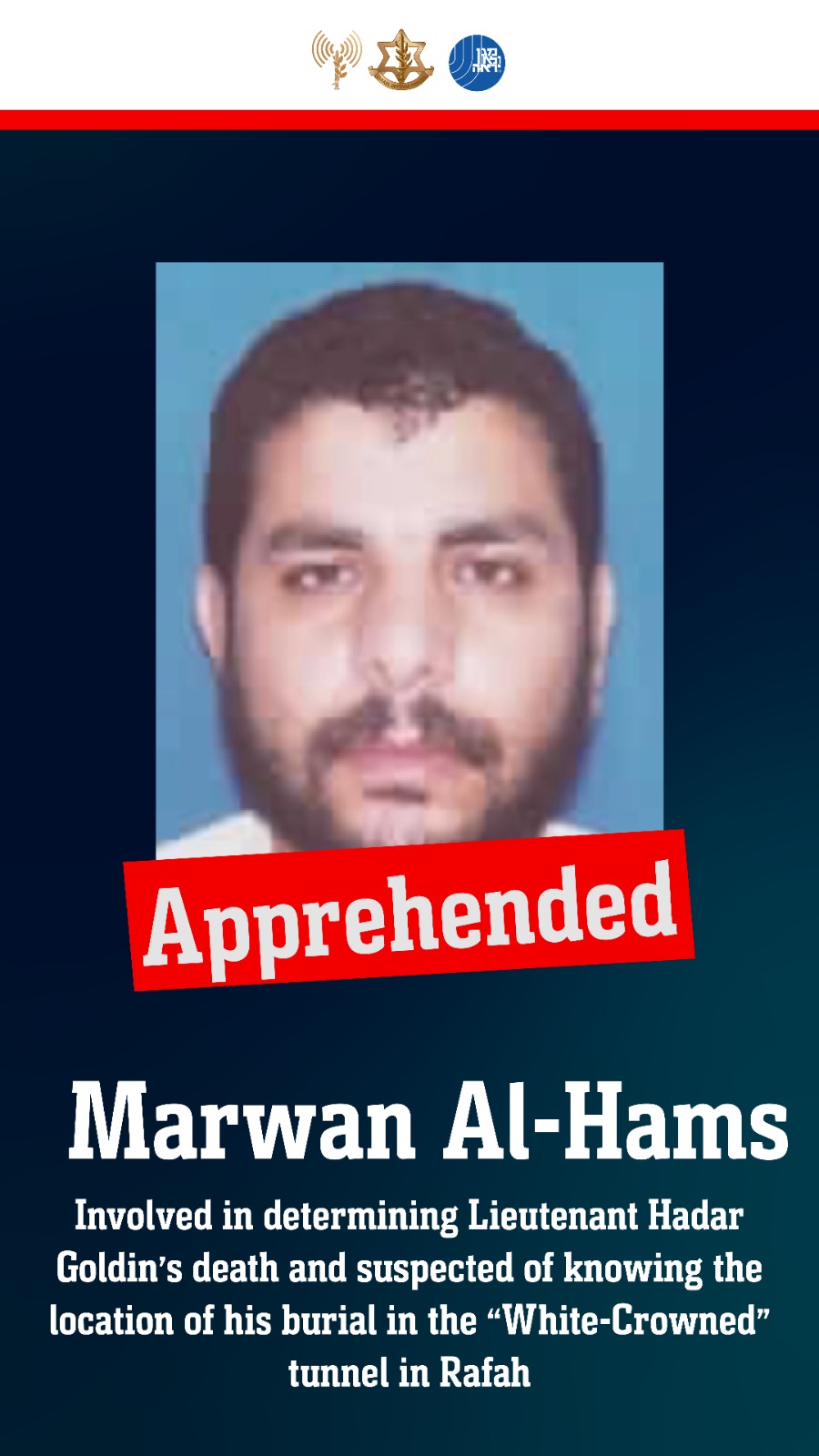
An infographic produced by the IDF regarding Marwan al-Hams.
Western media have long presented Marwan al-Hams as a neutral medical professional—“a doctor” and “Director General of Field Hospitals” for the “Ministry of Health in Gaza.” Typically omitted is the basic context: that ministry is part of Hamas’s governing structure. Al-Hams is, in reality, a senior official in a terrorist regime.
For months, reporters across the industry—from CNN to The New York Times—relied heavily on al-Hams’s claims about conditions in Gaza, often to assign blame to Israel.
Recent revelations make this even more troubling. According to the Israel Defense Forces, al-Hams is a “Hamas terrorist” involved in the decade-long kidnapping of the body of Israeli soldier Hadar Goldin.
Responsible journalism would require reassessing his credibility and reporting these findings. None of the outlets that previously relied on him have done so.
Historical Context for Current Events
The passage of resolution 2803 is especially notable in light of a failed attempt in 2018 to secure a UN condemnation of Hamas.
In November 2018, the United States introduced a draft General Assembly resolution condemning Hamas for “repeatedly firing rockets into Israel” and for its diversion of resources to build military infrastructure—including cross-border tunnels and rocket-launch facilities—rather than addressing civilian needs.
When the draft came to a vote on Dec. 6, 2018, U.S. Ambassador Nikki Haley observed: “[T]he United Nations has never once passed a resolution condemning Hamas. Never. Over 500 resolutions condemning Israel and not one single resolution condemning Hamas. That, more than anything else, is a condemnation of the United Nations itself.”
The resolution failed after a series of procedural maneuvers led by Hamas’s defenders. A central figure was Ireland’s ambassador Geraldine Byrne Nason, who introduced an alternative resolution demanding only that Israel “end” its “occupation that began in 1967.” Although she voted “in favor” of the U.S. draft, she was later seen celebrating its defeat alongside the Palestinian representative.
Less than five years later, Hamas invaded southern Israel, murdering, torturing, raping, and kidnapping civilians—using the very tunnels, rockets, and military infrastructure the UN had refused to confront.