
Famously, the slogan “All the News That’s Fit to Print” graces the front page of every New York Times edition. The slogan was coined at the end of the 19th century by the paper’s publisher, Adolph Ochs. Of course, in today’s hyper-globalized world, the slogan is wishful thinking. No paper could realistically cover all the important news stories of the day.
Still, it would be hard to argue that outlets like the New York Times, the Washington Post, CNN, and others adequately cover even those stories they do print. They often devote precious space to emotive or opinionated claims, while omitting highly material and relevant information that sheds important new light.
Provided below are three important, but underreported, stories from the week bearing on Israel and the Middle East that media consumers should know.
1) The Hostages Are Coming Home
Because no amount of reporting could do the story justice.
Coming home are: Ariel Cunio (27); Alon Ohel (23); Eitan Horn (38); Avinatan Or (31); Elkana Bohbot (35); Evyatar David (24); Bipin Joshi (24); Ziv Berman (27); Gali Berman (27); David Cunio (34); Eitan Mor (24); Maxim Herkin (36); Omri Miran (47); Bar Abraham Kupershtein (23); Guy Gilboa-Dalal (23); Nimrod Cohen (20); Matan Zangauker (25); Tamir Nimrodi (20); Matan Angrest (22); Segev Kalfon (27); Rom Braslavski (21); Yosef-Haim Ohana (24); Itay Chen (19); Eliyahu Margalit (75); Eitan Levi (52); Sahar Baruch (24); Joshua Luito Mollel (21); Tal Haimi (41); Arie Zalmanowicz (85); Ran Gvili (24); Dror Or (48); Tamir Adar (38); Ronen Engel (54); Inbar Hayman (27); Guy Iluz (26); Asaf Hamami (41); Lior Rudaeff (61); Muhammad Al-Atarash (39); Meny Godard (73); Omer Neutra (21); Yossi Sharabi (53); Daniel Oz (19); Daniel Perez (22); Uriel Baruch (35); Sontia Ok’Krasari (30); Sontisek Rintalk (43); Amiram Cooper (85); and Hadar Goldin (23).
Among these names, fewer than half remain alive.
2) More Hamas Tunnels Found Underneath Hospitals
Hamas’s cynical use of hospitals for military purposes is both prolific and well-documented. While outlets like CNN bafflingly continue to treat the issue as merely an Israeli allegation, the documentation of Hamas’s practice is only growing.
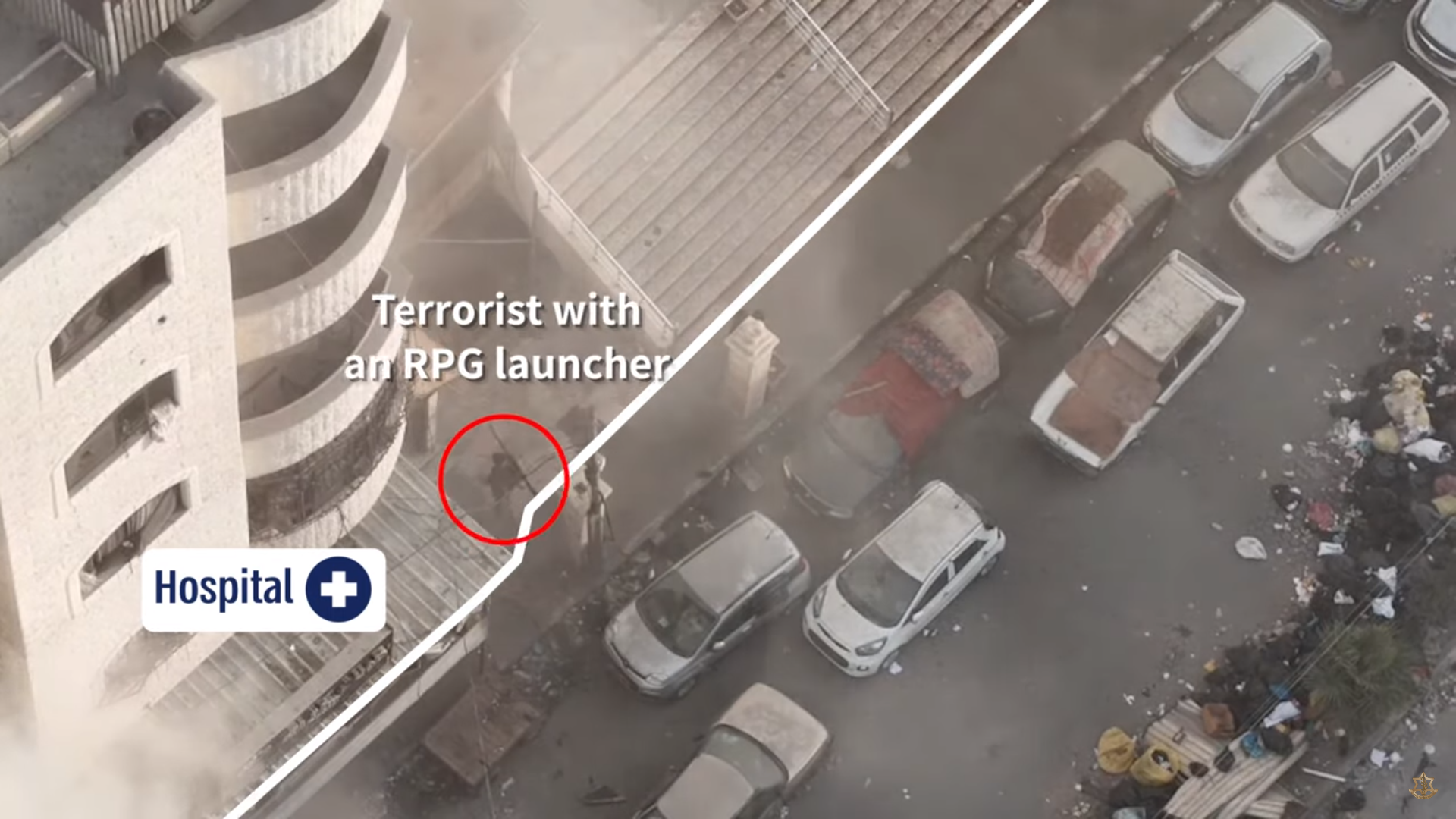
Drone footage showing a Palestinian terrorist with a rocket propelled grenade launcher using a hospital as cover.
This week, Israeli forces uncovered not one, but two more tunnel systems using Gazan hospitals as cover. One ran next to the Jordanian Hospital, with a tunnel shaft entrance adjacent to the complex that “led to an underground workshop used for manufacturing weapons” (drone footage here). Another ran underneath the Sheikh Hamad Hospital, with two tunnel shafts on either side of the hospital building (drone footage here). Notably, this isn’t the first time a tunnel has been found at the Sheikh Hamad Hospital. Drone footage has also shown Hamas forces firing on Israeli forces from the hospital building itself.
Tunnels have also been found underneath or adjacent to many other Gazan hospitals including al-Shifa Hospital, the Indonesian Hospital, and al-Rantisi Hospital.
Among non-Jewish or Israeli outlets, only the Washington Examiner, the New York Sun, the Daily Mail, and Sky News (in passing) covered the discovery of these tunnels.
3) Sanctions on Iran are Working
Iran is increasingly feeling the heat of sanctions over its nuclear weapons and ballistic missile programs. While the U.S. has been ratcheting up the pressure for a while now, the United Nations Security Council reimposed the “snapback sanctions” on September 27. Now, Iran’s economy is facing ever-increasing restrictions from the U.S., Europe, and beyond.
Consequently, Iran is being forced to adopt increasingly dramatic measures to sustain itself and its weapons programs. One such measure: Iran is increasingly relying on a barter system that avoids the global financial system by trading Iranian oil and other commodities for goods, and even infrastructure projects, from places like China. On October 6, it was reported that Iran was exchanging copper and zinc for Chinese cars. These tactics, however, can only go so far, and the United States is adopting measures targeting these sanctions-evading initiatives.
The outlook for Iran’s economy is thus bleak. According to the National Council of Resistance of Iran:
Future scenarios paint a grim picture. Under full sanctions enforcement, Iran’s oil revenue could fall below $18 billion, driving inflation beyond 90 percent. Even under the most “optimistic” outlook — with limited diplomatic relief — inflation remains above 60 percent, and oil income stagnates at $25 billion. This ongoing crisis reflects a strategic failure: a regime that has mortgaged Iran’s future for short-term survival. While other nations invest oil revenues in post-oil diversification, Tehran is trapped in daily bargain sales, draining its reserves for the benefit of Khamenei’s patronage networks.
Among major Western outlets, only Bloomberg and the Wall Street Journal have covered these developments.
Historical Context for Current Events
As the U.S.-brokered ceasefire deal, also known as the 20-Point Plan, begins taking effect – including the release of the Israeli hostages in exchange for hundreds of Palestinian terrorists – it is worth recalling the 2011 Gilad Shalit deal, the 14th anniversary of which will be next week.
Shalit was an Israeli soldier who was kidnapped in 2006. On October 18, 2011, he was freed in exchange for 1,027 Palestinian terrorists held in Israeli prisons.
The exchange remains highly controversial. Among those terrorists released was Yahya Sinwar, the mastermind of Hamas’s October 7 massacre, which led to the current hostage crisis. Other prominent released terrorists included Ahlam Tamimi (Sbarro pizzeria massacre), Zaher Jabarin (senior Hamas leader), Husam Badran (senior Hamas leader), Nasser Yataima (Netanya Park Hotel Passover bombing), Musab Hashlemon (involved in two suicide bombing attacks), and Walid Anajas (Jerusalem café bombing). These figures, along with many others released, returned to terrorism, leading to greater future harm.