
Early this month, four Agence France Presse photographers working in the Gaza Strip were named as Pulitzer Prize finalists for their “Breaking News Photography.”
“This recognition is a tribute not only to the talent and bravery of these photographers, but also to AFP’s steadfast commitment to documenting events with accuracy and integrity, wherever they unfold,” Phil Chetwynd, AFP’s global news editor gushed. “We are deeply grateful to Mahmud, Omar, Said, and Bashar, whose work gives voice to those caught in the heart of the conflict.”
Some of these photographers had previously been awarded prizes in a separate competition, Pictures Of the Year International (POY).
But zooming in on two of these individuals – Omar al-Qatta and Bashar Taleb – exposes them as the very picture of broken news photography.
Giving Voice to Terrorists
AFP photographer Omar Al-Qattaa has indeed given voice to those in the heart of the conflict. Specifically, he has repeatedly cheered terrorists who carried out attacks against Israelis.
Posting about a March 2023 attack in Tel Aviv, in which one civilian was killed, Al-Qattaa selected the song “Inn Ann,” which glorifies violence against Israel, as the soundtrack to a video from the attack.
Praising a January 2023 attack in Jerusalem, which killed seven civilians in ages ranging from 14 to 68, Al-Qattaa shared a 1998 headline about the perpetrator’s grandfather, allegedly killed by “Jewish terrorists”, adding:
Today, after 25 years, [someone] bearing the same name comes out of his spawn to avenge his grandfather and Palesine with the strongest revenge, carrying out an operation of self-sacrifice [lit. “redemption”] in occupied Jerusalem, killing 8 Zionists [in fact, 7]
Regarding a March 2022 attack in Bnei Brak near Tel Aviv, which killed four civilians aged 29 to 36 and an Israeli police officer, Al-Qattaa wrote: “If only the rifle could cheer ❤️”
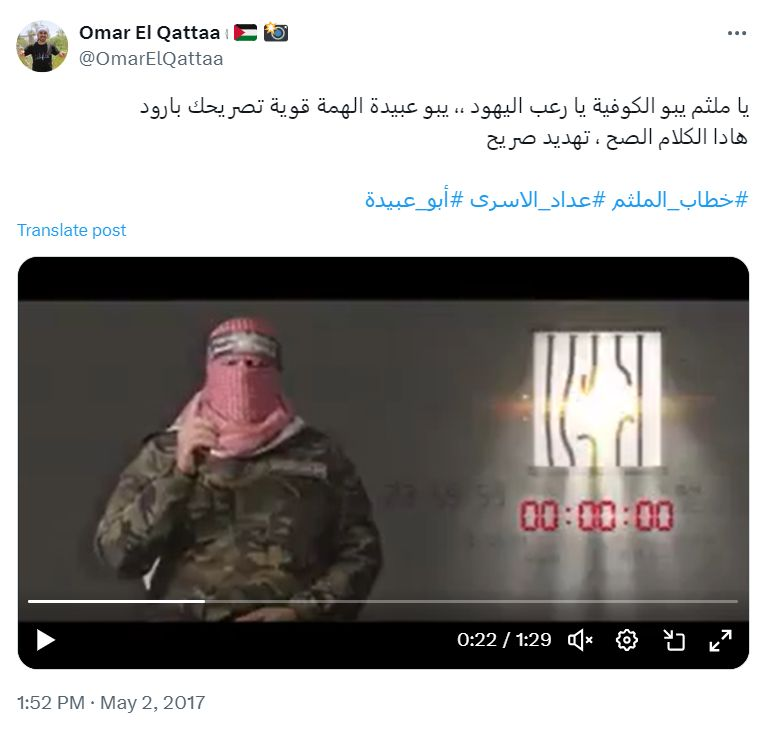
Al-Qattaa’s now deleted X post in which he extols Abu Obeida, “Oh terror of the Jews”
Not content to give voice only to terrorists, Al-Qattaa weighed in on their victims’ tortured screams. Celebrating a January 2023 stabbing attack in Jerusalem (no fatalities), Al-Qattaa eulogized: “your screams are music [to the ears].”
Previously, in May 2024, CAMERA’s Ricki Hollander documented additional top Al-Qattaa hits of giving voice to those in the heart of the conflict. Al-Qattaa, who has also worked for National Public Radio, extols the uber voice of the Hamas terrorists, Izz ad-Din al-Qassam Brigades spokesman Abu Obeida, “Oh Abu Obeida,” “Oh masked one who wears a kaffiyeh,” “Oh Terror of the Jews.” (Abu-Qattaa has since scrubbed that post on X, but a screenshot is at left.)
Free of Political Ties (Aside from PFLP, Hamas)
As part of its stated commitment to integrity, AFP promises to be “independent and free from any political, commercial or ideological influence.”
Bashar Taleb, another one of the Breaking News Photographer Pulitzer finalists, has been photographing in the Gaza Strip for AFP since 2010. Through Taleb’s Gaza lens, the principles of political and ideological independence assume more of an abstract style.
 As our colleagues at InfoEquitable revealed, in 2017, Taleb posted an invitation to a tribute ceremony for his late father. Above the father’s image in the heart-felt invitation, a small image appears: the red logo of the Popular Front for the Liberation of Palestine, designated by numerous countries, including France, as a terror organization.
The obituary notes that the departed Ahmed Taleb “Abu Faras” was a “combatant” who joined PFLP fresh out of school, spent two stints in Israeli prison, and was released the second time in 1985 as part of a deal in which three captured Israeli soldiers were exchanged for 1150 Palestinian prisoners including Sheikh Yassin, the future founder of Hamas. Ahmed retired following an ostensible career as a carpentry instructor for UNRWA.
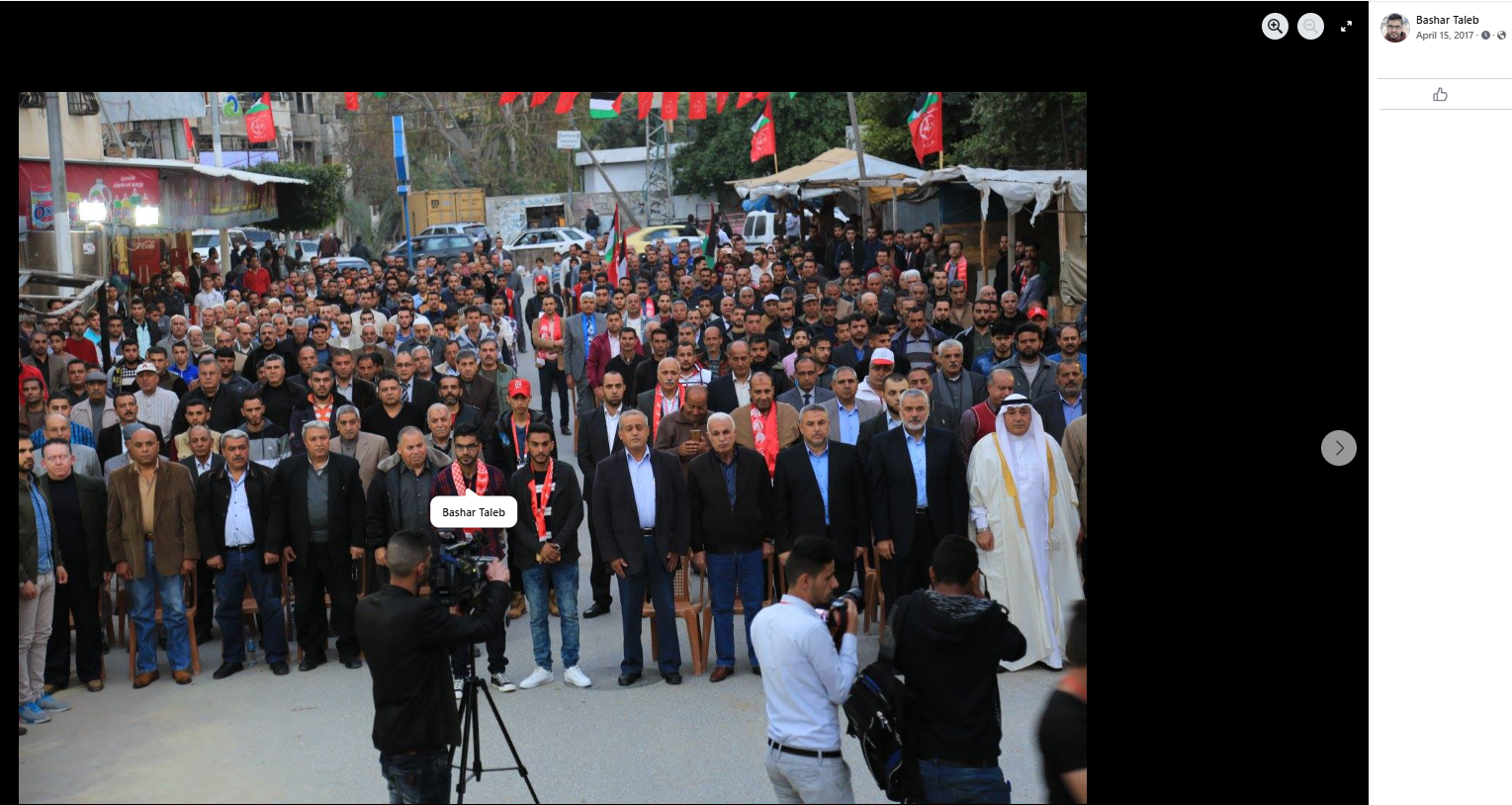
Haniyeh is in the first row, second from right. (Source: Taleb’s Facebook account)
Bashar’s first-degree familial relationship to a terror operative doesn’t necessarily reveal anything about him personally – after all, maybe he rejected his father’s ways. But the photographic evidence indicates otherwise. InfoEquitable flagged a photograph of the memorial event in which the younger Taleb (front row, first on left with red scarf), is seen sporting a PFLP scarf like many dignitaries gathered at the solemn occasion. Standing with them, and AFP’s Bashar, is no less than Hamas leader Ismail Haniyeh, the mastermind of the Oct. 7 massacre (front row, second on right). (Indeed, the photograph is one for the archives, as Haniyeh has since joined his departed colleague.)
At the sad event, Haniyeh “delivered a speech in which he listed the merits of the late Abou Firas, emphasizing that he had a long history in the Palestinian struggle.”
 Ensconced in this terror milieu, the AFP journalist is inevitably steeped in antisemitic views. Indeed, it’s hard to decide who is more talented at dehumanizing Jews. Bashar Taleb, who shared a post in memory of Saddam Hussein, praising the Iraqi dictator for bombing Tel Aviv and ridiculing Jews “caught like rats in shelters”? (He has removed the post, but a screenshot is at left.) Or his co-Pulitzer finalist and AFP colleague Al-Qattaa who referred to Jews as “pigs”? (Al-Qattaa also scrubbed his “pigs” slur, but it is archived here.)
While AFP acknowledges the looming shadow of the father in the life of his photographer son, the news agency touches up the imagery, carefully airbrushing out Ahmed’s terror profession. Thus, a February 2025 photo essay featuring Taleb’s work selectively recounts:
Bashar Taleb has been working as a photographer since he was 14. He is not just a contributor to AFP—he is also a resident of Gaza who has had to endure the trauma of war. “I am 35 years old and became engaged to my fiancée during the war and during my displacement”. Having lost his father, he is now responsible for his family of eight. After spending months trying to keep his family safe from harm in in the city of Deir al-Balah in central Gaza, he returned home only to find his neighbourhood had been damaged beyond recognition.
On July 31, 2024, AFP adopted new guidelines regarding proper sourcing. Touching specifically on the Israeli-Palestinian conflict, the guidelines caution: “We must take particular care to avoid any hint of bias or unfair apportioning of blame in the highly charged atmosphere of the Arab-Israeli conflict, where our coverage is under intense scrutiny on a daily basis.”
The agency also adds: “We must also ensure that local freelancers are working independently of the protagonists.” These are laudable principles.
But with Pulitzer finalist photographers Omar Al-Qattaa – who time and again has voiced his solidarity with protagonists terrorizing civilians – and Basher Taleb, who proudly wears on his sleeve his identification with terror protagonists – AFP’s implementation of these lofty guidelines is woefully out of focus.
This piece was written in collaboration with InfoEquitable, which provided research and writing. CAMERA Arabic also contributed to research.