
On May 6, 2026, Barak Ravid reported for Axios, “U.S. and Iran closing in on one-page memo to end war, officials say.” Ravid relied on “two U.S. officials and two other sources briefed on the issue” for this report, but he gave very little hearing to the skeptic camp and paid no attention to what the Islamic Republic side was saying. If he had done so, his reporting would not have been debunked so quickly.
Mehr News Agency, CC BY 4.0 <https://creativecommons.org/licenses/by/4.0>, via Wikimedia Commons
Immediately, Nour News, a regime outlet, denied the report, stating, “The American offer is being evaluated in Tehran, and there has not been any final conclusion.” It added, “Some Western media are trying to [manipulate] the situation by publishing narratives about the details of the two sides’ agreements or demands.” The report continued, “According to knowledgeable sources, [these] claims are largely false.”
Nour News is an affiliate of the Islamic Republic’s Supreme National Security Council. Islamic Revolutionary Guards Corps (IRGC) General Mohammad-Bagher Zolghadr, who replaced the slain Ali Larijani in March, heads the council. He concurrently oversees the Expediency Council.
These councils intend to create a “whole of government” approach in Iran and harmonize the regime’s different branches and agencies toward the same policy objectives. The Supreme National Security Council specifically focuses on foreign policy, while the Expediency Council oversees all political issues. As the head of both, Vahidi is one of the most powerful men in Iran.
According to reports and a statement from President Donald Trump, the Islamic Republic is divided on whether to seek a ceasefire agreement or continue fighting.
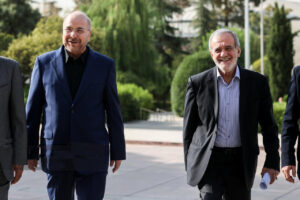
Allegedly, Speaker of the Parliament Mohammad-Bagher Ghalibaf and President Masoud Pezeshkian favor diplomacy. In contrast, the core of the IRGC prefers to resume the hostilities. IRGC Commander Ahmad Vahidi and Zolghadr lead this camp.
In a private conversation with his advisers, Ghalibaf reportedly attacked his opponents, accusing them of wanting to destroy Iran. This might have been a leak, authorized by Ghalibaf, and for the benefit of the U.S. negotiation team. Ghalibaf and Pezeshkian are also reportedly seeking to oust the foreign minister, Abbas Araghchi, who they view as too close to the IRGC.
Ravid’s report briefly alludes to the Iranian discord. “The White House believes the Iranian leadership is divided and it may be hard to forge a consensus across the different factions,” adding, “Some U.S. officials remain skeptical that even an initial deal will be reached.”
A major impediment to reaching an agreement is not the gap between the demands of the United States and Iran, but the disagreements within the Islamic Republic. These disagreements have been out in the public recently. Ravid’s failure to report on this issue poorly serves policymakers and voters.
Even the IRGC hardliners are bitterly divided. Recently, Tasnim News Agency and Raja News entered a brief online spat over the wisdom of diplomacy, accusing each other of treachery. Both outlets are affiliated with the IRGC and are known to be close to the hardline elements of the Islamic Republic.
There is a long tradition of such divisions. During the Obama-era negotiations, then-Islamic Republic President Hassan Rouhani and Minister of Foreign Affairs Javad Zarif favored diplomacy while the military leadership opposed talks. But that was a rare win for the pro-diplomacy side. In a leaked conversation in 2021, Zarif admitted that when he and the late IRGC Quds Force commander, Ghassem Soleimani, disagreed over whether to prioritize “diplomacy or the battlefield,” diplomacy lost every time.
Until February, there was an easy mechanism to resolve these disputes. Supreme Leader Ali Khamenei played the referee. Zarif negotiated the 2015 nuclear deal because Khamenei sided with him then. But with Khamenei dead and his successor reportedly gravely wounded, it is unclear how these divisions will be resolved.
According to Israel’s Channel 12 and Iran International, the IRGC pushed Ghalibaf out of the negotiating team and replaced him with Saeed Jalili, the former nuclear negotiator and former head of the Supreme National Security Council. Jalili is the most ideological and hardline politician in the regime, close to the security forces. The late Khamenei was fond of saying that Jalili’s supporters were the foundation of the Islamic Republic, meaning that they were the ones upholding the regime.
Ghalibaf appears to be trying to survive the power struggle by making hardline public statements. He mocked the Axios report as “faux,” and, on May 5, he tweeted in Persian that “the [American] evil will vanish.” This is at odds with his posture in private meetings with the U.S. delegation. Whether he is taking a hardline before the regime’s base, which is skeptical of his ideological commitment, to save himself, or privately trying to deceive the American team that he wants, a deal is unclear.
The real story of the talks is not the two sides’ demands, but whether the pro-diplomacy side in Iran can sell any deal to the IRGC, which is effectively in control, which Ravid did not investigate.
Instead, he simply repeated his sources in the administration, who might not be fully honest, be it to affect U.S. public opinion or play games with the Islamic Republic. But the fault does not lie with them; it lies with the journalist who took their words on face value without verifying the claim.