
Blink and you might miss it. Associated Press’ 1,262-word May 15 article on the so-called Nakba dedicates just 28 words to the historic events which led to the 1948 displacement of hundreds of thousands of Palestinians from the nascent Jewish state.
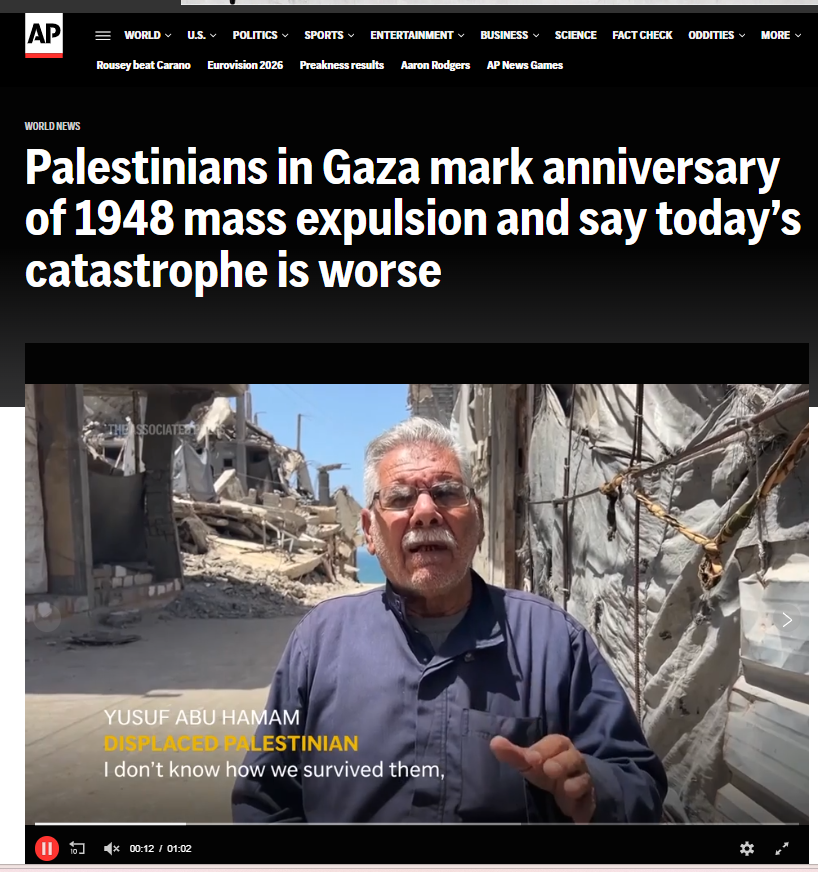 Deep in their May 15 article, “Palestinians in Gaza mark anniversary of 1948 mass expulsion and say today’s catastrophe is worse,” AP’s Julia Frankel and Wafaa Shurafa fleetingly and partially acknowledge the war of extermination which multiple Arabs armies, joined by local Arabs, launched against the nascent Jewish state. They obscure in the tenth paragraph:
The fighting began when Arab armies attacked following Israel’s establishment as a home for Jews in the wake of the Holocaust. Palestinians who remained behind hold Israeli citizenship.
Thus, just over two percent of the lengthy article refers to the basic historic fact of Arab responsibility for the Palestinian refugee issue, while some 96 percent of the story strains to depict Palestinian Arabs as blameless victims, both in 1948 and again since Hamas’ Oct. 7, 2023 massacre. (Incidentally, that’s 2.2 percent more than AP’s 2024 “Nakba” story, which contained zero reference to the Arab effort to eliminate the Jewish state.)
AP’s pervasive narrative is that “In Gaza, Palestinians live a new Nakba,” as an subheadline editorializes, with no qualifying quotation marks or attribution. This tireless theme swallows the fleeting informative 28 words about Arab responsibility for the 1948 refugee problem. (Incidentally, AP was an early adopter of the “new Nakba” in Gaza motif, with its first piece on the subject just one week after Hamas’ Oct. 7 massacre.)
Similarly, under the “new Nakba” rubric, AP treats Palestinian responsibility for the current fate of Gaza Strip Palestinians as a mere historical footnote. “It was triggered by Hamas’ Oct. 7, 2023, attack on southern Israel that killed some 1,200 people,” Frankel and Shurafa write about the Israeli offensive in paragraph 23. “Militants also abducted 251 hostages.”
With just 22 words, Arab responsibility for the 2023-2026 Gaza calamity, or the “new Nakba” as AP calls it, garners even fewer words than Arab responsibility for the original Nakba.
While most readers will miss the buried 28 words about Arab responsibility for the 1948 refugee problem, none will miss the article’s booming headline citing “1948 mass expulsion.” But contrary to the headline’s bombastic claim, the vast majority of Arabs who left mandate Palestine fled, often at the urging of their own leaders, and were not expelled.
Indeed, the article’s own poster child for displacement was not expelled. The article opens:
Blink and you might miss the few stone walls that are all that’s left of the village that Yusuf Abu Hamam’s family was forced to flee when he was an infant in 1948.
The village, al-Joura, was demolished by the Israeli military at the time.
Later, Frankel and Shurafa misleadingly add:
Al-Joura was seized by the Israeli military as it advanced against Egyptian forces in November 1948. Soldiers were ordered to destroy every home in al-Joura and neighboring villages to ensure their Palestinian populations couldn’t come back, according to miliary archives cited by Israeli historian Benny Morris.
Yet, Morris also reported that when troops arrived at Al-Joura on Nov. 30, 1948, they found “not a living soul,” meaning the residents had already fled (“Birth of the Palestinian Refugee Problem Revisited,” page 518).
Indeed, it appears that some residents left even before 1948. Another Al-Joura native who also left for the Al-Shati camp was Hamas’ Sheikh Ahmed Yassin. Reporting about Yassin, Khaled Abu Toameh wrote in the Jerusalem Report (July 20, 1998):
Ahmed Yassin was born in the village of Joura, near Ashkelon, in 1936. His family left the area for Gaza in 1947, when battles between Arabs and Jews broke out in the area, and settled in what was to become the Shati refugee camp. [TS adds: Abu Hamam’s family also left for the Shati refugee camp.]
Others likely fled in October 1948, not because of “mass expulsion,” but because of the sort of unfortunate incident which happens regularly in war. Regarding Operation Yoav, which began on Oct. 15-16, Morris wrote in his book “1948” (page 323):
The assault by the whole of the IAF hit the main Egyptian airfield at El ‘Arish and targets in Gaza and Majdal, the two Egyptian ground force HQs, at 6:00 PM. The aim was to catch the Egyptians on the ground and achieve air superiority, and to sow confusion in their command structure. At El ‘Arish, the IAF achieved complete surprise and, together with continuous follow-up raids, rendered the airfield inoperative (the Israeli daily Davar, absurdly, compared the initial strike to “the blow launched by the Japanese against Pearl Harbor”).17 The raids on Gaza and Majdal were inaccurate and militarily ineffective. But the raiders hit the village of al-Jura, mistaking it for Majdal, with devastating effect; al-Jura served as a refugee way station.
Finally, AP wrongly reports: “After the [1948] war, Israel refused to allow Palestinian refugees to return to ensure a Jewish majority within its borders.”
As CAMERA has previously noted, Israel offered to take back 100,000 Palestinian refugees even before any discussion of the refugee question as a goodwill gesture during the 1949 Lausanne negotiations. The Arab states, who had refused to negotiate face-to-face with the Israelis, turned down the offer because it implicitly recognized Israel’s existence (Nadav Safran, Israel: The Embattled Ally, Harvard University Press, p 336).
As of this writing, AP has failed to rectify the misleading “mass expulsion” headline and the editorialized “new Nakba” subheading. Nor has the news agency clarified that the residents of al-Joura fled. Editors have similarly not corrected the erroneous assertion that Israel refused to allow any refugees to return following the 1948 war.
“Saving what was lost, again and again,” is the long article’s final subheadline, above the text which begins: “The 1948 Nakba also brought the loss of Palestinians’ history, as those fleeing struggled to keep hold of the documents and possessions tying them to their homes.”
The loss of Palestinian history is truly lamentable, whatever the circumstances. It’s a pity that AP is contributing to that loss, actively erasing and downplaying Palestinian responsibility for the Nakba, then and now.