
Back in October 2025, the BBC’s Rushdi Abualouf wrote the following:
Mediators have made contact with the head of Hamas’s military wing in Gaza, who has indicated he does not agree to the new US ceasefire plan, the BBC understands.
Izz al-Din al-Haddad is thought to believe the plan was designed to finish Hamas, whether the group accepts it or not, and so is determined to fight on. [Emphasis added.]
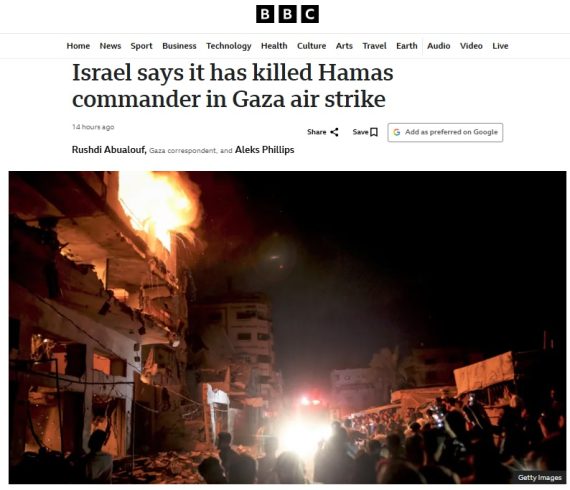 On May 15, 2026, the BBC News website published a report by Rushdi Abualouf and Aleks Phillips, originally headlined “Israel says it has killed Hamas commander in Gaza air strike,” which told readers:
Israel says it has killed Hamas commander Izzad-Din [sic] al-Haddad, who it described as “one of the architects of the October 7 massacre”, in an air strike on Gaza City. …
Hamas has neither confirmed nor denied claims Haddad, the commander of the group’s armed wing, the Qassam Brigades, had been killed.
The article did not clarify that since June 2025, Haddad was also the most senior Hamas leader in the Gaza Strip – having replaced Mohammed Sinwar – and it had nothing to tell readers about his record. A Ynet report from 2025 notes that:
Over the years, al-Haddad held key positions. During Operation Cast Lead (2008–2009), he commanded Hamas battalions in eastern Gaza City. In 2012’s Operation Pillar of Defense, he oversaw Hamas’s southern brigades in Gaza City, and by May 2021’s Operation Guardian of the Walls, he was responsible for combat support operations across the strip. …
He helped plan the October 7 massacre, overseeing the Gaza City sector and the deadly raid on Nahal Oz. […]
Hours before the October 7 attack, al-Haddad reportedly gathered six battalion commanders, giving them a handwritten message encouraging bravery and secrecy, banning cellphone use and instructing that their assaults be livestreamed.
During a January ceasefire interview with Al Jazeera, al-Haddad claimed Israel had planned a massive assault after the Jewish High Holidays and that Hamas pre-empted it by launching their attack. He thanked Hezbollah, Iran and the Houthis for their support.
Part of that interview can be seen here.
The BBC’s article failed to inform readers that Haddad had used hostages as human shields. Times of Israel reported: “During the war, Haddad moved between numerous hiding places, surrounding himself with many hostages, including the female surveillance soldiers, to avoid being targeted in Israeli strikes, the military source said.”
The BBC report promoted anonymous “eyewitness” accounts of strikes in the Rimal neighbourhood and on a vehicle fleeing, perhaps unwittingly revealing the Hamas tactic of exploiting civilian residential areas and facilities, reporting:
Three eyewitnesses told the BBC that a residential buildingknown as Al-Mu’taz was struck by three missiles launched simultaneously from two separate directions, before a fleeing car was hit. …
One eyewitness told the BBC that a body and several injured people had been removed from the building.
A second air strike, targeting a car seen leaving the scene, killed three people, according to eyewitnesses and a local source.
Sources said the vehicle may have been carrying Haddad after he had been seriously injured in the initial strike.
Eyewitnesses and a local source said armed members of Hamas dressed in civilian clothingevacuated a severely wounded person through a side entrance and placed him in a vehicle.
Witnesses said the car was hit around 1.5 km (0.9 miles) from the apartment block.
According to a report from Israel’s Channel 13, Haddad was in his hideout in the apartment block together with four bodyguards.
However, the synopsis to the May 16 edition of the BBC World Service’s “Global News Podcast” (which will remain online for two months) tells BBC audiences:
Israel says it’s targeted the head of Hamas’s military wing – describing him as an architect of the October 7thattacks. It’s not clear if Izz al-Din al-Haddad was killed in the airstrike in Gaza City but there were civilian casualties. [Emphasis added.]
In the item itself, presenter Will Chalk tells listeners: “Hamas hasn’t commented on the fate of the commander but the Palestinian Civil Defence spokesperson, Mahmoud Bassal, said the attack in Gaza City had killed civilians.
Chalk does not bother to inform BBC World Service audiences that Mahmoud Bassal is a Hamas operative or that the Gaza Civil Defense is a Hamas-run outfit. Neither does BBC tell audiences that among the civilians were Haddad’s wife and daughter who, according to Hamas, were with him in the hideout.
On the afternoon of May 16, editors updated the website’s written report and changed the headline to read “Hamas confirms top commander killed in Israeli air strike.”
Both the earlier and later versions of the report tell BBC audiences:
A ceasefire in Gaza came into effect on 10 October, but Israel has conducted regular strikes across the Palestinian territory since then.
Hamas has repeatedly accused Israel of breaching the terms of the ceasefire and attacking civilians. The Israeli government maintains it has license to target Hamas members.
It, in turn, accuses Hamas of refusing to disarm in breach of the ceasefire agreement.
As has all too often been the case since that ceasefire came into effect, the BBC had nothing to tell its audiences in its own words about the repeated violations of the agreement by Hamas and other terrorist organizations.
Both versions of the report conclude using the BBC’s much-used “frozen in time” formula, according to which the number of Israeli casualties remains static – ignoring both soldiers and civilians killed after Oct. 7, 2023 – but presents up-to-date Hamas-sourced figures for Palestinian casualties which do not differentiate between combatants and civilians. According to this formulation:
The two-year-long Gaza war was triggered by the Hamas-led attack on southern Israel on 7 October 2023, in which about 1,200 people were killed and 251 others were taken hostage.
Israel responded by launching a military campaign against Hamas in Gaza, during which more than 72,744 people have been killed, according to the Hamas-run health ministry. Of these, 857 have been killed since the ceasefire began, it says.