
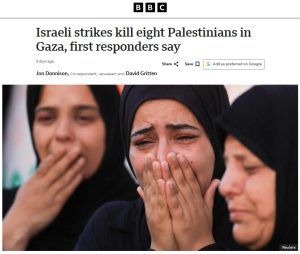
 On April 23 the BBC News website published a report credited to Jon Donnison under the headline “Israeli strike kills five Palestinians in northern Gaza, medics say.” Some four hours later editors amended to headline to state “Israeli strikes kill eight Palestinians in Gaza, first responders say” and added David Gritten to the credits.
The current version of that article (a link to which is promoted in a separate BBC report) includes the following:
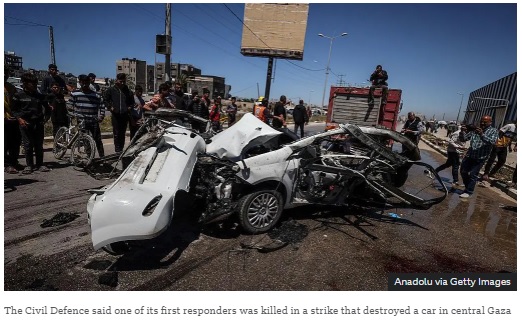
Later on Thursday, another three men were killed when Israeli shellfire hit a car in the central Maghazi area, according to the Hamas-run Civil Defence.
The agency said one of its first responders, Hazem al-Aidi, was among the dead.
The Israeli military said it was checking the reports.
A photograph caption similarly states: “The Civil Defence said one of its first responders was killed in a strike that destroyed a car in central Gaza.”
 Two days later, on Saturday April 25, it emerged that the Hamas-run Gaza civil defense agency’s “first responder” was in fact a Hamas cell commander who had participated in the Oct. 7, 2023 atrocities and that the other two people in the targeted vehicle were also Hamas operatives. The Times of Israel reported:
The IDF said Saturday that a recent airstrike in central Gaza killed several Hamas operatives who planned attacks on Israeli troops, including a terrorist who invaded Israel during the October 7, 2023, onslaught, as Palestinian officials reported that at least 13 people were killed in Israeli strikes across the enclave the same day.
The strike on Thursday targeted a cell of Hamas operatives who planned “imminent” attacks on Israeli troops stationed in central Gaza, according to the IDF.
The military and Shin Bet security agency said the strike killed Hazem Rami Ali Aidi, a commander of a Hamas cell who invaded Israel during the October 7 attack. It also killed Ibrahim Mansour, a Hamas platoon commander and a “key figure” in the terror group’s efforts to restore its capabilities, and Maher Tantawi, a Hamas intelligence operative.
The BBC has not updated its report to provide readers with that relevant context and to inform audiences that the man whom the report identified as a “first responder” purely on the word of a Hamas-run agency was in fact a terrorist.
BBC journalists have been uncritically quoting and promoting unverified claims made by the Gaza civil defense agency for over two years, often without adequate clarification of its connection to Hamas and the links of some of its employees to terrorist organizations. BBC reports published immediately following incidents in the Gaza Strip have all too often been based on unverified claims made by that Hamas-run agency, with no independent verification carried out.
Time and again, when new facts relating to a specific incident have emerged days or weeks later, the BBC has failed to provide its audiences with that information by updating its original reporting or producing new coverage.
As we have noted in the past – and as this example of a Hamas terrorist presented only as a “first responder” once again demonstrates – the result of that editorial policy is that the BBC News website’s “permanent public record” increasingly promotes superficial and partial stories based on unverified claims made by Hamas-run agencies, baseless denials from that terrorist organization and unconfirmed local eye-witness accounts. BBC journalists fail to make the effort to ensure that the public record includes the entire information relevant to understanding of a particular story and the broader subject matter.
This article originally appeared at CAMERA UK.