
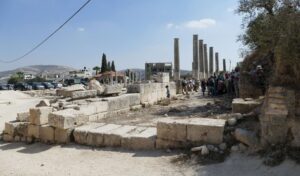
Ancient city of Samaria/Sebastia, adjacent to the village of Sebastia, West Bank. (credit: Bukvoed, CC BY 4.0, via Wikimedia Commons)
In 2006, Gareth Binns, then Keeper of Learning and Information at the British Museum, reaffirmed the institution’s founding principle as a “museum of the world for the world.” But this posture of “universal ownership” has faced fierce backlash from indigenous groups who view it as a convenient pretext for retaining colonial acquisitions.
This universalist rhetoric extends far beyond museum walls. A July 21, 2026, CNN article by Tal Shalev, Jeremy Diamond, and Zeena Saifi on the ancient site of Sebastia, once the capital of the biblical Kingdom of Israel, relied authoritatively on the Israeli NGO Emek Shaveh (“On this West Bank hilltop, a fight over the past will determine who controls the future”). Like the British Museum, it champions a “universalist” approach to heritage sites.
CNN disguised its minimization of a millennia-old Jewish presence by leaning heavily on the NGO’s “universalist” framing. In treating the ruins of imperial conquerors built atop ancient Samaria as evidence that the site belongs to “everyone,” the outlet used layers of colonial history to dilute its indigenous Jewish roots.
In an apparent balancing act, the network stated, “Each side believes the land – and its past – belongs to them,” that “the West Bank is home to thousands of archaeological sites … reflecting its long history as a crossroads of civilization,” and that “Sebastia is a testcase to a battle not just over the past, but about the present and the future of the territory and the people who live near its historic stones.”
Still, behind this cover of neutrality, the article framed Israeli efforts to preserve the site as inherently malicious, accusing the state of attempting to “seize” the site and the surrounding Palestinian-owned land, while treating the campaign by the Palestinian Authority (PA) to register Sebastia with UNESCO as legitimate.
CNN quoted Israel’s far-right Heritage Minister Amichai Eliyahu (Otzma Yehudit) on the site’s importance to Jewish heritage, then it noted that he was “known for floating a nuclear strike on Gaza in 2023 as ‘one option,’” using an ad hominem swipe to avoid engaging with his argument.
Immediately, CNN then introduced Emek Shaveh as an “Israeli watchdog group” that simply “tracks archaeology in the West Bank.” Unlike the context provided for Minister Eliyahu, CNN wholly concealed the political leaning of Emek Shaveh, which invokes “universalism” to argue that ancient sites belong to all humanity, and routinely supports the preference of international bodies, like UNESCO, to place these sites under PA control.
The ‘heart’ of the Jewish people
According to Jewish tradition, King Omri purchased the hill of Samaria around 876 BCE from a landowner named Shemer (the city’s namesake) and established it as the capital of the Kingdom of Israel. He ruled for 12 years. King Ahab succeeded his father and ruled for another 22 years.
Archaeologists have found extensive evidence of Jewish presence there. Examples include the “Samaria ostraca,” inscribed on in paleo-Hebrew, and the Samaria ivories, which many archaeologists argue are remnants of Ahab’s “ivory house” mentioned in the Bible. The article failed to mention any such archaeological evidence.
The reporters acknowledged that the area dates back to ancient Samaria, noting that King Herod rebuilt the site after it fell to the Assyrians in 722 BCE, but they omitted that King Herod was Judean.
Archaeologist Dr. Avi Solomon described Sebastia to CAMERA as the “heart” of the Jewish people, referring to the dozens of times it is mentioned in the Tanakh as the capital city of Samaria or as a synonym for the entire Kingdom of Israel. But CNN focuses on local Palestinian tourism director Zaid Azhari, who described Sebastia as “our heart and our memory at the same time. … It’s like your children – you cannot leave one of them.”
Under the Oslo Accords, the archaeological ruins sit in Area C (which remains under full Israeli civil and military administration), while the adjacent town and its tourism facilities sit in Area B (under Palestinian civil control and joint security oversight).
CNN cited local residents and a local tourism developer who claimed that they were recently barred (the article does not specify by whom) from conducting “basic preservation work on ruins in the Israeli-controlled side” and are “losing access to the site.” Dr. Solomon noted that Palestinian archaeologists have never conducted any basic preservation work at the site.
Media reports confirm decades of severe neglect. The Associated Press reported on June 3, 2013, that the site was “marred with weeds, graffiti and garbage,” where “unauthorized diggers and thieves have taken advantage of the lack of oversight to make off with priceless artifacts.” According to the AP report, Israel’s Civil Administration noted that any Israeli conservation works that were started in the 1990s were halted “due to the change in the security situation” following the Oslo Accords.
The Times of Israel reported on May 12, 2025, that the site “has largely remained undeveloped and unexcavated for decades.” Thus, contrary to CNN’s suggestion that Israel’s revitalization at Sebastia impinges on Palestinian preservation work on the site is unfounded.
Despite this track record, the PA has pushed to formally register Sebastia as a Palestinian UNESCO World Heritage site (it has been listed on UNESCO’s tentative list since 2012), a move CAMERA UK researcher Adam Levick detailed as part of a broader campaign to erase and rewrite Jewish history and connection to the land.
Notably, while the UNESCO listing mentions “ancient Samaria” and “biblical tradition,” its nearly 800-word description completely omits Sebastia’s explicitly Jewish roots.
Erasing indigeneity
This “universalization” ignores the unique, continuous relationship the Jewish people have with the land of Israel as an indigenous population. As indigenous rights advocate and author Ryan Bellerose wrote in Tablet Magazine (2017):
Indigenous status stems from the genesis of a culture, language, and traditions in conjunction with its connections to an ancestral land, most commonly derived from ties to pre-colonial peoples… Once a people have such a cultural, linguistic, and spiritual genesis as well as a coalescence as a people, they are generally acknowledged as an indigenous people.
Bellerose, alongside numerous scholars, points out that the Jewish people fully meet the international standard for indigeneity in this territory. Furthermore, Indigenous Bridges executive director Ateret Shmuel told CAMERA that the article ignored how the widespread, documented destruction and re-labeling of non-Muslim sacred sites has historically served as a tool of Arab settler colonialism, citing the Islamic State’s destruction in Iraq and Syria as extreme modern manifestations of this cultural erasure.
Regardless of the ongoing political debates surrounding site management, deciding which culture holds legitimate claims to ancient land is not CNN’s job.
This framing of Israeli preservation efforts as political land grabs while treating the PA’s UNESCO bid as benign actively helps sanitize the removal of an indigenous people from their own physical history. If the point of labeling something as “everyone’s” to say that the custodian does not have a right to destroy the site, that is fair enough. Better yet, Israelis have no such intent and have proven to be excellent operators of it.
But that is not what the campaign is about. Labeling this ancient site “everyone’s” is the first step of stripping Jewish control over it, the second step being transferring it to a single political body without a legitimate claim to it or a record in its preservation. It is indigenous erasure under a high-minded guise; a media revival of the very same defense the British Museum and its peers have long used to disinherit indigenous peoples.