
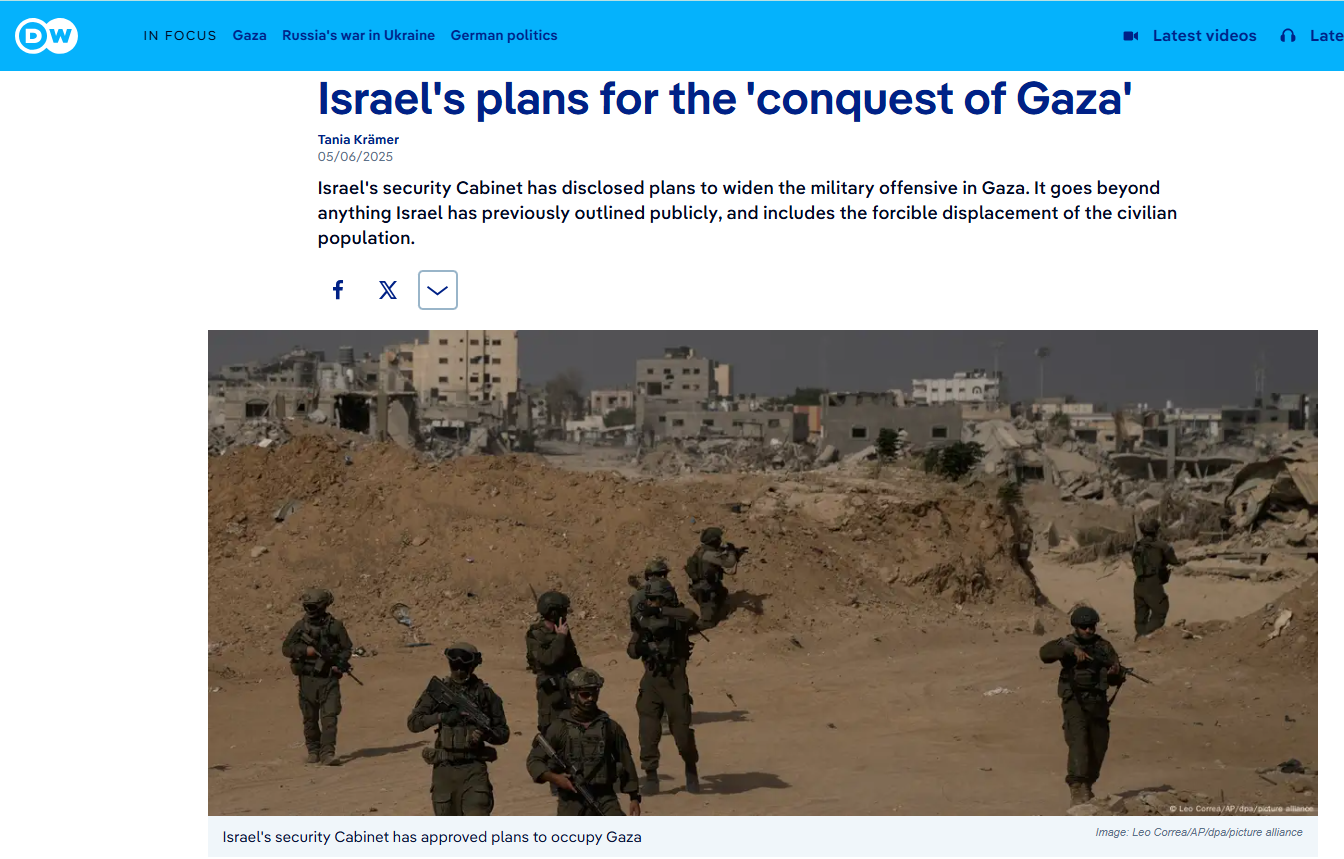
 Deutsche Welle’s misreporting of international law this month underscores the “damned if you do, damned if you don’t” conundrum which certain elements within the international community and media impose upon Israel. Thus, Israel’s evacuation of Gaza Strip residents from combat areas for their protection morphs into a crime against humanity no less.
Thus, in her May 6 article, Tania Krämer casts Israel’s evacuation of Gaza Strip residents from combat areas for their protection as no less than a potential crime against humanity. Conflating illegal forced displacement with Israel’s temporary evacuation of civilians for their own safety, she states (“Israel’s plans for the ‘conquest of Gaza‘”):
Following the Cabinet’s decision, Prime Minister Benjamin Netanayhu, who is wanted by the International Criminal Court (ICC) for war crimes and crimes against humanity, said in a video message posted on X that the new offensive in Gaza will be aimed at defeating Hamas. He added that the “population will be moved, for its own protection.”
Under international law, the forced displacement of civilians during armed conflict is a war crime. When done systematically, it can also be counted as a crime against humanity. [Emphases added.]
First, contrary to Krämer‘s reporting, international law does not categorically prohibit forced displacement. As the United Nations High Commissioner for Refugees (UNHCR) Handbook for the Protection of Internally Placed Persons explains:
Forced displacement is often, but not always, unlawful. While international law provides numerous safeguards against forced displacement, there may be circumstances in which it can serve a legitimate purpose. Even in such cases, however, it must meet certain minimum safeguards and take place in conditions of safety and dignity. . . .
As a general rule, every effort must be made to prevent unlawful displacement from taking place. When displacement does occur, efforts should be made to minimize and mitigate its adverse impact on individuals and communities and ensure a durable solution for all those affected. . . .
Forced displacement can only be justified on an exceptional basis under human rights law and subject to strict conditions. It must be provided for by law and be necessary and proportionate to achieve a legitimate aim, such as to protect national security or public order, public health or morals, or the rights and freedoms of others. It must be non-discriminatory and consistent with other human rights and international legal obligations of the State.
Thus, Article 49 of the Geneva Convention for the Protection of Civilian Persons in Times of War, states:
Individual or mass forcible transfers, as well as deportations of protected persons from occupied territory to the territory of the Occupying Power or to that of any other country, occupied or not, are prohibited, regardless of their motive.
Nevertheless, the Occupying Power may undertake total or partial evacuation of a given area if the security of the population or imperative military reasons so demand. Such evacuations may not involve the displacement of protected persons outside the bounds of the occupied territory except when for material reasons it is impossible to avoid such displacement. Persons thus evacuated shall be transferred back to their homes as soon as hostilities in the area in question have ceased. [Emphasis added.]
Second, with respect to Israel’s “Gideon’s Chariots” operation, the plans do not entail the forced evacuation of residents of the Gaza Strip into Israeli territory or into third countries, but to the southern part of the Gaza Strip. Given that the intention of the evacuation is to protect civilians, the relocation of residents to areas within the Gaza Strip outside of the combat zones does not constitute illegal forced displacement.
As Israel Democracy Institute explained:
To ensure that evacuation is not considered forced displacement but indeed evacuation, Israel had to adhere to the following obligations:
(1) Evacuation must be temporary during wartime and intended to protect residents from the war. There must be no intention to permanently relocate the residents.
(2) Humanitarian corridors must be defined, allowing movement to protected areas, with sufficient time provided to reach them.
(3) Evacuation must be to places where there is assurance that residents will be protected from attack.
(4) Basic humanitarian assistance must be provided in evacuated areas: food, water, electricity, adequate hygiene conditions, and basic medical supplies.
Israel faced considerable criticism at the beginning of the war, especially regarding whether sufficient time was given to reach protected areas and compliance with humanitarian principles. However, it seems that with the onset of hostilities, Israel did comply with its obligations.
Interestingly, some NGOs have faulted Israel for not giving sufficient warning prior to evacuation. Elements within the human rights community and press corps which inevitably find fault with Israel cannot have it both ways: accusing Israel of providing insufficient warning in order to enable evacuation AND also claiming it is illegal to evacuate civilians away from combat zones.
Deutsche Welle, a publicly-funded German media outlet, has informed CAMERA that it stands by its reporting.