
A knife-yielding copilot today stabbed the pilot of a flight from Dubai to Tel Aviv carrying 174 passengers, of which 166 were Israelis. The blood-soaked pilot issued distress signals – including signals communicating a hijacking – while approaching the Jordanian border, as the plane dove between 14,000 and 20,000 feet (reports vary) in the span of two minutes. What might news consumers think if they heard this level of detail from their media sources?
Terrorism? Hijacking?
While western media outlets have been notably allergic to ascribe the word “terror” and its derivatives to a person or act, or avoid it totally, there is little explanation, even in the earliest reports, of calling the stabbing of a copilot and the nosedive thereafter a “clash,” “altercation,” “cockpit incident,” “brawl,” or “fight” between the pilots in their headlines. In addition, many outlets omitted the stabbing altogether, leaving the reason for the diverted flight a mystery.
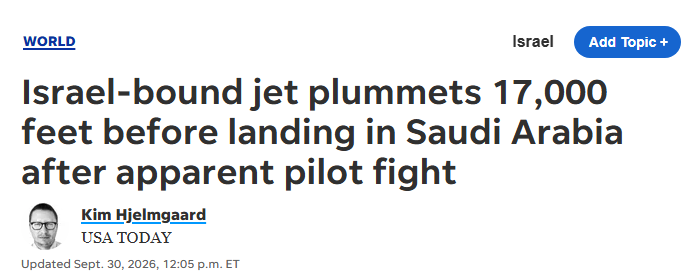
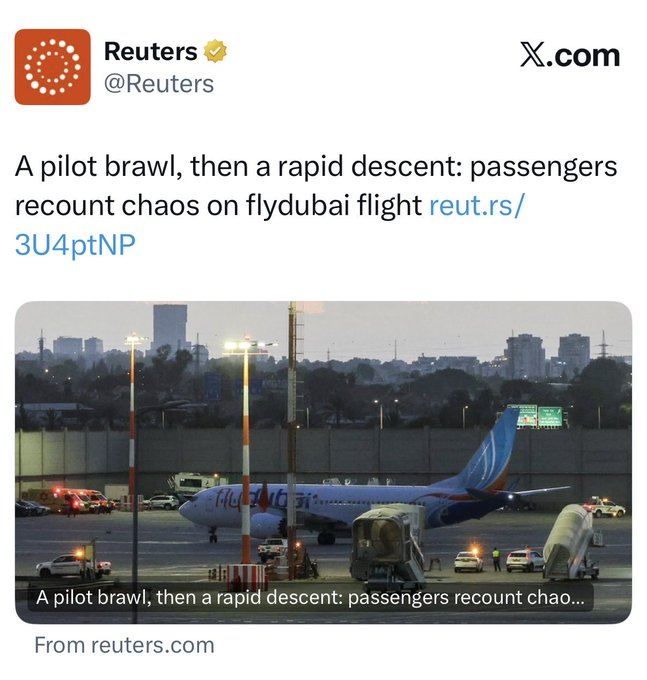
Sometime before 9:45 a.m. local time in Saudi Arabia, or 2:45 a.m. in the flagship offices of The New York Times, brave Israeli passengers helped other crew members subdue the attacking pilot on FlyDubai Airlines flight FZ1073 and take over the cockpit, as the plane had taken a nosedive. The stabbed pilot issued both distress and hijacking (interference) signals.
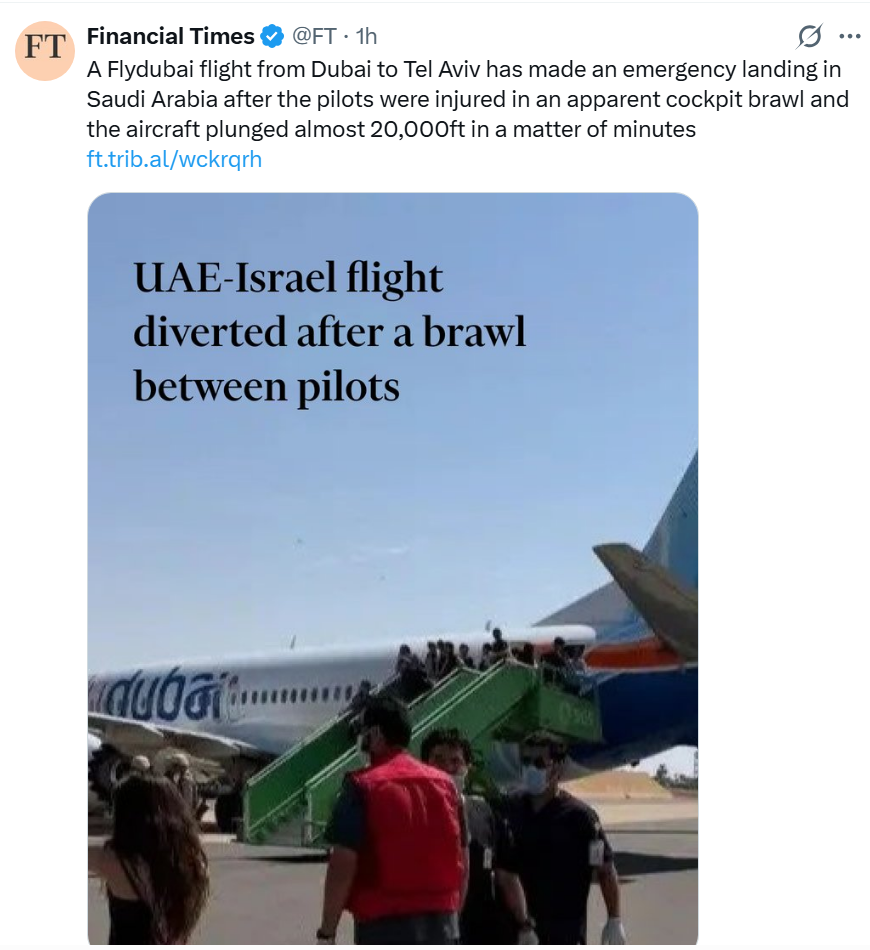
Thankfully, other crew members, or on-board, off-duty pilots (reports varied) took control of the plane and landed it safely in Saudi Arabia while medical professionals on board reportedly gave medical treatment to the stabbed pilot – now identified as Indian captain Smit Machchhar. But these were not the headlines readers were seeing.

Videos from passengers on the flight circulated promptly, including of the stabbed, bloody pilot. This made headlines such as “cockpit incident,” “clash” or “brawl” even more head-scratching.
The BBC initially characterized the incident as a “fight between pilots” and framed the news around “far right” Israeli minister Itamar Ben-Gvir. (In what appears to be an act of the network’s fixation with the minister, it also called Israel’s Ben-Gurion Airport “Ben Gvir Airport” in the midst of reporting.) As to the facts reported by eyewitnesses on the plane, the BBC characterized it as what “passengers [told] Israeli media,” but made sure to alert its audience to the fact that it could not verify the accounts.
The BBC’s coverage of flydubai FZ1073—starting with an on-air presenter framing the news around “far-right” minister Ben-Gvir—was disappointing, but not surprising.
A short thread:🧵 pic.twitter.com/Xey8tkoULn
— CAMERA (@CAMERA4Truth) September 30, 2026
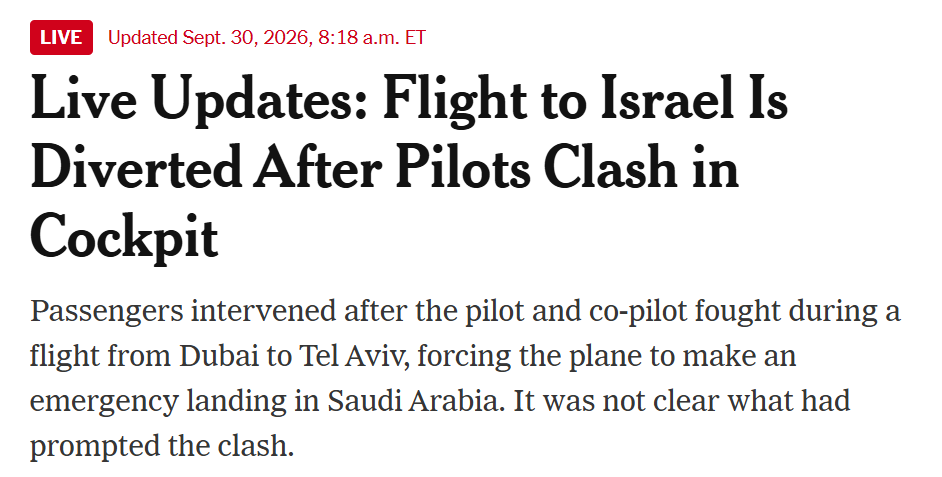 And when CAMERA pointed out The Times’ problematic morning headline on the social media platform X, the NYTimes Communications (@NYTimesPR) retorted with a self-own – unwittingly acknowledging it has full control over when it is cautious in its coverage and when it is not. “Our headlines and live coverage contain all the facts we’re able to confirm as we confirm them. Unlike activists and partisans, we don’t publish speculation or unverified information.”
The statement is patently false. How does The New York Times explain its disastrously incorrect coverage of the Al-Ahli Hospital incident – when it blamed Israel for killing hundreds in the Gazan hospital in Oct. 2023 only later to have to admit it was an errant Palestinian Islamic Jihad rocket that hit the parking lot and caused far fewer casualties? How can The Times issue this statement after it published unverified claims by Nicholas Kristof, including of Israeli dogs raping Palestinian prisoners?
Our headlines and live coverage contain all the facts we’re able to confirm as we confirm them. Unlike activists and partisans, we don’t publish speculation or unverified information. Here’s a Gift Link to follow along as we update our reporting:https://t.co/TL1k9H9ywh
— NYTimes Communications (@NYTimesPR) September 30, 2026
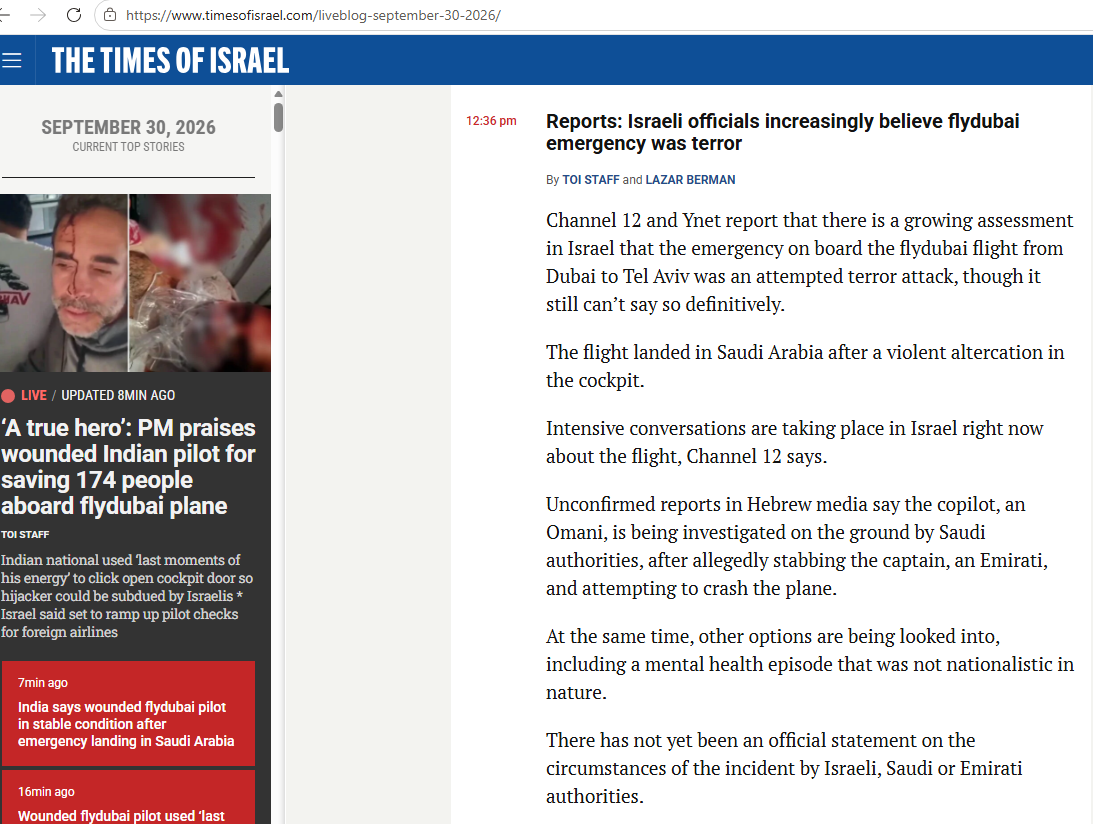
Moreover, about six hours before The Times’ Public Relations account issued its cranky retort, the Times of Israel had reported (at 12:36 p.m. Israel time/5:36 a.m. in New York) that “the growing assessment in Israel . . . [was] that the emergency on board the flydubai flight . . . was an attempted terror attack, though it still can’t say so definitively.” Even if The Times did not want to make its own assessment about whether the incident was terror, it could have reported the growing assessment in Israel as well as the fact that the pilot had issued a hijacking signal, both of which were known hours before The Times’ headline saying the “pilots clashed.”
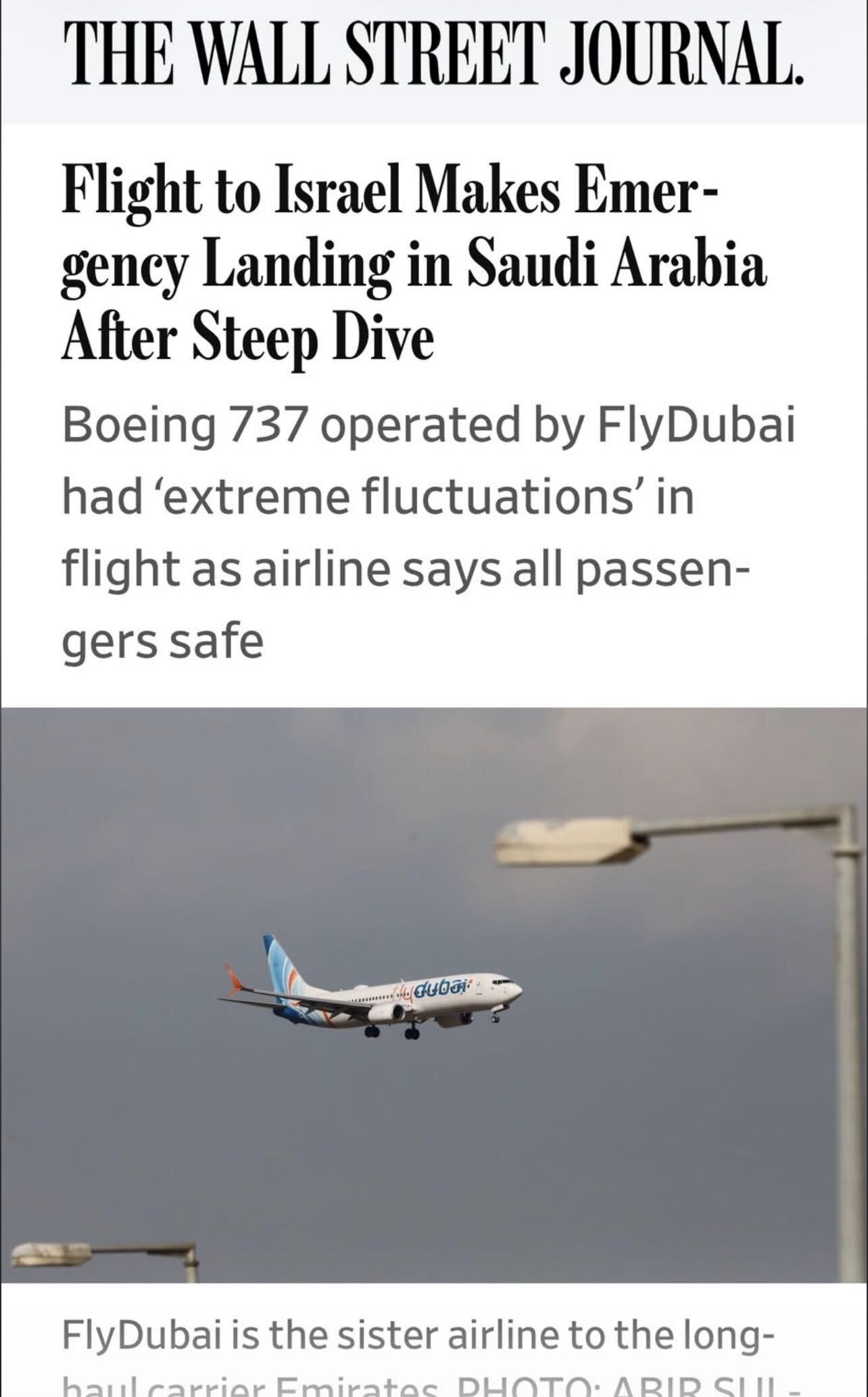
In some cases, coverage improved moderately as the morning progressed, like in the case of the Wall Street Journal, whose early headline mentioned nothing about the pilots.
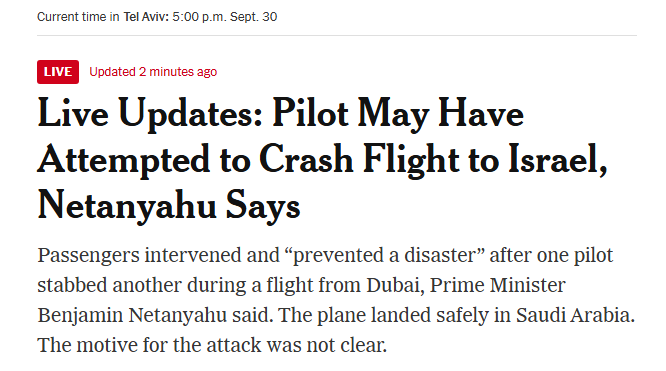
The New York Times also demonstrated some moderate improvement by 10:00 a.m. (5:00 p.m. Israel time) as it finally used the word stabbing, but only in its subheading, and only attributed to the Israeli prime minister.
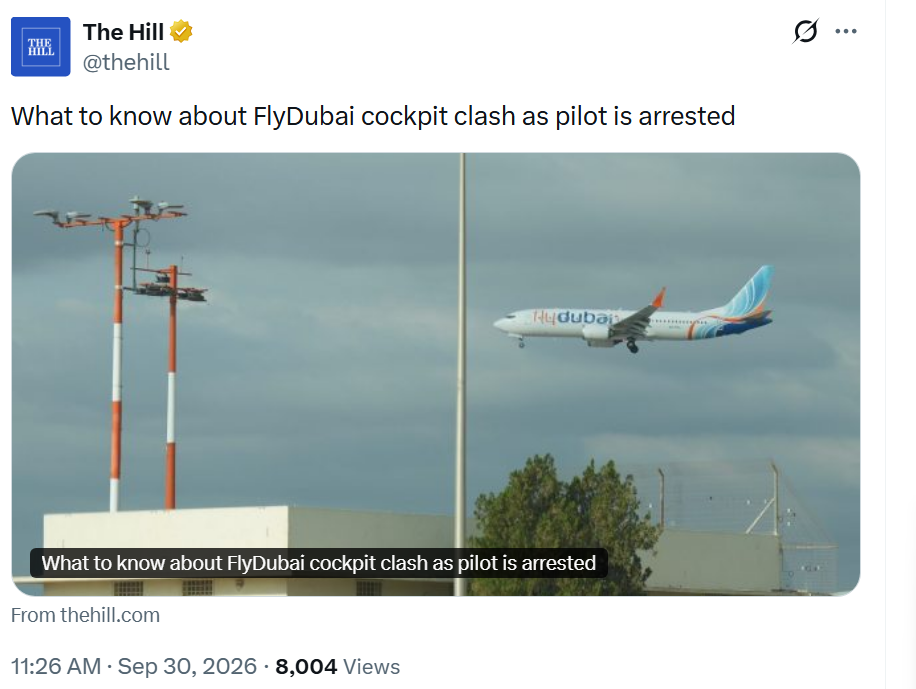
But The Hill’s late-morning tweet still headlined it as a “cockpit clash.”
By late morning, Israeli and Jewish news sources, like The Jerusalem Post, were reporting Israeli officials’ statements that the event was an attempted hijacking by one of the pilots.
An ABC News’ post on X from late morning still contained a highly sanitized headline, but at least in the video, Ian Pannell reported that “it is increasingly looking like a terrorist incident, and that is certainly what Israel is calling it right now.”
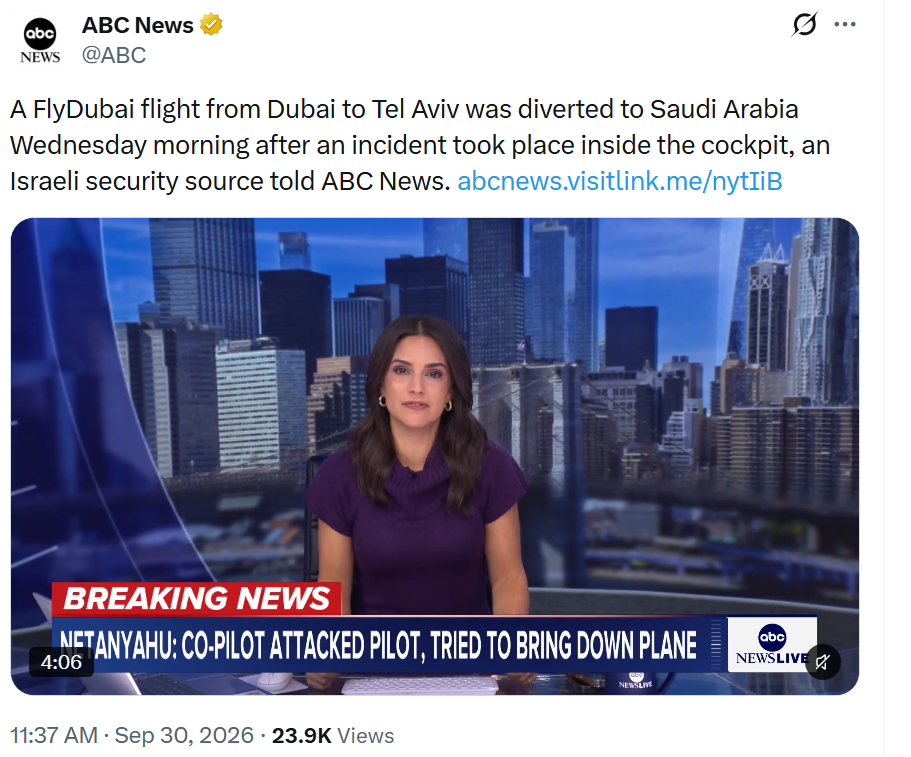
The passengers have all been safely transported back to Israel, with at least one video showing passengers singing “Od Avinu Chai” (a song expressing the survival of the Jewish people) after they landed safely in Saudi Arabia. While the spirits of the Israelis are admirable, the same cannot be said of the western mainstream media.
The minimized and sanitized reporting on the terrifying, bloody, near-fatal attack of the Dubai-Tel Aviv FlyDubai flight serves as a stark case study in the modern news ecosystem. In an era where eyewitness videos from inside an airplane cabin can circulate globally in minutes, and the pilot’s activation of the hijacking signal was reported by Israeli media early on, the western media’s reliance on euphemistic language like “clash,” “altercation,” or “incident” to describe one pilot stabbing another, the sending of hijacking signals and incredible passenger and crew bravery, feels detached from reality. When major outlets reserve their deepest skepticism for clear acts of violence while casually using language that minimizes terror, they invite legitimate questions about their editorial standards. In the end, journalism is meant to illuminate the truth and report facts, not underplay violence.