
In March 2025, the Spain’s state-owned EFE news agency contextualized a report regarding Houthi attacks against Israel, stating that:
The Iran-backed insurgent movement has launched hundreds of attacks against Israel … since the outbreak of the war in the Gaza Strip on October 7, 2023, in response to the slaughter of Palestinians by the Jewish state. (Emphasis added)
Notably, the war did not break out in the Gaza Strip on Oct. 7; it began in southern Israel as thousands of Hamas terrorists and unaffiliated civilians invaded the Jewish state, inflicting mass atrocities including murder, rape, kidnapping and mutilations.
In July 2025, in another dispatch regarding Houthi attacks, EFE similarly erased Hamas’ Oct. 7 atrocities:
Since Benjamin Netanyahu’s government launched its invasion against the devastated Gaza Strip in October 2023, more than 59,000 Gazans have died, the majority women and children, and more than 142,000 people have been injured — many with lifelong injuries and amputations — according to Palestinian authorities.
Both articles datelined in Sana’a, Yemen serve as clear examples of the Spanish agency’s common practice appearing in its coverage of Israel. Whether framing information or offering background context, there is a consistent tendency to adopt the figures, vocabulary, narratives and accounts provided by Hamas or anti-Israel groups.
Furthermore, EFE treated Hamas-supplied death tolls as true, and depicted all casualties as defenseless civilians, while ignoring Israeli data. The tendentious vocabulary justifying Houthi attacks on Ben Gurion Airport— “the slaughter of Palestinians by the Jewish state” — is a crude example of a practice that is often more subtle, yet equally biased.
As the primary Spanish-language news agency and a Spanish state-owned enterprise, EFE’s dispatches are syndicated daily by hundreds of newspapers, radio stations, and television outlets across Spain and Latin America. Its framing choices do not remain confined to a single newsroom; they proliferate, shaping how millions of people perceive one of the most complex and polarized conflicts in the world.
The examples appearing in this analysis are illustrative of standard practice. Analyzing dozens of wire dispatches published by EFE on the Middle East since Oct. 7, 2023, reveals a consistent set of recurring patterns in sourcing, framing, terminology, and victim hierarchy that ultimately shape a specific, biased narrative of the conflict.
Libels Level Up into Supposed News
In parroting statements from Hamas or anti-Israel organizations — in many cases without applying basic journalistic standards — Spanish state agency distinguishes itself as the only major wire service to promote hoaxes that were, in many instances, nothing more than recycled blood libels.

A screenshot of EFE’s December 2023 alleging Israeli organ theft from Palestinian corpses
For instance, on Dec. 27, 2023, EFE ran the following headline including a libelous fabrication as fact: “Hamas denounces organs stolen from bodies removed from Gaza while Israel denies it.”
While other Western agencies correctly reported the return of 80 bodies, EFE highlighted a proven blood libel in its headline, giving it maximum impact while placing the narrative of an Islamist terrorist group side-by-side with that of a democracy equipped with institutional checks and balances.
In another headline which repeated an unverified Hamas claim without any attribution, EFE reported Dec. 8, 2025: “A 1-year-old girl killed by an Israeli sniper among 3 dead today in Gaza.”
Numerous international media outlets which rely on EFE published this article, as they do most EFE dispatches. Notably, no other major news agency — such as Associated Press, Reuters or Agence France Presse — echoed the accusation. CAMERA requested additional information from EFE regarding the case, but editors failed to provide further details. EFE did not again revisit the Israeli sniper’s alleged killing of the child — and left the isolated, uncorroborated accusation standing on the record.
In Iran as well, EFE was also quick to report unverified claims with a level of certainty far exceeding the available evidence. Coverage of the Minab school incident exemplified this recurring failure. On Feb. 28, 2026, just hours after joint U.S.-Israeli strikes against the Islamic Republic began, images of a bombed girls’ school with dozens of casualties circulated. Initially, there was significant confusion regarding responsibility. Nevertheless, EFE published a definitive headline attributing the attack to Israel: “Authorities confirm 85 dead in Israeli attack on girls’ school in Iran.”
Only the truly dedicated readers who reached the final paragraph of the story would discover EFE’s crucial disclaimer: “EFE has been unable to independently verify the scope of the Israeli and U.S. strikes in the Islamic Republic, where international media are not permitted to visit or photograph the sites affected by the bombings.”
In short, EFE did not know who was responsible for the deadly strike, and yet published a headline which unequivocally blamed Israel. Moreover, the news agency did not issue a correction when, just a few hours later, it became clear that a U.S. strike hit the school.
Erasure of Context and Prior Aggressions
One of the most striking features of EFE’s coverage is its tendency to depict Israel’s military responses in isolation, disconnected from the actions that precipitated them.
For example, a May 28, 2026, headline read: “Israel bombs Beirut after attacking more than 135 “targets” in the south of the country in one day.”
The lead paragraph stated: “The Israeli military bombed the Lebanese capital, Beirut, on Thursday in a new escalation that puts the ceasefire in doubt, following strikes on more than 135 ‘targets’ elsewhere in Lebanon over the past 24 hours.”
It is revealing that the state news agency found that it was Israel’s bombing — and not Hezbollah’s launching of over 1,000 drones and 700 rockets which precipitated the Israeli strike — that placed “the ceasefire in doubt.” Furthermore, EFE’s report completely ignored Hezbollah’s attacks though other international wires like the Associated Press covered them.
EFE’s omission fundamentally altered readers’ understanding of events, creating the false impression that Israel unilaterally chose to escalate the conflict.
The same pattern was a feature of Gaza ceasefire coverage as well. On April 14, 2026, EFE ran the headline: “Israel kills five Palestinians, including a child, in two attacks in Gaza.”
The dispatch, which contained not a single Israeli source to clarify that the target was military, framed Israel as the sole violator of the truce. It omitted numerous breaches by Hamas and other armed groups during the same period — such as lethal attacks, ambushes targeting Israeli forces, the return of human remains that did not match the promised hostages, and the looting of humanitarian aid.
Thus, the Israel attacks occupy all of EFE’s attention, entirely displacing coverage of the preceding actions, and flipping the strikes against terror targets into assaults on innocent civilians.
Israeli Victims Disappear
Another consistent pattern is the differential visibility granted to victims depending on which side of the conflict they occupy. EFE often omits the Oct. 7 attack altogether, and when it does reference the massacre, it routinely notes that the slaughter of men, women and children resulted in “around 1,200 deaths and the kidnapping of 251 people.” However, it rarely updates the human cost the war has exacted on Israel since then, omitting the hundreds of Israelis killed over the course of the military campaign. At EFE, headlines such as “More than 900 Israeli soldiers killed since Oct. 7″ or “Israel surpasses 2,000 dead since the start of the war” simply do not exist.
The occasional stories in which EFE does mention Israel’s post-Oct. 7 casualties are almost exclusively about the Israeli military. While post-Oct. 7 Palestinian fatalities are permanent fixtures in all general coverage of the war, the Israeli numbers are absent from the background information in general coverage.
For example, in “Army announces death of three soldiers during combat in northern Gaza in the past day,” a EFE noted: “The total number of Israeli soldiers killed since the start of the Israeli offensive in Gaza, which today reaches its 15th month, has risen to 395.”
(Note once again how EFE framed Israel as solely responsible for the “offensive,” omitting Hamas’ massive act of war on Oct. 7).
Another dispatch, “Some 20,000 Israeli soldiers injured since Gaza offensive began,” provided a textbook example of the agency’s routine framing. The opening paragraph read:
Some 20,000 Israeli soldiers were injured in Gaza and other territories where Israel has perpetrated attacks since October 7, 2023, the day it launched its campaign in the Strip in response to the attack carried out by the Palestinian Islamist group Hamas and other factions against Israeli territory, the Ministry of Defense reported. (Emphasis added.)
In this asymmetrical formulation, EFE described Hamas’ Oct. 7 attack in the passive voice with neutral language (“carried out”). In contrast, the news agency reserved the active voice for Israeli military operations and used a Spanish verb heavily associated with crimes or illegal acts (“perpetrated”), imparting a negative moral judgment absent from the bland description of Hamas’ murderous rampage.
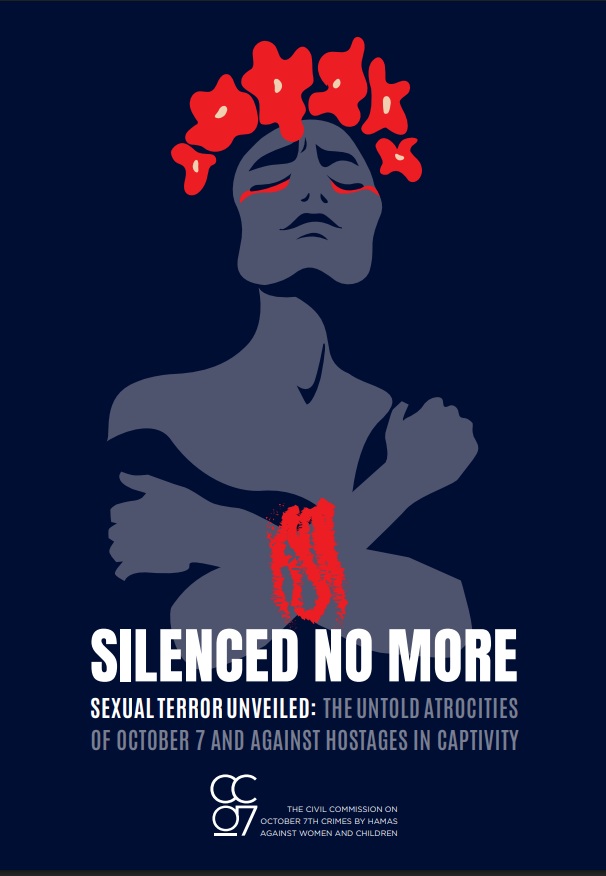
The Israeli civil commission report on Hamas’ Oct. 7 sexual crimes
At the end of the report, EFE appended four paragraphs detailing the Gaza body count as context. This is standard procedure for the agency, which regularly frames statements from Israeli officials against metrics of Gazan suffering. For instance, in a story regarding the atrocities committed on Oct. 7, “Israeli civil commission denounces ‘systematic’ sexual violence in Oct. 7 attacks,” EFE concluded with a counterweight that shifts the focus away from the core subject:
The Hamas-led attack on October 7, 2023, caused the deaths of around 1,200 people and the abduction of another 250 to the Strip. That same day, Israel launched a military offensive on Gaza that has already left at least 72,742 dead in the Palestinian enclave, an action qualified as ‘genocide’ by a UN commission.
By contrast, nearly every dispatch regarding Gaza incorporates the cumulative death toll supplied by the Hamas-run “Gaza Ministry of Health,” updating it constantly.
On June 13, 2026, EFE published an article titled, “Gaza death toll reaches 73,000 from Israeli attacks since October 2023.”
The story opened with a paragraph exemplifying these established patterns — the erasure of Oct. 7 and the legitimization of Hamas as the “Gaza Ministry of Health”:
The death toll in the Gaza Strip from Israeli attacks since the start of its offensive in the Palestinian territory in October 2023 reached 73,003, according to data published Monday by the Gaza Ministry of Health, which includes the latest deaths recorded Sunday.
Another example appeared in the May 28, 2026 report from Lebanon, which reported that the Israeli response had caused more than 3,200 deaths and displaced one million people. However, the agency omitted that, according to other international sources, 23 Israeli soldiers, a defense contractor, and two Israeli civilians had been killed in northern Israel and southern Lebanon, many of them victims of drone attacks.
The result is a narrative framework in which Gazan suffering appears as a constantly rising count, while the ongoing human cost to Israel remains frozen in the tragedy of Oct. 7 — barely mentioned and failing to reflect the casualties suffered during the subsequent months of war.
Beyond the disparities in which victims EFE highlights, there’s a significant gap in how the news agency portrays fatalities from both sides they are portrayed, as CAMERA has previously demonstrated.
Conclusion: Hamas as the Primary Source
Uncertainty is inherent to wartime reporting, and it is natural for errors to occur in the fog of conflict. However, EFE’s core fault is treating Hamas as a privileged source. With a patina of institutional credibility using labels like “health authorities,” “Gaza Civil Defense,” or “Ministry of Health,” EFE elevates the terror group’s credibility over that of the democratic state of Israel.
Consequently, in this cartoon-like rendition of the conflict, EFE depicts Israel as the primary driver of violence, while reducing Hamas or Hezbollah actions into episodic or nonexistent background noise.
What emerges from this analysis is a unmistakable pattern: the amplification of unverified claims, the omission of relevant context when it favors Israel, the differential humanization of casualties, the privileged reliance on biased sources, the ongoing erasure of Israeli suffering, and the adoption of interpretive frameworks that consistently position Israel as the primary aggressor while reducing Hamas and Hezbollah to reactive or secondary players.