
EFE is Spain’s state-owned wire service — roughly equivalent in influence to the Associated Press in the United States or Reuters internationally. Its dispatches are reproduced across newspapers, television networks, radio stations and digital outlets throughout the Spanish-speaking world, shaping how millions of readers understand international events.
Two EFE articles published four months apart reveal with striking clarity a double standard in the news agency’s coverage of Palestinian suffering versus Israeli suffering.
What is emphasized? What is contextualized? Which victims have a face? Which are reduced to statistics? Which pain is presented as a human tragedy, and which as the bureaucratic byproduct of a larger conflict?
The first article, published in January 2026, reported on a study by the Israeli NGO B’Tselem accusing Israel of turning its prisons into “torture camps” for Palestinians (“Israel has turned its prisons into ‘torture camps’ for Palestinians, Israeli NGO B’Tselem says“).
The second, published in May of the same year, summarized an Israeli investigation into systematic sexual violence committed by Hamas during the Oct. 7 attacks and afterwards, in assault targeting hostages (“Israeli civil commission denounces ‘systematic’ sexual violence in the October 7 attacks“).
Both articles deal with atrocities. Both describe extreme abuse. Both rely on Israeli sources. The articles otherwise belong to two entirely different universes.
Even from the opening paragraph of each story, the diametrically opposed framing of the two stories is readily apparent, as evidenced simply by the grammar. In the article about Palestinian prisoners, EFE states as fact, in the present tense, that Palestinians “continue to be subjected to” torture. In the article about Israeli women, however, the agency resorts to qualified language: the acts “would have taken place.”
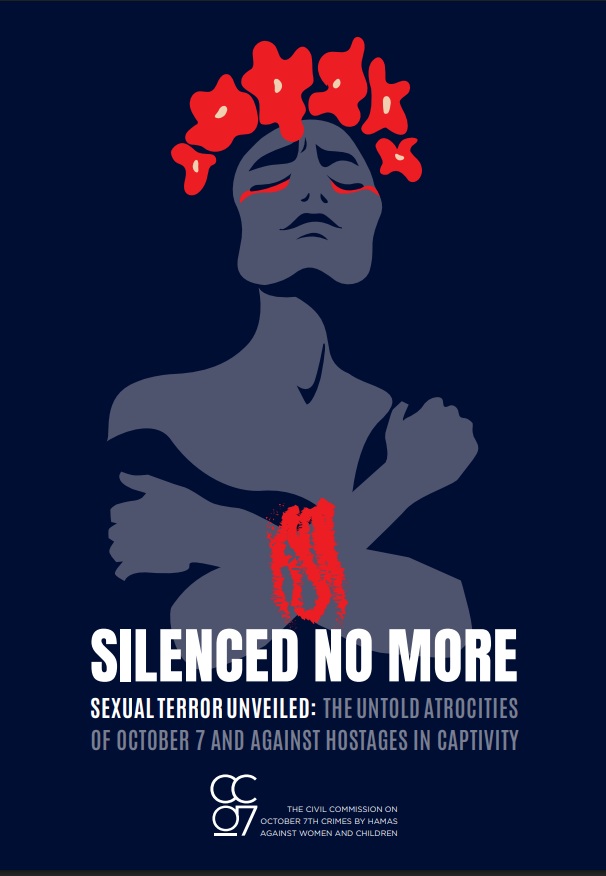 In other words, EFE treats Israel’s Civil Commission on the Oct. 7th Crimes by Hamas Against Women and Children with doubt while presenting B’Tselem as factual, despite the fact that the activist organization has a long record of misinformation.
In the article about Palestinian prisoners, EFE constructs an emotional experience. There are names, ages, mothers speaking, children left in a family void. The article does not simply inform; it seeks to create proximity. The reader enters the cell, hears the screams, imagines the body.
“His body showed signs of having been handcuffed for days before his death, as well as bruises on the left side of the chest, back, buttocks, right arm, thigh, head and neck. He also had broken ribs and a fractured sternum, according to a forensic examination document shared by the family,” EFE reports, adding:
Marii spent his final days in an isolation cell, according to testimony in the report from a prisoner in the neighboring cell. “Those who were there and witnessed it told us that before his death he was screaming: ‘Brother, brother, come to me. Brother, come, I am dying, brother,” his mother continued.
By contrast, the piece about the Oct. 7 Israeli victims is technical and antiseptic. Even when mentioning rape and mutilation, the language avoids emotional immersion and limits itself to listing concepts:
The report describes cases of rape, sexual assault, forced nudity, humiliation, torture and mutilation, noting that these acts would have taken place in different settings, including homes, roads, military bases and the area surrounding the Nova music festival, one of the centers of the massacre carried out by Gaza militias.
There is no survivor speaking in this article. No mother. No scene. No screams. The language sanitizes the horror appears with legal language referring to “the creation of specialized judicial mechanisms” and “international cooperation in matters of investigation and prosecution.”
It is difficult to cry over a judicial mechanism; it is easy to cry for a mother describing her son’s agony.
The difference becomes even more visible in the closing paragraphs of both pieces. In the article about the Oct. 7 rapes, EFE concludes with a counterweight that shifts the focus away from the story itself:
The Hamas-led attack on October 7, 2023 caused the deaths of around 1,200 people and the kidnapping of another 250 into Gaza. That same day, Israel launched a military offensive against Gaza that has already caused at least 72,742 deaths in the Palestinian enclave, which was described as “genocide” by a UN commission.
This is whataboutism used as a narrative tool.
Thus, EFE appends a sort of “moral asterisk” horror to Israeli women’s suffering suggesting that their pain must immediately be offset by a greater tragedy. EFE also chooses to cite morally compromised U.N. commission while ignoring that even Karim Khan, prosecutor of the International Criminal Court, has recently pointed to the lack of evidence needed to legally sustain the accusation of genocide.
Yet the article about alleged torture of Palestinians includes no equivalent balancing device. There is no final paragraph reminding readers of the Oct. 7 massacre or terrorism as context for Israeli prison policy. The focus remains entirely on Israeli responsibility.
Ultimately, when the victim is Palestinian, EFE presents the suffering in terms of an immediate human experience. In contrast, the news agency neutralizes the suffering of Israelis, refusing to acknowledge it as morally independent from the conflict.
According to this warped framework, the Oct. 7 rapes require the asterisk of Gaza.
But deaths in Israeli prisons do not require the asterisk of terrorism.
According to this asymmetry, the narrative device either humanizes suffering or obscures it with dry legalese.
For the Spanish version of this article, see CAMERA Español.