
Nov. 19 UPDATE:
Ynet Corrects in English
In response to communication from CAMERA's Hebrew department, on Nov. 18 Ynet corrected its English-language article, deleting the erroneous reference to a "negative migration balance" and also adding information about the large numbers of recent immigrants who fled the Russian-Ukrainian war leaving Israel after only a couple of years. See below for a detailed update.
Oct. 29 — The issue of emigration from Israel is always a hot topic that makes headlines periodically in Israel. Recent tumultuous years marked by domestic political turmoil throughout 2023, the events of October 7, and the war in Gaza have been no exception.
On Oct. 16, the Israeli Knesset's Research and Information Center, the Israeli equivalent of the Congressional Research Service, published a report on Israeli emigration based on the latest data collected by the Central Bureau of Statistics. On Oct. 20, the Knesset's Diaspora Affairs committee reviewed the report's findings that since 2022 the number of Israelis who left the country for extended stays abroad has risen while the number of those who chose to return has declined.
Reacting to the report's findings, committee chairman MK Gilad Kariv observed: "This is not just a wave of emigration — it's a tsunami of Israelis choosing to leave the country."
Along with the "tsunami" of emigration is a flood of Israeli media misreporting including factual errors, misunderstanding of demographic concepts and the failure to provide critical context about various factors contributing to emigration including domestic tensions, economy, security and even the Russia-Ukraine war.
Ynet's English-language article by Itamar Eichner outlines the Knesset reports' main findings ("Record number of Israelis have left the country since 2020, with no plan to stop the exodus," Oct. 20):
A special report by the Knesset’s Research and Information Center (RIC), prepared ahead of today’s session of the Knesset Committee for Immigration, Absorption and Diaspora Affairs, presents troubling numbers: between 2020 and 2024, some 145,900 more Israelis left the country than returned.
… In the years 2022–2023, there was a sharp jump in long-term departures: in 2022, 59,400 Israelis left, representing a 44 % increase over the prior year, and in 2023 that rose to 82,800, up 39 % from 2022, with a marked increase of departures in October 2023 after the war broke out.
Ynet adds that in the same period, the number of Israelis returning to the country has been decreasing year by year:
Meanwhile, the number of Israelis returning after extended stays abroad fell: 24,200 in 2023 versus 29,600 in 2022; and between January and August 2024, only 12,100 returned versus 15,600 in the same months of 2023.
In all recent years the number of returning Israelis has been smaller than the number of leaving…
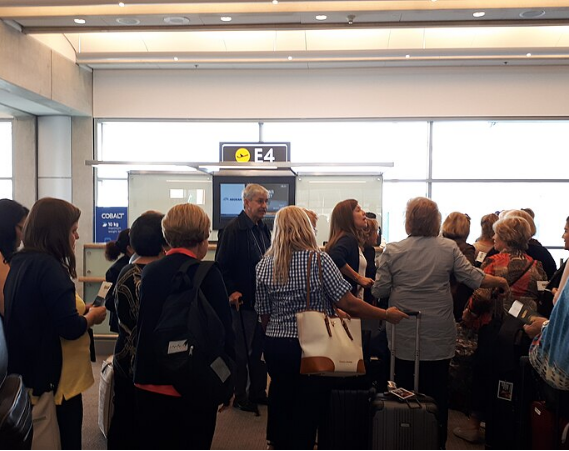
Illustrative image of passengers departing from Ben Gurion Airport Oct. 14, 2018 (Photo by Rakoon, CC0, via Wikimedia Commons)
While Ynet's summary of the data is accurate, the journalist errs in his interpretation of the data.
Thus, the article errs in the first paragraph that "Israel is running a negative migration balance" and repeats in a subheading further down: "Negative migration balance in Israel."
But the migration balance in Israel is not negative. The Knesset report's focus is on "Israelis' international migration balance," meaning the number of Israelis leaving Israel for the long term offset by the number of Israelis returning (emphasis added). This measure is indeed negative. However, the term "migration balance" (also known as "net migration") is defined internationally as the number of people immigrating into a country (including new citizens or citizens who never before have lived in the country) minus the number of people emigrating out of it.
The Knesset report passingly refers to this separate measure as "Israel's overall international migration balance" (emphasis added). The report notes that Israel's overall international migration balance is positive:
It should be emphasized that Israel's overall international migration balance, not just that of Israelis leaving for long-term stays abroad or returning after extended periods abroad, was positive during that period. This is because it also includes new citizens, such as immigrants, citizen immigrants, and those who underwent naturalization or family reunification, while subtracting the population of departing Israeli residents. (Page 7, emphasis added)
In other words, contrary to Ynet's reporting, the Knesset document explicitly notes a positive migration balance.
Secondly, Itamar Eichner's article omits important context which addresses at least part of the increase in emigration from Israel: the rise in recent years of immigrants from Ukraine who came to Israel due to the war in their country and decided to leave after a relatively short time. The Knesset Research and Information Center report notes (p. 3): "It appears that at least part of the increase in the number of emigrants in 2022 can be attributed to many immigrants who came to Israel due to the Russia-Ukraine war in 2022 and left after a short time."
In an examination of Central Bureau of Statistics data, Ishay Shnerb revealed in Israeli newspaper Makor Rishon that approximately 60 percent of those who emigrated in 2023 were foreign-born and most of them had immigrated to Israel in 2022–2023, a finding reflecting Ukrainian immigration followed shortly later by emigration.
Although this factor does not fully account for emigration increase, it is a significant factor and its omission from the Ynet story is glaring.
Though CAMERA's Israel office pointed out these shortcomings to Ynet, as of this writing editors have failed to take any steps to clarify their coverage.
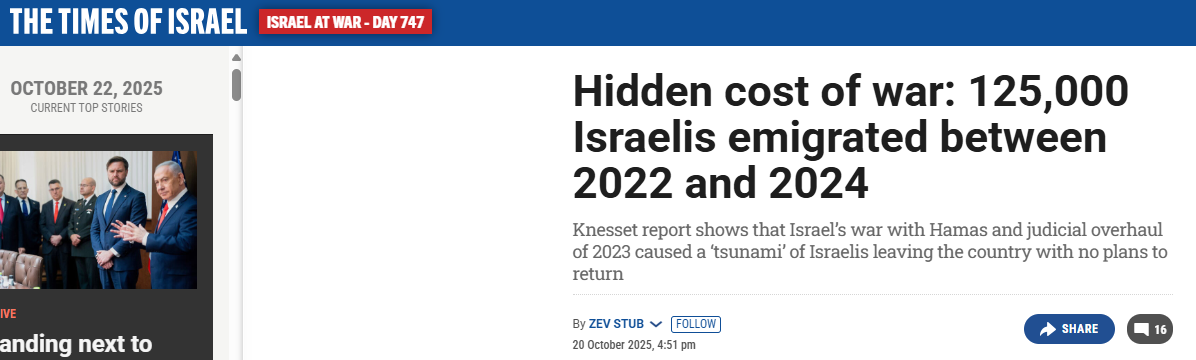 Times of Israel coverage ("Hidden Cost of War: 125,000 Israelis emigrated between 2022 and 2024") had a different factual problem. The original subheadline erred: "Knesset report shows that Israel’s war with Hamas and judicial overhaul of 2023 caused a ‘tsunami’ of Israelis leaving the country with no plans to return." [Emphasis added.]
The second paragraph likewise reported that the Knesset report identified the following factors driving the reported jump in emigration:
The report, compiled by the Knesset Research and Information Center, found that a series of factors, including the nation’s war with Hamas in Gaza, political unrest that culminated in mass protests against the government’s judicial overhaul plan in 2023, and the ripple effects of the Russian-Ukrainian war caused the number of Israelis leaving the country permanently to skyrocket during those years. [Emphasis added.]
While the Knesset report does cite the Hamas-Israel war and the Ukraine-Russia wars as potential factors pushing emigration, the report cites neither judicial overhaul nor political unrest.
CAMERA's Jerusalem office contacted Times of Israel regarding this error, and the editors commendably corrected the story. The corrected subheadline states: "Knesset report shows a ‘tsunami’ of Israelis leaving the country with no plans to return, possibly linked to Gaza war."
Furthermore, the article now accurately reports:
The report, compiled by the Knesset Research and Information Center, said that Israel’s war with Hamas in Gaza may have been a factor causing the number of Israelis leaving the country permanently to skyrocket during those years.
Other factors mentioned in a previous report in February, including the political unrest that culminated in mass protests against the government’s judicial overhaul plan in 2023 and the ripple effects of the Russian-Ukrainian war, were not explicitly mentioned.
Haaretz's article about the Knesset report, entitled “''A Slippery Slope': Average Number of Israeli Emigrants Doubled Since Netanyahu Returned to Power,” attributes the rise in emigration primarily to Israeli government policies and includes interviews with several opposition members to support this narrative.
Judy Maltz's article begins: "The number of Israelis leaving the country has more than doubled since 2023, right after the most right-wing government in the nation's history took power, according to a special Knesset report presented on Monday."
While the Knesset report does not mention government policies as a factor, it did in fact, as noted above, cite the Israel-Hamas war and the Russia-Ukraine wars as likely factors contributing to increased immigration.
Haaretz is of course free to add context which it considers relevant regarding factors fueling emigration. Nevertheless, it's striking that the paper omitted the factor which the report itself describes as a significant reason behind departures from Israel: the emigration of many of the 100,000 immigrants from Ukraine who arrived in Israel 2022–2023 following the Russian invasion.
CAMERA's Israel office contacted Haaretz editors in request to add this important context. As of this writing, the article remains unchanged.
For the Hebrew version of this post, please see here.
Nov. 19 Update: Ynet Corrects in English
In response to communication from CAMERA's Hebrew department, on Nov. 18 Ynet commendably made two corrections to its English-language article. Editors deleted both references to "negative migration balance" which had appeared in the article, including in the first paragraph and the subheading. The subheading now refers to "a worrying trend" instead of "negative migration balance."
In addition, editors added the following key information to the story: "Part of the rise in emigration in 2022 appears to be linked to immigrants who arrived in Israel due to the Russia-Ukraine war and left shortly afterward."
CAMERA continues to call on Ynet's Hebrew edition to likewise correct.