
In a flurry of news coverage about United Nations Security Council Resolution 2803 to adopt President Trump’s plan for the Gaza Strip, a fleeting moment of rare clarity appeared in an Associated Press headline: “Netanyahu applauds UN adoption of Trump’s Gaza plan and Hamas rejects it.”
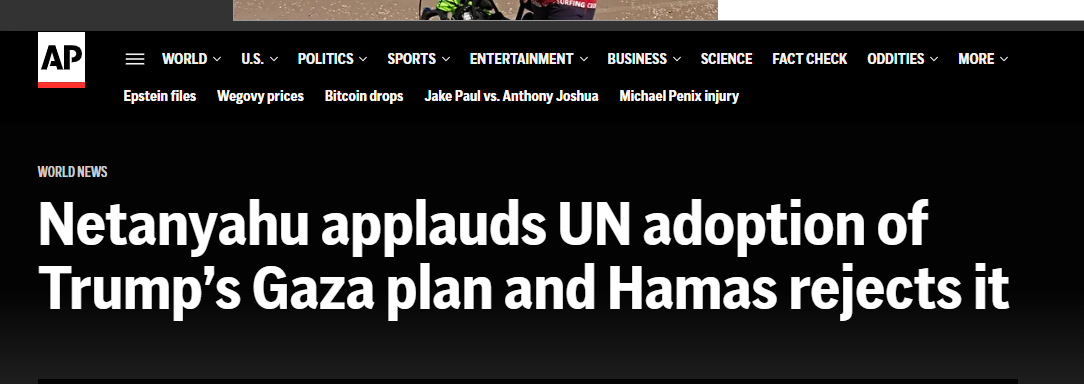 But then events quickly moved on, the AP’s flash in the pan informative headline about Israel’s and Hamas’ reaction to the ceasefire plan was replaced by a less informative headline about the latest deadly Palestinian terror attack, and the most notable feature of the news coverage of the Security Council vote gave way to the well-worn narrative marking Israel as the rejectionist party standing in the way of peace.
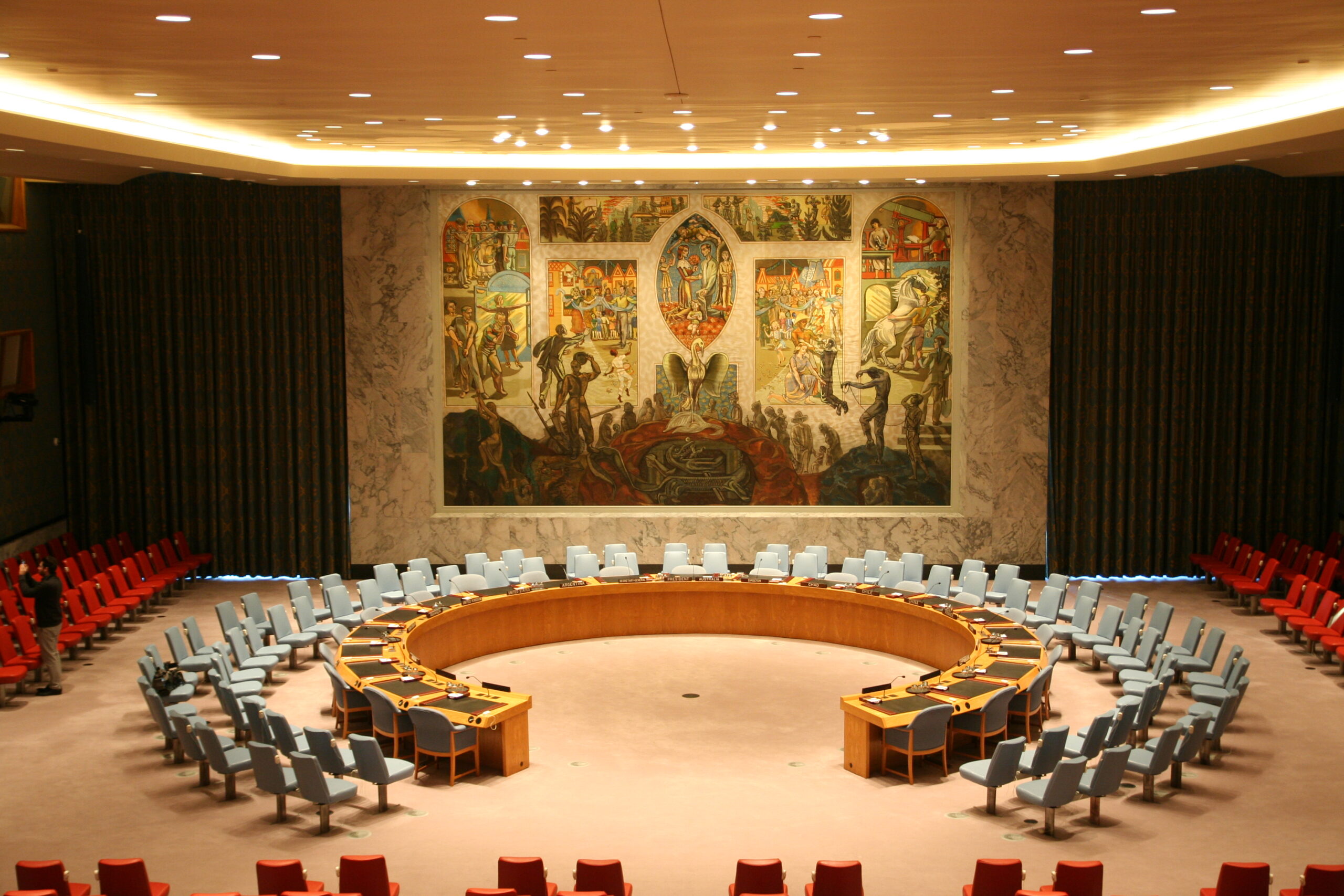
Illustrative image of the United Nations Security Council in New York (Photo by MusikAnimal, CC BY-SA 4.0, via Wikimedia Commons)
The New York Times, which has long led the way in entrenching this particular strain of anti-Israel bias, was true to its well-established routine: finding fault with Israel alone as the perennial obstacle to a peaceful resolution while overlooking Palestinian rejectionism. Thus, U.N. correspondent Farnaz Fassihi wrote (“In Major Breakthrough, U.N. Security Council Resolution Adopts U.S. Peace Plan for Gaza“):
Still, the path forward is plagued by many uncertainties, with Israeli strikes continuing in Gaza and outbreaks of violence erupting in the West Bank. Among the next steps would be naming members of the Board of Peace, the body in charge of overseeing the transition in Gaza, and clarifying under whose authority the stabilization forces would operate.
Completely omitted in Fassihi’s highly selective telling of the “many uncertainties” is the fact that Hamas has flatly rejected the requirement in President Trump’s plan that the terror group disarm.
As AP’s article rightly reported:
The plan calls for the stabilization force to ensure “the permanent decommissioning of weapons from non-state armed groups.” It authorizes the force “to use all necessary measures to carry out its mandate” in compliance with international law, which is U.N. language for the use of military force.Hamas said Monday that the force’s mandate including disarmament “strips it of its neutrality, and turns it into a party to the conflict in favor of the occupation.” It said the resolution did not “meet the level of our Palestinian people’s political and humanitarian demands and rights.” Hamas demanded that any international force be under U.N. supervision, deploy only at Gaza’s borders to monitor the ceasefire and operate exclusively with Palestinian institutions.
Among the challenges the International Stabilization Force will face is how to confront Hamas’s fighters, who are still armed and present in Gaza. The resolution states that the force would be responsible for destroying military infrastructure in Gaza and decommissioning the militant groups’s [sic] weapons.
The language in the resolution about Palestinian statehood had drawn objections from Israel, with Prime Minister Benjamin Netanyahu saying on Sunday that “our opposition to a Palestinian state in any territory has not changed.”
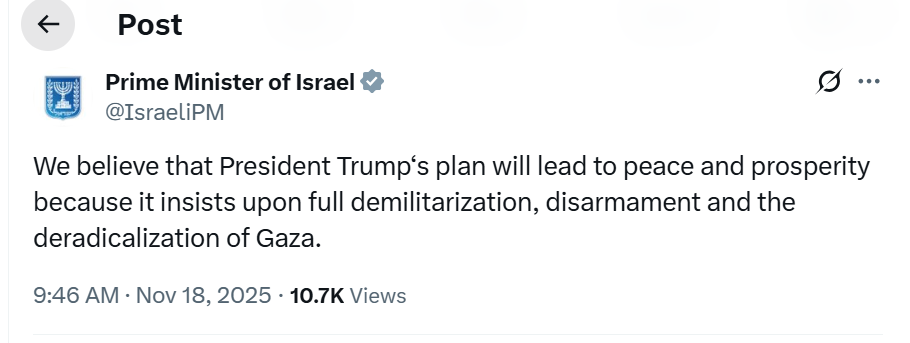 At no point did she note that Prime Minister Netanyahu applauded the Security Council’s vote to adopt the resolution. As the Associated Press earlier reported in the aforementioned article (though the quote was sliced out of the later version):
Netanyahu on Tuesday applauded the U.N. approval of Trump’s plan for postwar Gaza.“We believe that President Trump‘s plan will lead to peace and prosperity because it insists upon full demilitarization, disarmament and the deradicalization of Gaza,” Netanyahu’s office wrote on X.
Israel seeks either a temporary truce to free more of the roughly 60 hostages still held in Gaza or a permanent deal that guarantees Hamas’s defeat. But Hamas opposes both scenarios, so the war will likely drag on unless Israel softens its position.
This is from a month ago. But check out this fascinating arithmetic from the @nytimes. pic.twitter.com/Dab13yMkhK
— Gilead Ini (@GileadIni) June 12, 2025