
There was no need to sit through long days of testimonies, as Haaretz‘s Yair Foldes apparently did, to know the foregone conclusions of the so-called “Gaza Tribunal” session which convened last month at Istanbul University in Turkey. One, the purported experts and scholars would not give Israel a fair shake. Two, they would find Israel guilty of genocide, along with a host of other abominable crimes.
Foldes’ long and sympathetic piece seemingly acknowledged the pre-determined nature of the tribunal’s rulings (“Israel has already been convicted of genocide, at least at this people court“):
Without any legal authority or enforcement powers, the tribunal does not seek to determine guilt or issue binding verdicts. Its purpose, the organizers explain, is “to close the enforcement gap” regarding Israel by applying civil society pressure on governments around the world.
Haaretz‘s extensive coverage of the “tribunal” was exceptional. Outside Turkey, where the state-controlled media lavished the gathering with extensive attention, the only media outlets which covered the confab were overtly anti-Israel or Qatari funded or owned, such as Al Jazeera, Middle East Monitor and The New Arab.
Why did Haaretz send a reporter all the way to Istanbul and dedicate extensive space to an event funded by the Organization of Islamic Cooperation? What is the news value for readers in Israel and abroad in an uncritical report on a tribunal accusing Israel of genocide given that its organizers demurred from commenting on Hamas’ war atrocities and proudly refused to invite Israelis to present their country’s case?
Foldes’ gushing descriptions
The answer may be found in Foldes’ gushing descriptions, signaling the journalist’s ideological affinity to his subject:
The gathering in Istanbul continues a growing tradition of “people’s tribunals” established in conflict zones around the world. These include the Russell Tribunal, founded by British philosopher Bertrand Russell in 1966 to examine U.S. actions in the Vietnam War… At the opening session of the first Russell Tribunal… philosopher Jean-Paul Sartre said: “It is true that our Tribunal is not an institution. But, it is not a substitute for any institution already in existence: it is, on the contrary, formed out of a void and for a real need.”
A similar rationale seems to underlie the establishment of the current tribunal. “The situation in Gaza is a dramatic example in which the established order failed to stop genocide,” Prof. Richard Falk, Chairman of the tribunal in Istanbul, told Haaretz.
Foldes’ message is quite clear: the conclusions of the “Gaza Tribunal” carry deep moral legitimacy and therefore deserve to be heeded. According to his telling, chairman Richard Falk is a successor of intellectual and moral beacons such as Bertrand Russell and Jean-Paul Sartre.
For the benefit of readers unfamiliar with Richard Falk, Foldes writes:
Falk, who taught international law for decades at Princeton University and served as UN Special Rapporteur in the Occupied Palestinian Territories in the previous decade, has often faced criticism for his views and activities. And, despite his Jewish background, some have accused him of antisemitism.
From Foldes’ sanitized account, the uninformed reader would reasonably conclude that Falk is an authority in his field and that the criticism against him is entirely baseless. Foldes notes that “criticism was directed at his activities,” but refrains from specifying those activities. In addition, readers would likely glean from this passage that Falk is also unjustly accused of antisemitism. (He is of Jewish descent, after all.)
Unfortunately, the reality is just the opposite. Just a few examples from Falk’s record are sufficient to discredit not only everything he says about Israel, but also the tribunal itself, along with Haaretz‘s glowing coverage.
For example, as Haaretz itself previously published, Falk had called the Sept. 11, 2001 terror attack an initiative of the U.S. government. In response, the U.S. ambassador to the United Nations called for his dismissal from his position. Then-U.N. Secretary-General Ban Ki-moon also condemned his remarks, calling them “ridiculous” and stating that they constituted “an affront to the memory of more than 3,000 people who died.”
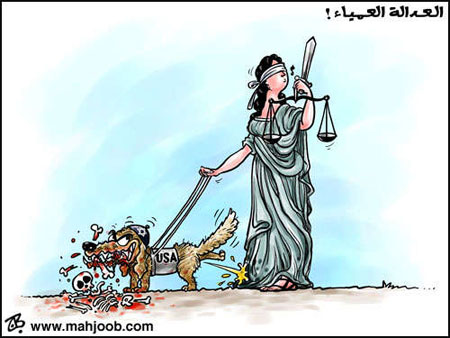 Also in 2011, Falk’s blog published a blatantly antisemitic cartoon depicting a dog bearing the word “USA” and wearing a kippah with a Star of David, urinating on the figure of Lady Justice while eating from a pile of bloody bones (pictured at left). The U.N. High Commissioner for Human Rights strongly condemned Falk.
Additionally, Falk lauded the book “The Wandering Who” by Gilad Atzmon, who defines himself as a “self-hating Jew.” The book states, among other things, that “Hitler might have been right after all,” that historical blood libels against Jews may not have been false, and that “The history of Jewish persecution is a myth, and if there was any persecution the Jews brought it on themselves.” Falk’s words of praise for the antisemitic screed were published on the book’s cover.
The accusations of antisemitism and the criticisms against Falk do not come out of thin air, despite Yair Foldes’ suggestion otherwise. By withholding relevant information about Falk’s toxic bigotry towards Jews and Israel, Folkes proves to be no more credible than the morally corrupt anti-Israel tribunal which he so glowingly covers.
Haaretz declined to follow up on CAMERA’s urging to amend the article and add critical context about Falk’s conspiracies, blatant antisemitism and record of disgrace.
For the Hebrew version of this post, please see here.