
Taking the definition of an “armchair critic” to an extreme, CNN host Fareed Zakaria’s June 28, 2026, interview with former National Security Advisor Jake Sullivan – conducted from the luxury resorts of Aspen, Colorado – displayed a callous disregard for the hardship Israelis have lived with during nearly three years of on-and-off war with Iranian proxy groups and the head of the octopus itself.
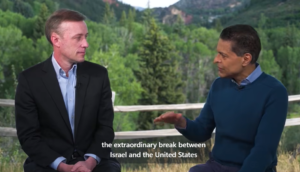
Screenshot of June 28, 2026, interview by CNN host Fareed Zakaria with former National Security Advisor for the Biden administration Jake Sullivan in Aspen, Colorado.
Understanding the cost of war
The segment began with Zakaria asking Sullivan about the daylight between the U.S. and Israel following the U.S.-Iran Memorandum of Understanding on June 14, 2026, which established a bilateral ceasefire. Sullivan argued that American and Israeli interests diverged because “from Israel’s perspective, they didn’t mind this continuing… they didn’t mind the Strait of Hormuz being closed, they didn’t mind the instability and the shocks to global markets,” whereas the U.S. did.
If only oil prices were Israel’s biggest concern (Israelis were already paying over two times more for gas than Americans). The exchange completely ignored the incomparably higher human cost Israel bore, a reality both Sullivan and Zakaria failed to grasp.
At the war’s immediate outbreak, the IDF called up about 25,000 soldiers and reservists (in a country with a population of only 10 million), forcing families nationwide to put their lives on hold.
Over a six-week period alone, missiles from Iran and Lebanon killed 23 civilians and 12 soldiers within Israel. While the IDF recorded 683 direct physical injuries, Israel’s Health Ministry logged nearly 8,000. Furthermore, missiles destroyed 6,473 homes during the war, while Israelis filed over 28,000 property damage claims.
Evaluating the conflict strictly through its macroeconomic impact while overlooking the profound personal price Israelis paid mischaracterizes the national mood. Israel’s citizens have repeatedly expressed a willingness to endure these sacrifices only if the existential Iranian threat is permanently removed. For instance, an Associated Press video report from March 9, 2026, featured Angela Mirachor, an Israeli Jew of Iranian descent, stating in Hebrew:
President Trump and Bibi [Israeli Prime Minister Benjamin Netanyahu] united together in order to overthrow this damn regime, and to help all the people there [in Iran] … This will not be easy … This war will take a few more months [to end].
Israeli public opinion only soured when the U.S. reached a ceasefire agreement with Tehran before the regime could be fundamentally dismantled.
Zakaria: Israel’s response to Hezbollah’s drones an ‘overreaction’
Sullivan went on to claim that “the priority that Israel places on not only being able to continue to fight Iran, but also fight its proxies” caused the diplomatic rift, framing Israel as a belligerent force actively seeking war. However, Israel’s strikes against Iran and its proxies have been defensive reactions to the Islamic Republic’s repeated calls for the Jewish state’s destruction, its nuclear ambitions, and its persistent proxy attacks.
Zakaria doubled down on this framing by explicitly minimizing the havoc wreaked by Hezbollah’s drone warfare. Channeling the perspective of “Democratic foreign policy types,” Zakaria called Israel’s operations an “overreaction” and “disproportionate,” stating: “Look, if… two Hezbollah drones go and land in the middle of a desert or get shot down by Israel’s air defenses, you don’t have to go and blow up several buildings in Beirut.”
While this represents a common outside viewpoint, an experienced commentator like Zakaria should look beyond his own Aspen armchair. Sound analysis requires understanding both the external and internal drivers of a state’s behavior rather than evaluating military actions in a vacuum. Suggesting Israel should simply absorb drone attacks if they land in the desert – overlooking the fact that Israel’s desert is in the south, not along the northern border with Hezbollah – ignores the reality of how a geographically tiny democratic state with a conscript army in a volatile region of the world must operate. The comment also reflects a basic ignorance of geography in the country where Zakaria feels entirely comfortable judging from afar.
Since the April 17, 2026, ceasefire, Hezbollah has launched over 637 attack waves using UAVs and drones, accounting for over half of its total operations against Israel, according to the Alma Research and Education Center. These drones have claimed the lives of 27 Israeli soldiers and one civilian since Oct. 8, 2023, according to CAMERA’s count. Fiber-optic FPV (First Person View) drones have proven particularly lethal during the ceasefire period due to the immense difficulty of intercepting them.
The critique that Israeli responses to Hezbollah drones are overreactions assumes a framework where an unbiased global observer should prioritize civilian lives over those of active combatants.
Albeit a standard international law debate, the belief that Israel should set a lower premium on the lives of its soldiers illustrates a profound misunderstanding of the country. To Israelis, the people in uniform are not a distinct, professional careerist class like a volunteer military; they are citizen-soldiers woven directly into the fabric of everyday families. The state mandates all Jewish, Druze, and Circassian citizens over the age of 18 to serve in the IDF (with few exceptions). Deeply rooted in the Jewish mandate of Pidyon Shvuyim (the redemption of captives) and a foundational post-Holocaust determination to never leave Jewish lives defenseless, Israeli military doctrine explicitly prioritizes aggressive force protection. Consequently, this advocacy for tactical restraint ignores the fact that minimizing soldier deaths is a strategic necessity required to maintain the public backing of a conscript army. For Zakaria to label this doctrine an “overreaction” is weak political analysis. It demands that a democratic state ignore its own foundational survival mechanisms, rendering any ceasefire built on such a naive premise structurally doomed to collapse.
Sullivan’s late-night thoughts on pressuring Israel
Finally, Zakaria pivoted to historical revisionism, noting, “You are still criticized for not having stopped the war in Gaza, for not having put more pressure on the Israeli government at the time.” Sullivan agreed, admitting, “I’ve said publicly that we should have done more to put pressure on Israel… That’s something that I sit with and lie awake at night thinking about.”
Both interviewer and interviewee operated under the flawed assumption that more U.S. pressure on Jerusalem would have secured a deal sooner. History proves otherwise. Prior to Hamas releasing the final 20 living hostages, Donald Trump applied direct pressure on the terrorist organization, not Israel: “Tell Hamas to IMMEDIATELY give back all 20 Hostages (Not 2 or 5 or 7!), and things will change rapidly. IT WILL END!” he posted on Truth Social on Sept. 3, 2025. Hamas only then agreed to resume negotiations within five days, culminating in a deal a month later.
Conversely, the Biden administration’s decision to pause bomb shipments to Israel in May 2024 to pressure Israel against operating in Rafah failed to yield any sort of respite. Notably, despite the push against Israel’s operation in the southern Gazan city, in August 2024, the military recovered the remains of six hostages from Rafah tunnels whom terrorists murdered shortly before the Israeli soldiers arrived, as well as one living hostage.
That failed strategy ignored Hamas’s ideological commitment to Israel’s destruction and rested on the naive assumption that if Israel stopped fighting, a terrorist group would willingly hand over its primary leverage – civilian hostages. This solution flips the aggressor vs. the defender, making Israel out to be the nefarious party, when in fact, it was Hamas that started the war by invading the country, slaughtering its residents, and kidnapping hundreds to use as leverage in a bid to release its members from Israeli prisons.
Detached journalism
The segment operated as a case study in detached, revisionist journalism that privileges global macroeconomic concerns over a population’s immediate survival. It is easy for a journalist like Zakaria and a pundit like Sullivan to moralize from their armchairs in Aspen, where their own communities are not at stake. From that comfort, an analyst can casually dismiss drone strikes that miss populated centers as minor inconveniences, but that luxury evaporates when the soldiers on the front lines are your neighbors, your siblings, and your children. Ultimately, it is easy to advocate for a flawed peace when you do not have to live with the catastrophic consequences of its collapse.