
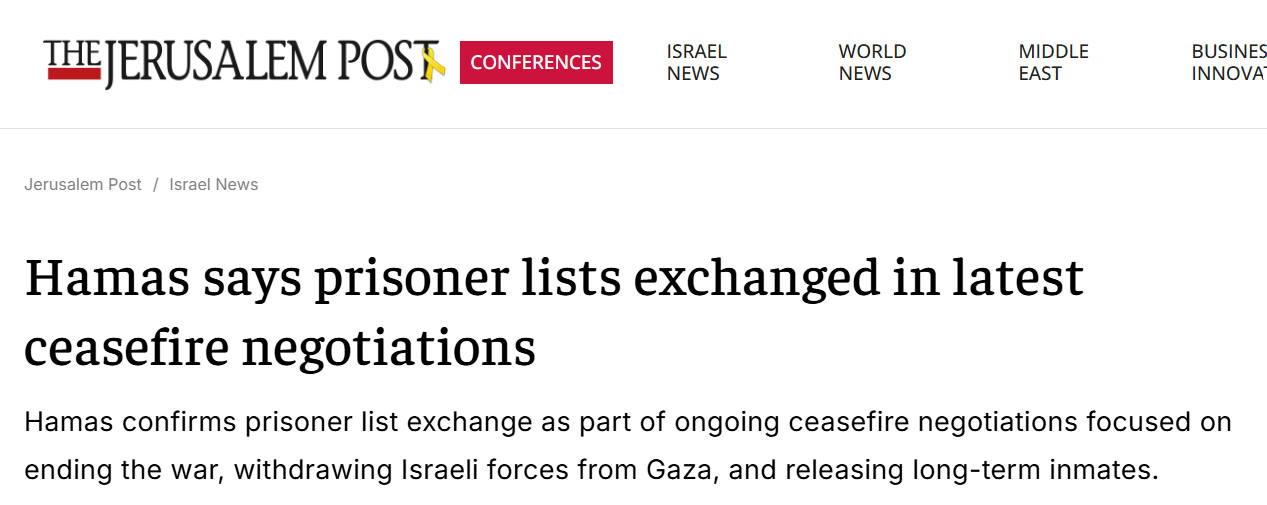
 In response to communication from CAMERA’s Israel office, The Jerusalem Post has corrected a headline and parts of an article which wrongly referred to Israeli and foreign hostages held by Hamas and other terror organizations in the Gaza Strip as “prisoners.” Adopting Hamas terminology, the Oct. 8 headline had originally stated (screenshot at left): “Hamas says prisoner lists exchanged in latest ceasefire negotiations.”
The accompanying article repeated the erroneous terminology in multiple instances, stating:
Hamas confirmed on Wednesday that prisoner lists were exchanged as part of ongoing indirect talks aimed at reaching a ceasefire agreement.
The negotiations, according to a statement by the group, are focused on three main points: ending the war, the withdrawal of Israeli forces from the Gaza Strip, and the exchange of prisoners. . . .
The statement added that the exchanged prisoner lists were based on previously agreed criteria and figures. [Emphases added.]

Israelis gather at Hostage Square in Tel Aviv Oct. 9, 2025 to celebrate the anticipated release of the hostages (Photo by L. Sternthal)
In addition, the subheadline likewise contained inaccurate terminology for hostages, stating: “Hamas confirms prisoner list exchange. . . .”
The hostages held in the Gaza Strip have not committed crimes and are not being held lawfully. Nor are they awaiting any trial of any kind. They are held incommunicado with no Red Cross visits and in total violation of international law. The captured soldiers are not prisoners of war because until Hamas launched its surprise slaughter and kidnapping spree targeting civilians and soldiers alike, the two sides were not in a state of war.
Unfortunately, The Post adopted Hamas’ false terminology without even applying qualifying scare quotes.
Following communication from CAMERA’s staff in Jerusalem, editors commendably amended the headline to accurately state: “Hamas says hostages, prisoner lists exchanged in latest ceasefire negotiations.”
In addition, the subheadline no longer refers to a “prisoner list exchange,” and instead rightly states: “Hamas confirms the list of Palestinian prisoners to be released in exchange for Israeli hostages . . . “
Similarly, the first sentence now accurately reports: “Hamas confirmed on Wednesday that prisoner lists were presented to Israel . . . .” As of this writing, however, the second paragraph continues wrongly to cite the “exchange of prisoners” and another paragraph likewise refers to “the exchanged prisoner lists. . . . “
Other media outlets which previously corrected after falsely referring to the hostages as “prisoners” or “captives” include Haaretz, United Press International and BBC Arabic (see before and after).
Separately, the Jerusalem Post article also cites without challenge dubious Hamas propaganda, reporting: “The official also said that most prisoners released in previous deals have not returned to terrorism or political activity, and many now reside abroad with limited involvement in Palestinian affairs.”
As The Jerusalem Post itself reported in 2025:
Shin Bet (Israel Security Agency) head Ronen Bar presented data to the ministers in the security cabinet on Friday, stating that “82% of those released in the Gilad Shalit deal in 2011 returned to terrorism,” and that 15% of them carried out attacks themselves after their release in the deal, or planned the attacks.