
CNN’s October 2 feature on an alleged “famine” in Gaza (“How Israeli actions caused famine in Gaza, visualized” by Sana Noor Haq, Rachel Wilson, Soph Warnes, Lou Robinson, and Henrik Pettersson, with contributions from Ibrahim Dahman, Kareem Khadder, and Eyad Kourdi) offers a case study in what happens when journalists let their storylines lead the facts instead of the other way around. The article’s central premise—that famine has taken hold in Gaza and that Israel is solely to blame—collapses upon examination of CNN’s own reporting.
The Big Lie
At the core of CNN’s report lies an extraordinary claim: that Gaza is experiencing famine. The allegation relies on an August 15 report from the Integrated Food Security Phase Classification network (IPC) which claimed a “famine” was ongoing in part of the Gaza Strip. (For substantive critiques of the IPC report, see the Network Contagion Research Initiative, the Foundation for Defense of Democracies, the American Enterprise Institute, Mark Zlochin, Salo Aizenberg, and Israel)
Citing the IPC, the network states that “a famine can only be declared if three thresholds are met,” one of which is “at least two in every 10,000 people die each day from starvation, or from malnutrition and disease.” Gaza’s population is approximately 2.1 million. If famine was present across the whole territory, that would mean around 420 deaths per day.
However, the IPC declared there was famine in only the Gaza Governate (essentially Gaza City). In August, it was estimated there were approximately 800,000 – 1,000,000 residents in Gaza City. To meet the famine threshold, there would need to be at least 160-200 deaths from starvation per day, amounting to 7,680-9,600 deaths between August 15 (the IPC’s declaration) and October 2 (CNN’s article).
But let’s give CNN every benefit of the doubt. During this period, most residents evacuated Gaza City ahead of anticipated hostilities there. By October, it was estimated that only around 200,000 residents remained in Gaza City. If that was the population for the entire 48-day period between the IPC’s declaration and CNN’s article, the famine threshold would require at least 40 deaths per day, totaling 1,920 deaths.
And how many Gazans, according to CNN, actually died of starvation or malnutrition? 455. Total. Throughout all of Gaza over two years, more than 720 days of war.
CNN adds that 177 of those 455 died “since August 15,” when the “famine” was declared. Even if every single one happened in Gaza City, that’s less than 10% of the minimum famine threshold—after bending every assumption in CNN’s favor.
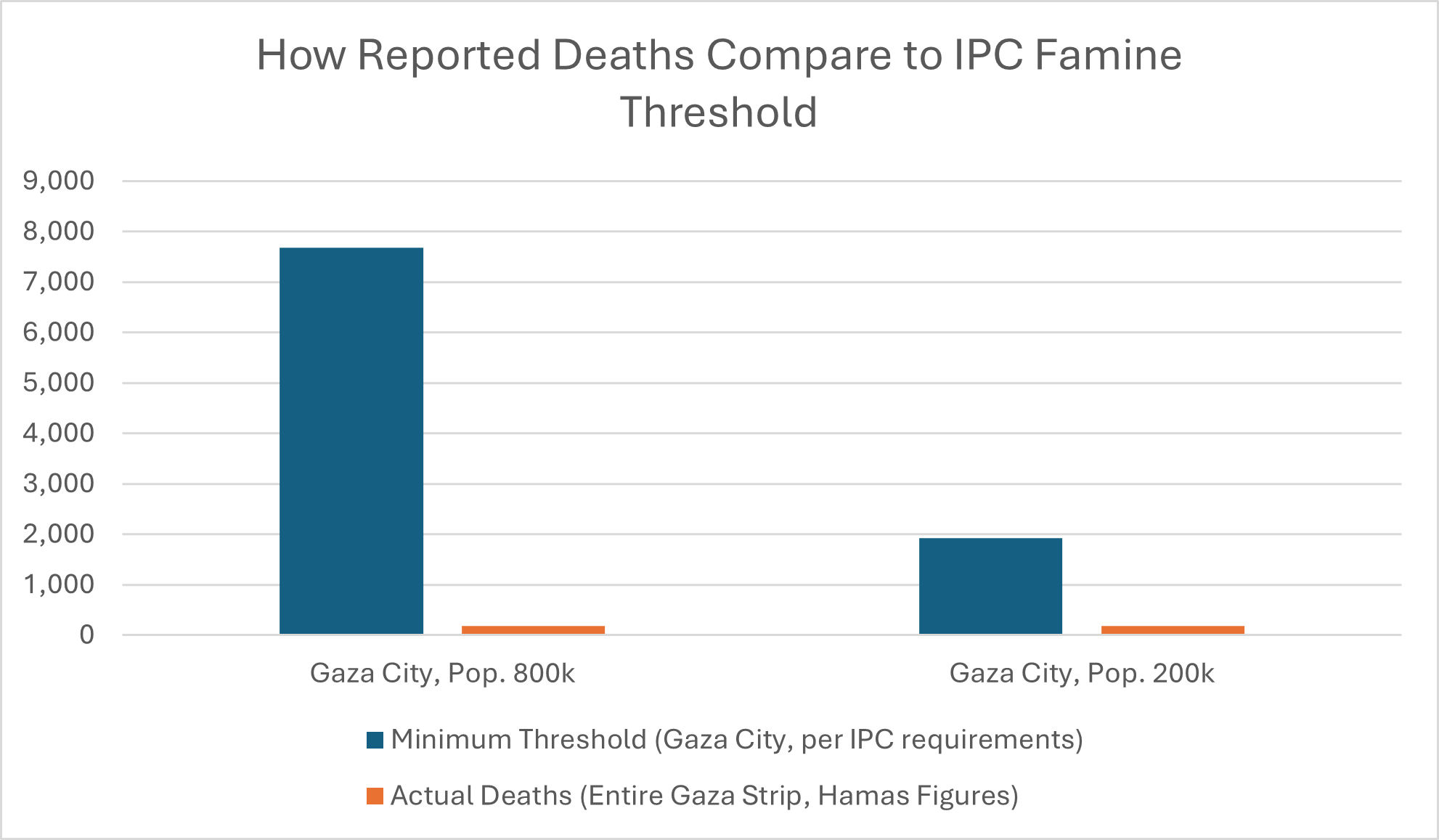
A graph depicting the minimum number of deaths required to meet the IPC’s famine threshold in Gaza City between August 15 and October 2, based on different estimated population figures in August and October, and the actual number of famine-related deaths reported by Hamas throughout all of the Gaza Strip during this period.
So how did the IPC justify declaring a famine? By assuming, without evidence, that Hamas was undercounting famine-related deaths—by a factor of ten or more. That’s not analysis; it’s wish-casting. Especially absurd given Hamas’s long history of inflating civilian casualty figures.
If CNN’s own reporting includes information debunking the central premise of its story, then why does the headline still treat the claim of “famine” as an established fact? Not one of the eight contributing journalists appears to have asked this question or considered challenging the IPC’s conclusions. This is no trivial matter. As the network itself states, the IPC report “helped to fuel growing international outcry” and “was cited by some of countries (sic) that recently made moves towards formally recognizing a Palestinian state.”
Blaming Israel
Having conjured a “famine,” the authors then worked to depict Israel the villain.
The deception starts with the opening phrase: “Israel’s nearly two-year war…” A war that began with Hamas’s surprise attack and massacre of Israeli civilians is thus repackaged as Israel’s initiative. From there, every problem in Gaza becomes Israel’s fault; Hamas and the UN fade into the background as mere scenery.
CNN’s framing of the aid situation follows the same pattern: exaggerate Israeli control, erase everyone else’s agency.
The authors blame “Israel’s vast web of bureaucratic impediments… [which] throttles the amount of aid that makes it” to Gaza. It then attacks the role played by the Gaza Humanitarian Foundation (GHF), an Israeli and U.S.-supported aid effort, referring to its aid distribution sites as “militarized,” “dehumanizing,” and “inaccessible.”
But they rely on critical omissions and obfuscations that range from absurd to outrageous.
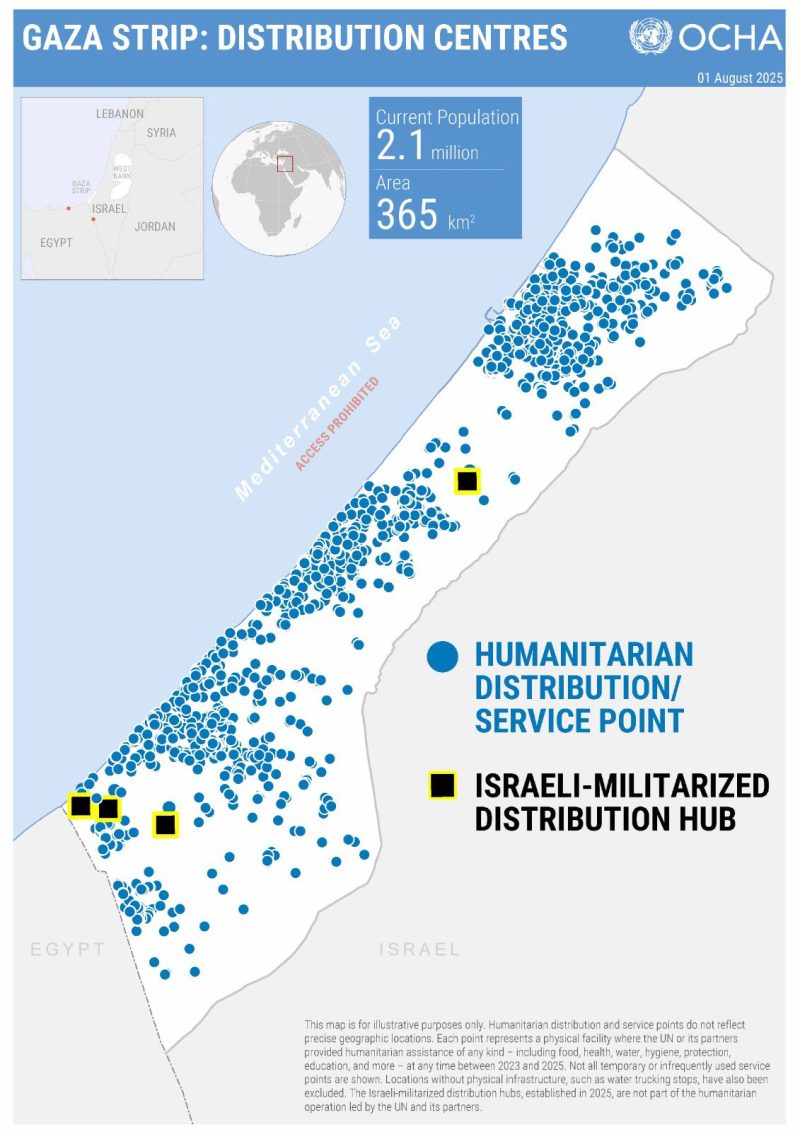
A map, produced by the controversial UN agency OCHA-OPT, depicting all the aid distribution sites scattered throughout the Gaza Strip. The CNN map depicted only those marked as “Israeli-militarized distribution hubs,” misleadingly depicting the situation.
On the absurd end, a “visual” map warns that aid entry points are “at least four kilometers” from populated areas—as if Gazans are expected to trek to the border for handouts. Distribution networks span the Strip, and CNN knows it. Yet their next map conveniently shows only GHF sites, omitting the many others Israel has helped enable.
On the outrageous end, consider the following sleight of hand. CNN included a statement by Israel’s COGAT that “4,400 calories per person per day entered Gaza since the beginning of August,” the period during which the IPC declared “famine.” But the authors then immediately cite a UN report from May that claimed Gazans were “consuming just 1,400 calories per day…”
It’s a rhetorical trap laid for casual readers. The problem isn’t only that CNN used outdated figures to mislead on the current reality. The outdated figures themselves are dubious; they’re based on opaque “data simulations” that are, predictably for the UN, inaccessible to the public.
The authors take it even further. Instead of using COGAT’s data, which is transparently accessible to the public, to challenge the IPC, they instead portray COGAT’s data tracking as sinister. Citing an UNRWA official, the article depicts COGAT as exercising control, “to the calorie,” of the aid that enters Gaza by employing a system “designed not to function smoothly.”
But, as CAMERA has previously pointed out, Israel is facilitating the entry of nearly twice the amount of food aid that the UN itself says is necessary. If Israel is using its “control” to “throttle” the entry of aid, then it’s doing a poor job.
Convenient Omissions on Aid Distribution
Given this data, if there are food security issues in Gaza, then clearly the problem has less to do with aid entering Gaza and more to do with how aid is being distributed within Gaza. While the entry of aid requires Israeli approval, the distribution of that aid within the territory is carried out by the UN and other aid agencies.
Here, too, CNN deceives, finding only two parties responsible: Israel and GHF. Take, for example, the article’s assertion that “1,172 people” have been killed by “indiscriminate fire” at or near GHF aid distribution sites, which receive security support from Israel.
The authors sidestep (i.e., ignore) Hamas’s documented practice of infiltrating and attempted attacks at GHF aid sites precisely to generate controversy. But they also omit a crucial detail about those casualties. According to the UN, “the vast majority of deaths and injuries” that have allegedly occurred at or “near” these aid sites have been “[y]ounger men and older boys” (Gazan terror groups are known to regularly recruit older children). So much for the “indiscriminate fire” narrative.
Omitting the UN’s Responsibility
While much of the article’s criticism of Israel is tied to anonymous “relief and health workers,” the authors notably refrain from addressing the responsibility those actors face for the aid situation in Gaza.
For example, one of CNN’s graphics claims “much of the aid is intercepted by hungry people or armed gangs before it reaches its intended destination.” Omitted is that this language is in reference to the UN’s aid delivery efforts. Unlike GHF, the UN refuses to accept Israeli security support for its aid delivery. Consequently, between May 19 and August 5, nearly 90% of UN aid trucks were “intercepted” either “peacefully by hungry people or forcefully by armed actors, during transit in Gaza.” That figure has only slightly improved.
Hamas: The Vanishing Actor
Perhaps the most stunning omission of all is Hamas itself.
Consider one example of how CNN erases Hamas’s role. The authors downplay Hamas’s theft of aid by pointing to an “internal US government review” which, they claim, “found no evidence of widespread theft by Hamas of US-funded humanitarian aid in Gaza.” Now consider some details, from a July 2024 USAID Office of Inspector General report, that the authors declined to mention:
[W]ith respect to the reporting of alleged misconduct affecting its programs, USAID relies on reporting from aid organizations themselves…. [M]ost UN agencies are generally only reporting a small percentage of allegations directly to USAID OIG compared with the disclosures we receive directly from USAID.”
In other words, USAID was relying on organizations based in Gaza – which has been oppressively governed by Hamas – to self-report any diversion of their aid by Hamas.
The authors also assert that aid workers are facing “intensified hostilities” and “damaged roads” that are “minimizing viable routes and blocking access.” Unmentioned: Hamas’s role in exactly that. Just two weeks before CNN’s article, Hamas was caught firing on and then hijacking UN aid trucks. It then used a stolen UN vehicle to erect a sand barricade blocking a new road that was being prepared as another alternative aid route.
Conclusion
CNN’s “Gaza famine” coverage isn’t journalism—it’s advocacy masquerading as reporting. Every layer of the story is engineered to fit a preordained script: Israel starves Gaza, Hamas disappears, and the UN’s own failures are airbrushed away. The bias is unmistakable. Tellingly, it’s not even the first time CNN, and Sana Noor Haq in particular, have so dramatically skewed their coverage of the IPC and the food security situation in Gaza.
Facts that don’t serve the narrative are buried. Numbers that refute it are distorted. Critics are ignored unless they can be caricatured as “official Israeli sources” and their criticisms left unexplained. Instead of bringing in voices to challenge the IPC’s extraordinary allegations, CNN features the likes of UN rapporteur Michael Fakhri, a figure whose work includes gratuitous imagery steeped in antisemitic tropes. And yet, for the pull quote of record, the article features Fakhri’s claim: “Israel has built the most efficient starvation machine you can imagine.”
When propaganda dresses itself in journalistic language, the public deserves to know it. CNN didn’t just misreport a story; it inverted it.