
M. Shadows, lead singer of the band Avenged Sevenfold, sent a beautiful and compassionate video message last week to released hostages Evyatar David and Guy Gilboa-Dalal. “So excited to hear you are home…. Hopefully we can see you guys soon,” he said. When Rolling Stone reported on the message, the singer told the music magazine, “This was just a humanist approach — these people have been through a lot.”
But what, exactly, have they been through? Rolling Stone passed up the opportunity to tells its readers, as Times of Israel reported of the two in March:
Hostages Evyatar David and Guy Gilboa-Dalal are being starved and kept in chains with bags over their heads while in captivity in Gaza, their families told Hebrew media on Saturday….
The report said that Gilboa-Dalal suffered extreme dehydration in captivity and could not talk for a month due to the discomfort. He has also lost his hearing in one ear. David, meanwhile, is unable to see as he is without his glasses.
The captives’ legs and hands are chained, they are provided with food in complete darkness so they can’t see what they are eating, and are only allowed to shower with a bucket once a month, according to the report.
The two were seen for the first time since their kidnapping on October 7, 2023, in a Hamas propaganda video released last month, being forced to watch a group of hostages get released, an act widely panned as cruel psychological torture.

Evyatar David in Hamas captivity
In August, video showing a skeletal looking David digging what he was told would be his own grave circulated. Gilboa-Dalal now struggles to eat. But Rolling Stone’s readers actually learn nothing of what they endured. (“Avenged Sevenfold Singer Defends Message to Israeli Hostages: ‘It’s Not Political — It’s Human’,” Shirley Halperin, October 19.)
Compare that to the magazine’s treatment of Carsie Blanton, “a folk singer and songwriter who’s been self-releasing records and touring the country for the past decade,” who was arrested by Israel for her participation on the Global Sumud Flotilla. Blanton told her story to Rolling Stone in extended detail, including:
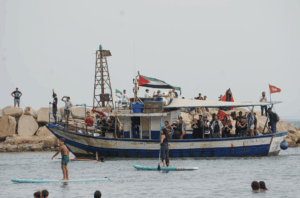
The Global Sumud Flotilla
Blanton spent four nights and five days in detention. After not receiving food for 30 or so hours, the detained activists were given rice and tomatoes the first two days, followed by an unexpected day of bread, hummus, chicken, and cheese. Each night, she says, the detainees were woken up in the middle of the night and moved around to different cells. Every few hours throughout the night, guards turned on the lights and counted them. Blanton also says that outside her cell, there was a documentary regularly playing about the events of Oct. 7, 2023, when a horrific Hamas attack killed roughly 1,200 Israelis and resulted in several hundred hostages being taken.
Blanton, according to Rolling Stone, “remains surprised by the degree to which the flotilla activists were denied basic prisoner rights.” (“An American Singer and Activist on What She Experienced as a Prisoner in Israel,” Jonathan Bernstein, October 10, 2025.”)
Furthermore, Rolling Stone dedicated an entire article to the experience of this would-be blockade runner without noting that the blockade, first imposed in 2009, was found to be legal, even by the notoriously anti-Israel United Nations.
In 2011, the UN’s Palmer report stated, “The naval blockade was imposed as a legitimate security measure in order to prevent weapons from entering Gaza by sea and its implementation complied with the requirements of international law.” The report further stated, “There is no right within those rules to breach a lawful blockade as a right of protest” (paragraph 158). Moreover, in order to maintain the blockade’s legality, the IDF must enforce it “impartially,” meaning, if Israel were to allow these particular ships through, this could potentially destroy the legality of the blockade. For the flotilla organizers, therefore, it’s win-win, even though they were the ones acting illegally. If Israel allows them through, they can argue the blockade’s legality is in question, and if Israel doesn’t allow them through, they can get good publicity from willing dupes like those at Rolling Stone magazine.
Three earlier Rolling Stone reports, dated June 8, July 26, and Aug. 20, on previous attempts to breach the legal blockade similarly failed to inform readers of this highly relevant fact.
Even under new leadership, the magazine whose writers and editors once thought IDF stood for “Israel Defence League” (subsequently corrected) (did no one notice “League” starts with L, not F?) continues to demonstrate how out of its depth it is anytime it attempts to write about the Arab-Israeli conflict.
As CAMERA has documented extensively, this one-sidedness is nothing new for Rolling Stone. Past coverage has included a headline saying that Israel is “conducting a war against humanity itself,” a line worthy of Joseph Goebbels himself. (What do you do with a people who are “at war with humanity itself”?) With the entertainment industry having reverted to boycotts that are reminiscent of the Nazi era, this leading entertainment industry publication now legitimizes such a boycott through continued biased reporting.
On Sept. 8, the publication reported on Hollywood celebrities who pledge to boycott the Israeli film industry, as well as, on Sept. 17, and again on Oct. 10, on another group that urged musicians to block their music from being streamed in Israel. (“Ayo Edebiri, Olivia Colman, More Pledge to Boycott Israeli Film Institutions Over ‘Carnage’ in Gaza,” By Tomás Mier, Sept. 8; “MIKE, Faye Webster, Japanese Breakfast, and More Join Israel Streaming Boycott,” by Andre Gee, Sept. 17; Clairo, Lucy Dacus, Nao, More Join No Music for Genocide Boycott, by Mankaprr Conteh, Oct. 10.) The Sept. 17 and Oct. 10 articles also repeated the highly contentious claim of “genocide” in Gaza without noting, as the Sept. 8 article did, that it is widely disputed.
Yet CAMERA was unable to locate any reporting in Rolling Stone either on Paramount’s or Warner’s responses to the film industry letter, which was to reject it, or on a different group of actors, organized by Creative Community for Peace, that wrote to similarly condemn the boycott call. The CCFP letter referred to the boycott letter as a “document of misinformation.” Covering only those who take one side of this conflict creates a false impression for readers that there is a consensus on this issue, when there clearly is not one.
And on Oct. 20, Rolling Stone chose (not for the first time) to cover the rap group Bob Vylan’s excuses for chanting “Death, Death, to the IDF” last summer at the Glastonbury Festival in England. The group’s chant was genocidal – the IDF is the only thing that stands between Israelis and the jihadis from Hamas, Hezbollah, Palestinian Islamic Jihad, and others. “Death to the IDF” means exposing Israelis to more deadly terror attacks. Yet Rolling Stone let them whitewash it, quoting Bobby Vylan (one member of the duo) on a podcast saying:
My whole issue with this thing is that the chant is so unimportant. It’s so unimportant, and the response to it was so disproportionate…. What is important is the conditions that exist to allow that chant to even take place on that stage. And I mean, the conditions that exist in Palestine. Where the Palestinian people are being killed at an alarming rate. Who cares about the chant? It’s like, what is it that is allowing for that chant to even exist? That’s what the focus should have always been on it. [“Bobby Vylan Addresses Glastonbury Chant Controversy in New Interview: ‘I’m Not Regretful of It,’” Charisma Madarang, Oct. 20.]
Although Noa Tishby’s beautiful Oct. 7 remembrance published on the two-year anniversary of the attack was a welcome departure, overall, the arrival of a new Co-Editor in Chief at the beginning of September doesn’t seem to have brought about any real change there.