
For months, Israeli observers have warned that Hamas seeks to establish a situation which parallels that of Hezbollah in Lebanon. For instance, military analyst Yaakov Lappin wrote in March: “Hamas seeks to end the war while maintaining its military control over Gaza, mirroring Hezbollah’s pre-war dominance in Lebanon. Israel must not allow this to happen, even if Egypt pushes for it.”
He explained:
Hamas’s primary goal at this time is to secure a ceasefire in order to survive the war, rebuild its terror army and cement its political control of the Gaza Strip.
To accomplish this, it has signaled its willingness to create a governance model in Gaza similar to Hezbollah’s pre-war control of Lebanon: an internationally recognized government providing a façade of authority, while Hamas retains full military-terrorist control on the ground and de facto political power.
In recent days, international media outlets have likewise noted that the Gaza situation may well increasingly mirror that of Lebanon. The problem, however, is that when reporting at those media outlets grossly distorts the situation in Lebanon, the coverage of anticipated similar developments in the Gaza Strip coverage reflects those same distortions.
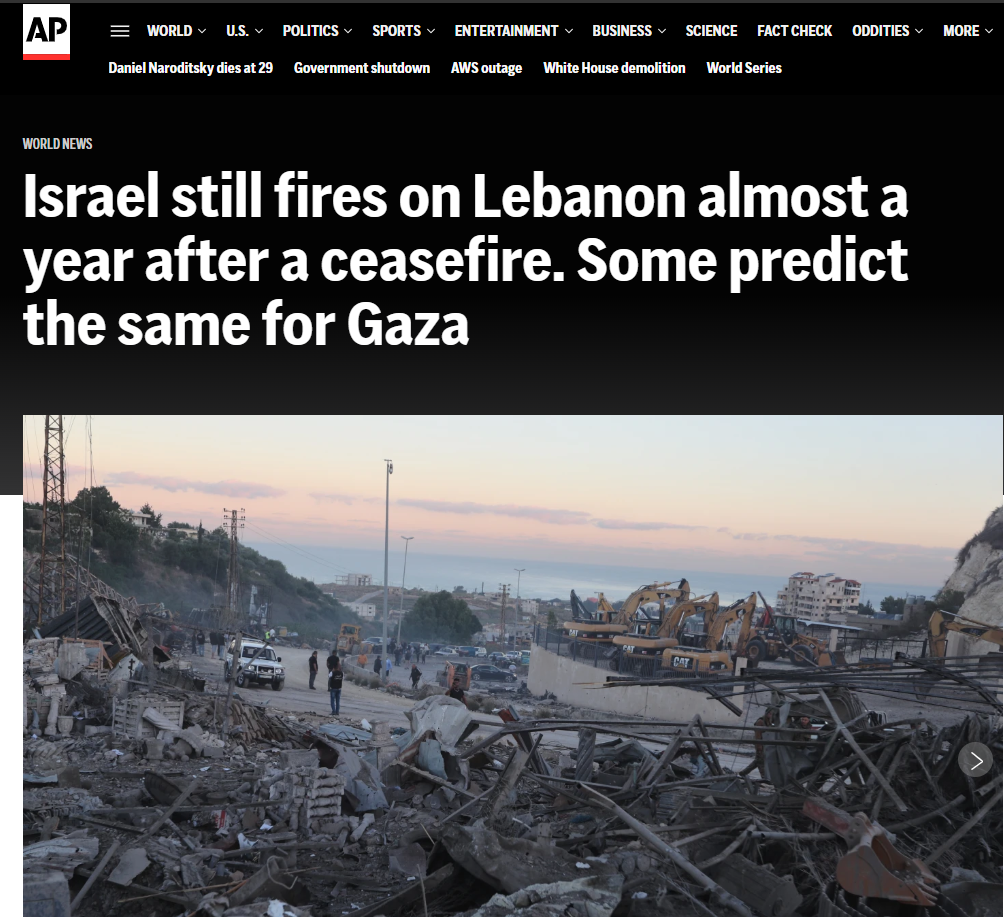 Yesterday’s Associated Press headline and article, “Israel still fires on Lebanon almost a year after ceasefire. Some predict same for Gaza,” exemplifies the broken mirror phenomenon.
 In practice, Israel has largely taken enforcement into its own hands, asserting that its strikes in Lebanon target Hezbollah militants, facilities and weapons.Israel says it aims to stop the badly weakened group from rebuilding. Lebanese officials say the attacks obstruct its efforts to get Hezbollah to disarm by giving the group a pretext to hold onto its weapons.
In September 2025, IDF forces attacked Hezbollah facilities and eliminated operatives of the organization as part of ongoing operations against Hezbollah’s presence in south Lebanon, which violates the ceasefire agreement understandings, and against Hezbollah’s efforts to increase its military capabilities and restore its arsenal. At least 11 Hezbollah terrorists were eliminated, including intelligence and artillery operatives, an arms dealer who had guided cells planning terrorist activity from Syria, and a Hezbollah operative who also served in the Iranian Imam Hussein Division militia and was involved in rocket fire during Operation Northern Arrows, leading Hezbollah rehabilitation efforts after the ceasefire. In addition, aerial and ground attacks in south Lebanon destroyed Hezbollah headquarters in the al-Nabatieh area, weapons depots belonging to the elite Radwan Force, a naval vessel used for intelligence gathering, a rocket launcher, engineering equipment and production sites aiding Hezbollah’s recovery and attack planning against Israel (IDF spokesperson, September 1–30, 2025).[8] Hezbollah’s social media accounts and affiliated Lebanese media published announcements of the deaths of 13 Hezbollah operatives (Balaa and South Lebanon–Enemy Watch Telegram channels and Lebanese media, September 1–30, 2025):
 Indeed, Associated Press headlines earlier this week regarding Hamas’ fatal Oct. 19 attack on Israeli troops, and Israel’s retaliatory airstrikes followed that precise formula: “Israel strikes southern Gaza in test of ceasefire” and “Israel strikes Gaza in the first major ceasefire test, saying Hamas attacked troops.”
Thus, in an Oct. 18 article which embraces Hamas propaganda, the Guardian pivots to Lebanon in the last two paragraphs, touching on the aforementioned Oct. 11 strike in Msayleh (“Israel has violated ceasefire 47 times and killed 38 Palestinians, says Gaza media office“):
In a separate development on Saturday, an Israeli strike on a construction vehicle in southern Lebanon killed a man, the Lebanese health ministry reported.
Israel has repeatedly bombed Lebanon despite a November ceasefire that brought to an end more than a year of hostilities with the militant group Hezbollah that culminated in two months of open war.
The Guardian included not one word about the Israeli military’s information that Hezbollah was using the construction vehicle in question to rebuilt its terror infrastructure.
CAMERA approached both the Associated Press and The Guardian requesting clarifications, and both media outlets failed to take steps to improve their problematic coverage.
Hamas in Gaza mirrors Hezbollah in Lebanon, and failed media coverage of the former mirrors failed media coverage of the latter. This flawed media coverage, ignoring Arab violations of the ceasefire and casting Israel as an unprovoked bully, is full of mirrors — none of them clarifying.