
In some journalists’ looking-glass view of the Israeli-Palestinian conflict, when Palestinians attack Israelis, the quiet has not been jeopardized, the ceasefire is not tested, and tensions are not roiled. But when Israel dares to respond to the Palestinian attack? It is only at that point, according to this warped depiction, that the tense quiet is shaken and all is no longer well in the troubled Middle East.
So it was in June 2014 when Hamas terrorists kidnapped three Israeli teens and Israeli troops set out to search for them in the West Bank. About their abduction and rescue attempts, The New York Times infamously editorialized: “The growing search for them and their captors further destabilized Israeli-Palestinian relations . . . .”
At the time, CAMERA observed:
[t]he Gray Lady conforms to its well-worn narrative in which, regardless of the reality on the ground, Israel stars as the wrecking ball of peace. According toThe Times, it is not Hamas’ kidnapping of Gil-Ad Shaar and Naftali Frankel, two eleventh-graders on their way home from school, together with Eyal Yifrach, an unarmed, 19-year-old civilian, that is responsible for eroding Israeli-Palestinian relations. Rather, The Times singles out Israeli efforts to bring the boys home as the key cause of friction.
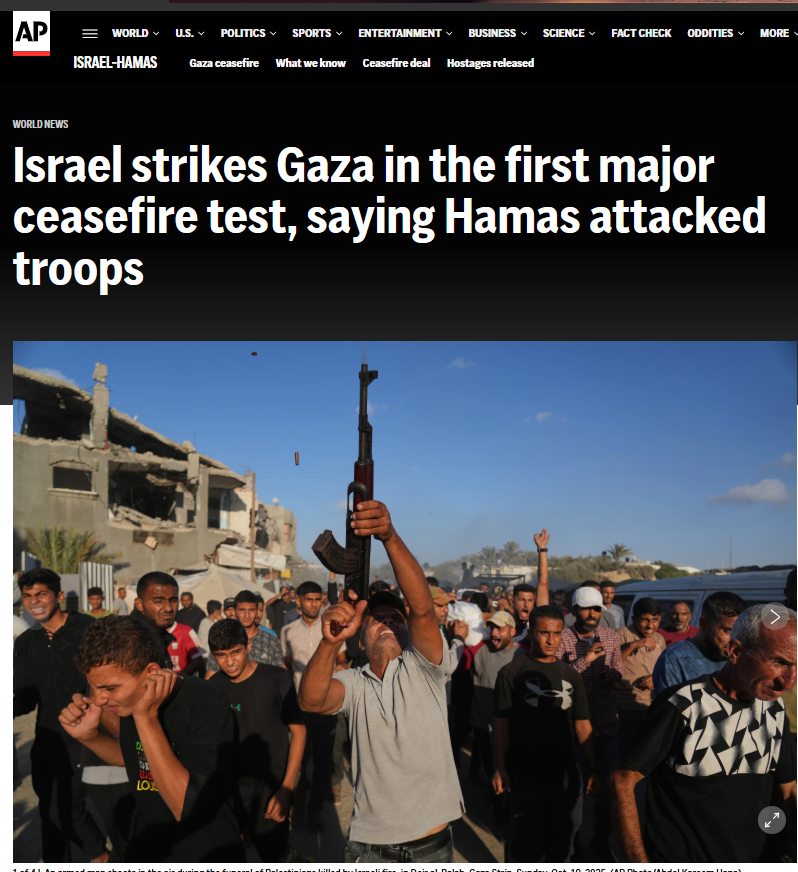 The twisted scenario replayed yesterday when Hamas terrorists attacked Israeli troops positioned in Rafah on the Israeli side of the “yellow line” set in President Trump’s ceasefire plan, and Israel responded with airstrikes on Hamas targets across the Gaza Strip. About these events, the Associated Press, which boasts about “Expanding the power of facts,” published at least two egregiously skewed headlines: first, “Israel strikes southern Gaza in test of ceasefire” (archived here), and then the nominally improved version: “Israel strikes Gaza in the first major ceasefire test, saying Hamas attacked troops” (screenshot at left).
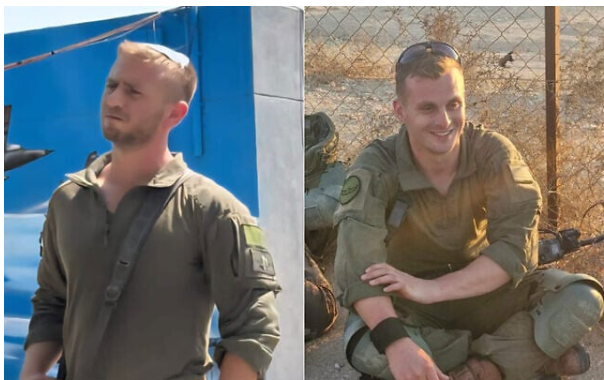
Maj. Yaniv Kula (left) and Staff Sgt. Itay Yavetz, who were killed in an attack in the southern Gaza Strip on October 19, 2025. (Israel Defense Forces)