
Famously, the slogan “All the News That’s Fit to Print” graces the front page of every New York Times edition. The slogan was coined at the end of the 19th century by the paper’s publisher, Adolph Ochs. Of course, in today’s hyper-globalized world, the slogan is wishful thinking. No paper could realistically cover all the important news stories of the day.
Still, it would be hard to argue that outlets like the New York Times, the Washington Post, CNN, and others adequately cover even those stories they do print. They often devote precious space to emotive or opinionated claims, while omitting highly material and relevant information that sheds important new light.
Provided below are three important, but underreported, stories from the week bearing on Israel and the Middle East that media consumers should know.
1) The Curious Death of a Propaganda Icon: Mr. Fafo
Mr. Fafo is dead, and this time not just in one of his own staged propaganda videos.
Who exactly was Mr. Fafo? His real name was Saleh al-Jafarawi, a Gazan who rose to fame thanks to his over-the-top pro-Hamas propaganda videos. On October 7, 2023, he gleefully filmed himself celebrating as Hamas launched its massacre of Israeli civilians. Once Israel began to respond militarily, al-Jafarawi switched tactics to posting faked videos depicting himself as suffering life-threatening health wounds or, in at least one case, pretending to be a doctor treating the wounded. His nickname, Mr. Fafo – an acronym for “F*** Around, Find Out” – was born from the stark contrast between these videos.
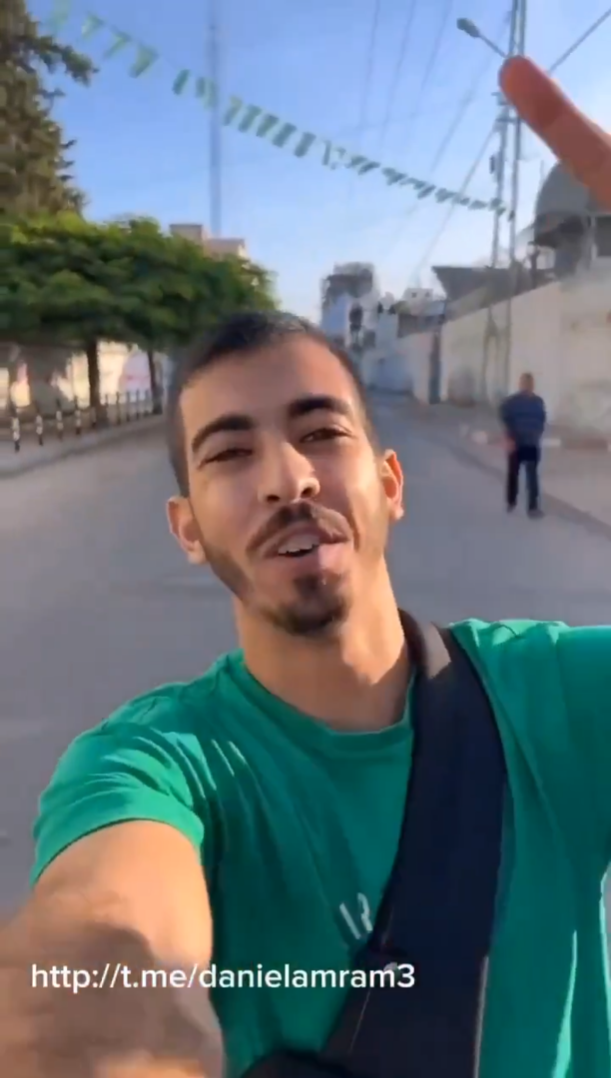
A screenshot of al-Jafarawi’s video celebrating as the October 7, 2023 massacre is launched by Hamas.
Less commonly known is that al-Jafarawi used his fame and popularity among gullible but sympathetic viewers, according to the Palestinian Authority, to embezzle donations meant for rebuilding a children’s hospital. Local Gazans have accused him of instead diverting the funds to the terrorist organization Hamas, though there is no publicly available evidence for this allegation.
Ironically, al-Jafarawi was killed by his fellow Palestinians. His death occurred as he was allegedly accompanying Hamas’s infamous al-Sahm unit – notorious for its murder and torture of Palestinian dissidents – which was carrying out attacks on the Doghmosh clan in Gaza City. Since the start of the ceasefire, Hamas forces have killed 52 of the clan’s members, including through brutal public executions (WARNING: GRAPHIC). Another notable figure killed during the clashes: Naim Bassem Naim, the son of senior Hamas leader Bassem Naim.
The significance of al-Jafarawi’s demise alongside a notorious Hamas unit is evident from the reach of his propaganda videos throughout the war. Anti-Israel activists, journalists, and organizations are using the opportunity to falsely describe al-Jafarawi as a “journalist” and falsely portray him as having been killed by Israeli forces. National Students for Justice in Palestine has used al-Jafarawi’s death to call for the murder of “collaborators,” that is, Palestinians accused of working with Israelis. The Qatari propaganda outlet Al Jazeera also used his death to baselessly claim the besieged Doghmosh clan is an “Israel-linked ‘militia’.”
Despite al-Jafarawi’s prominence, major Western outlets have avoided covering the circumstances of his death, except in the context of reporting on New York City mayoral candidate Zohran Mamdani’s wife mourning his death (see New York Post and The Independent).
2) The Palestinian Authority Rewards Released Terrorists with Massive Paydays
As Israelis celebrated the release of their hostages, who were targeted simply for being Israeli, Palestinians celebrated the release of terrorists from prison, who were there for attacking and murdering civilians. While Israel will provide the released hostages with desperately needed healthcare following their ordeals, the Palestinian Authority will be providing the released terrorists with a financial reward for their crimes.
As Palestinian Media Watch has meticulously detailed, there are now 160 new Palestinian millionaires who earned their wealth by committing terrorism. Under the PA’s “pay-for-slay” laws, terrorists are rewarded for their crimes, with the size of the reward dependent on the seriousness of their crimes.
Mohammed Daoud, for example, will receive 2.2 million NIS for murdering a pregnant woman and her five-year-old son. Imad Shehadeh, who raped and murdered a 13-year-old boy, will receive 2.1 million NIS. Baher Badr will receive 1.1 million NIS for his role in manufacturing explosive belts for the suicide bombers who carried out attacks at a bus stop and a café in 2003. Iyad Abu al-Rub will also receive a similar amount for his role in overseeing several other suicide bombing attacks. The list goes on, with 250 terrorists in total having been released.
Beyond the obvious, the significance of this story has everything to do with the success of the 20-Point Plan, from which the ceasefire was born. Points 18-20 envision promoting “tolerance and peaceful co-existence” and reform of the Palestinian Authority to this end. But without the termination of the PA’s pay-for-slay program, and the end to Palestinian incitement to hatred and terrorism, peaceful co-existence will remain but a dream.
No major Western media outlet covered this story.
3) Top Pro-Terror Streamer, and Media Darling, Accused of Animal Abuse
Hasan Piker is one of the most popular political streamers on the platform Twitch. In recent months, he has received fawning coverage from major media outlets, including the New York Times, NPR, and GQ Magazine. Omitted in this coverage is the sheer extent of his extremist and bigoted views. He has hosted a Houthi terrorist on his stream, referred to Jews as “inbred,” glorified Hezbollah, and declared, “It doesn’t matter if rapes happened on October 7.”
Now, in addition to extremism and antisemitism, we can almost certainly add “animal abuse” to his record.
During a recent stream, Piker was seen shouting, “Kaya please, just f***ing go back–” as his dog, Kaya, stood up and began walking from her bed. At that precise moment, Piker reaches for something off-screen on his desk, at which point Kaya suddenly yelps in pain and promptly returns to her bed. The streamer was quickly accused of using a painful shock collar to force his dog to remain in the same spot for hours on end as a screen prop for Piker.
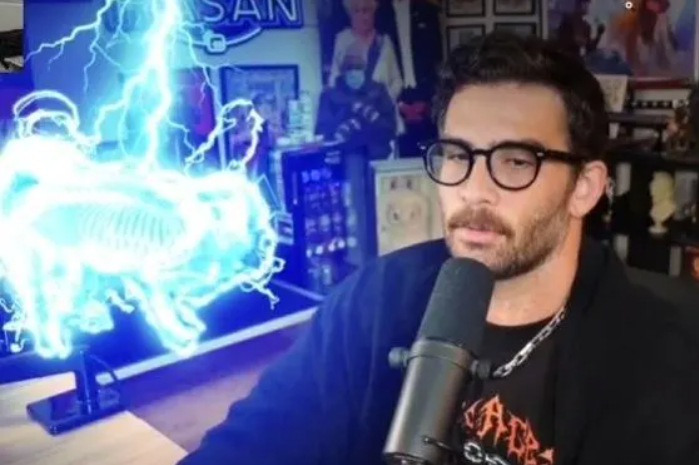
A meme that has gone viral depicting Twitch streamer Hasan Piker shocking his dog, Kaya.
Piker’s increasingly contradictory denials have largely fallen flat. While he attempted to show the collar on screen the next day, Internet sleuths identified it as a specific shock collar model with the prongs removed and with black tape covering it up. During a later stream, Piker then accidentally showed a view of his desk, on which sat the remote associated with the particular shock collar model in the exact spot Piker was seen reaching for when Kaya yelped in pain. Piker attempted to move the remote off screen, but not before viewers had already noticed it.
Viewers subsequently dug up even more evidence of abuse from Hasan Piker’s past streams.
Hasan Piker maintains a large platform, which he uses to influence young minds, often for bigoted and extremist purposes. The abuse of his dog in pursuit of that goal would be plainly newsworthy, given that major news outlets devoted their time and resources to promoting a softened image of him.
Unfortunately, neither New York Times, NPR, nor GQ Magazine have followed up on their fawning coverage. Among major outlets, The Hill, National Review, Newsweek, the New York Post, and Forbes have covered the scandal.
Historical Context for Current Events
Many of those who have been demanding a ceasefire for two years seem oddly displeased with the news of a ceasefire. In the United Kingdom, for example, the Palestine Solidarity Campaign (PSC) called for protests against the ceasefire. PSC’s director, Ben Jamal, explained: “It leaves intact Israel’s illegal military occupation of Palestinian territory and system of apartheid that extends across all of historic Palestine.” “Historic Palestine,” of course, is a euphemism for all of Israel. In other words, it was never about ending the war for these protestors; it was about delegitimizing “the Zionist state of Israel.”
Such sentiments recall particularly powerful remarks made by Welsh journalist Gorondwy Rees in 1975. On October 17, 1975 – exactly 50 years ago today – the United Nations’ Third Committee adopted the infamous “Zionism is Racism” resolution (the General Assembly plenary would later officially adopt the resolution a month later). The U.S. representative, Leonard Garment, would state to the committee: “I choose my words carefully when I say that this is an obscene act.” Daniel Patrick Moynihan, then the U.S. ambassador to the UN, simply responded “F*** ‘em,” before reportedly walking with the Israeli ambassador, Chaim Herzog, to the nearest Irish pub.
But Gorondwy Rees’s response to the draft resolution best captured the obscenity of the moment. Shortly after the Third Committee’s adoption, Rees wrote in Encounter:
There were ghosts haunting the Third Committee that day, the ghosts of Hitler and Goebbels and Julius Streicher, grinning with delight to hear not only Israel, but Jews as such, denounced in language which would have provoked hysterical applause at any Nuremberg rally…. For the fundamental thesis advanced by the supporters of the resolution, and approved by the majority of the Third Committee, was that to be a Jew, and to be proud of it, and to be determined to preserve the right to be a Jew was to be an enemy of the human race.
Then, as now, anti-Zionism – the movement to deny Jews their right to self-determination in their ancient homeland – remains a powerful threat to the Jewish people.