
JULY 14 UPDATE:
New York Magazine Corrects
After CAMERA informed New York Magazine of the errors and distortions detailed here, editors corrected four of those errors. The severe skew toward extreme anti-Israel activists has not been redressed. See below for a detailed update.
Suzy Hansen’s June 2025 essay in New York magazine, “Crimes of the Century: How Israel, with the help of the U.S., broke not only Gaza but the foundations of humanitarian law,” charges Israel with breaking international law — not just in the sense of violating a particular provision, but of shattering the entire global legal order.
It’s quite the grandiose claim. But if you’d think the author would follow with meticulous, sober argumentation to show it isn’t mere bombast, you’d be mistaken. Over the next 10,000 words, Hansen floods readers with falsehoods and half-truths, and in fact doesn’t make it through her first paragraph without a brazen deception.
The piece opens as follows:
On April 4, the Palestinian poet Mosab Abu Toha posted a video of an obliterated urban landscape. Suddenly, there are bombs: Smoke erupts from the base of the buildings, and two large objects are ejected from the rooftops into the sky. Arms and legs seem to undulate in the air — they appear to be human bodies — before they crash down onto the pyre. “This is scary more than ever,” Abu Toha wrote on Instagram. “In the air strikes, two people flew even above the clouds of death.” In the background, the girl videotaping is crying as she holds the phone. She knows that those two people, perhaps briefly alive in the sky, have died, that Israel is bombing an already annihilated place, and that eventually those bombs may come for them all.
The video is a jumping off point for the first of Hansen’s odious comparisons between Israel’s war with Hamas and the Nazis' extermination of Jews. And the author revisits the clip at the close of her essay, again insisting in her florid style that it’s “genocidal” to “bomb an already-destroyed place until its ruins spit up two more bodies from the vast grave, throw them into the sky like trophies, and scar a girl’s mind forever.”
For a careful viewer, and certainly for any writer who cares more about journalistic rigor than narrative embellishment, the video should raise some key questions:
What if the putative bodies were Hamas combatants? War, by one enduring definition, is hell. By any definition, it involves the killing of enemy combatants.
Who added plaintive background music to the clip? Since the music signals that the video has been edited, where is the raw footage?
And most fundamentally: Does the character who stars at the start and close of Hansen’s essay, the scarred and crying videographer, even exist?
To this last question, at least, there is a clear, and damning, answer: There was no crying girl filming the airstrike. The clip, so key to Hansen’s narrative that it features in both her opening and closing arguments, was doctored. Not by the credulous essayist. Perhaps not even by her anti-Israel poet. In truth, it could have been any random social media user who manipulated the clip, ripping audio of crying from a different video and overlaying it on the unrelated footage of the bombing before circulating it on social media. But it was Hansen herself who manipulated New York magazine readers, egregiously violating journalistic ethics by attributing fake thoughts and feelings to a fake camera operator and passing them off as fact.
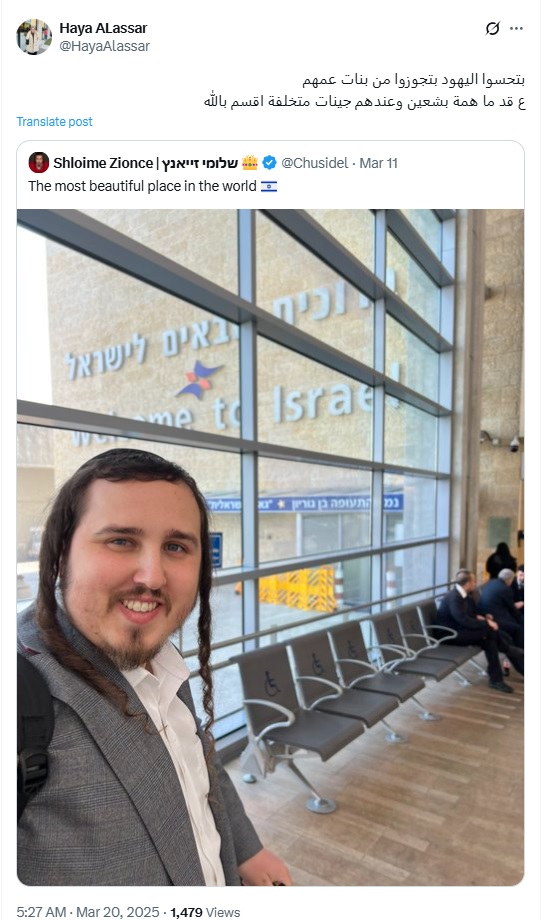
The woman meant to represent Israeli evil and Palestinian purity celebrates violence and traffics in biologized hate speech about Jews.
The misappropriated audio is a key element of Hansen’s morality play, which casts a demon-like Israel against “the Palestinians,” who are no less than “defending human values and trying to free the world.” This isn't just a facile take, but an ironic one: The woman whose voice was stolen (she is not, as Hansen claims, a “girl”) has expressed her values by venerating the Oct. 7 massacre, celebrating suicide bombers, cheering indiscriminate missile strikes against Israel, and glorifying Hamas war criminals. And that’s not all. “You feel that Jews marry their cousins, because they are ugly and have backward genes, I swear to God,” reads one of her social media posts. “They and their religion are cursed,” reads another.


She saved one curse, at least, for whoever was behind the deceptive edits. “I don't understand the benefit of you editing it and putting my voice over it,” she said. The benefit, to the clip’s creator and the New York magazine essayist alike, is to manipulate the audience’s emotions. The video, used in the essay as a metaphor for Israeli evil, in fact represents the falsehoods, sloppiness, and journalistically indefensible spin found throughout Hansen’s essay.
Journalism or Propaganda?
It’s an essay written by an advocacy journalist whose writing promotes her pre-conceived notions of Israeli supremacy and evil.
Take, for example, her reaction to October 7, 2023, the worst massacre of Jews since the Holocaust, perpetrated by Hamas, a terrorist regime sworn to Israel’s destruction. Hansen’s “reflexive focus,” she admitted in a column for The New York Times, was “not on what was happening in the near present but on what might happen in the near future.” In other words, even as Jewish corpses were being collected by the truckful, she was not thinking as much about Jews being victimized by Palestinian terrorists as she was about what they might do in response.
Steeped in negativity toward Israel, Hansen abandons all pretense of journalistic ethics and responsibility, offering in its place crude agitprop. She employs a propagandist’s standard toolbox, appealing to the emotions of the reader so that they will accept her own distorted notions about Israel. Starting with the fabricated video, Hansen offers falsehoods, misquotes, misrepresentation, airbrushing of Hamas, and facile analysis, both by the author and by the endless stream of dubious, extremist anti-Israel activists her piece relies on.
“Naked” Prisoners
The doctored video was quickly followed by other fabrications. Hansen, for example, tells readers that photos emerged in December 2023 of “naked prisoners tied up and piled in the backs of trucks.” Her language evokes imagery of the victims of Nazi atrocities, their nude corpses “stacked like cordwood.” But the detainees in question, suspected of being Hamas fighters, were neither “naked” nor “piled.” They were stripped to their underwear as part of what Israeli officials clarified was a search for explosives or weapons. (Hamas is notorious for its use of explosive vests in suicide bombings.)
Countless journalists at the time managed to report accurately on the captives’ state of semi-undress. “Israeli images showing Palestinian detainees in underwear spark outrage,” reads a typical headline. Hansen could have easily done the same. She simply chose not to.
International Court of Justice Ruling on Genocide Case
Hansen compounded her fabrication about naked prisoners which she claimed prompted South Africa’s claim of genocide against Israel at the International Court of Justice (ICJ). She falsely implies that the ICJ determined there were “plausible merits” to South Africa’s claim.
But contrary to Hansen’s best efforts to distort the facts, the president of the ICJ at the time, Joan Donoghue, went on record to clarify exactly what the ICJ had and had not determined. It was a procedural finding and not a determination on the case’s merits. She explained:
The court decided that the Palestinians had a plausible right to be protected from genocide and that South Africa had the right to present that claim in the court … But it did not decide … that the claim of genocide was plausible. (Donoghue on BBC HARDtalk, April 25, 2024)
Misquoting “Amalek”
Hansen again misleads readers in support of her genocide charge when she misquotes Israel’s prime minister. Insisting that “eliminationist statements by Israeli officials are not difficult to find,” she continues:
On October 28, 2023, as Israel began its ground invasion of Gaza, Netanyahu invoked a line from the Torah exhorting followers “to wipe out the memory of Amalek from under the heavens” — often understood as a perpetual commandment to kill any descendants of the Amalekite people, or the Israelites’ enemies.
Netanyahu, though, didn’t quote the verse about “wiping out the memory” of Amalek. He cited a preceding verse: “Remember what Amalek has done to you.” Far from being evidence of “genocide,” this passage is commonly invoked in Jewish tradition as a call to remember oppressors of the Jewish people, not least during and after the Holocaust. The quote can be found inscribed, for example, on Holocaust memorials and in Holocaust museums.
Even if Hansen is unversed in Jewish tradition, she could have simply read the speech she cites. In his Oct. 28 remarks, Netanyahu not only made clear the country’s goal is to destroy, specifically, “Hamas’s military” and governing capabilities, but he also emphasized that Israel “does everything to avoid harming non-combatants.” It is the precise opposite of “eliminationist” or “genocidal” language.
Getting this right isn't journalistic extra credit — it's the assignment, at least for any serious writer of any honest essay. But that’s not what this is, so Hansen ignores some parts of the speech while inventing other parts.
Fabricated Authorities and Distorted Sources
The author similarly distorts both the content and nature of the documents she cites as she attempts to manipulate readers through the use of well-recognized propaganda techniques: She “appeals to authorities,” “cherry-picks” her sources, and uses the “bandwagon” approach to create a false illusion of widespread support among those she misrepresents as authorities and experts, when they are, in fact, fellow propagandists and activists with histories of demonizing the Jewish state.
Bogus or Compromised Genocide Scholars
The first person Hansen cites to call Israel’s war on Hamas genocidal is Raz Segal, an "Israeli genocide scholar” who “called it a genocide by October 15, eight days after it began.”
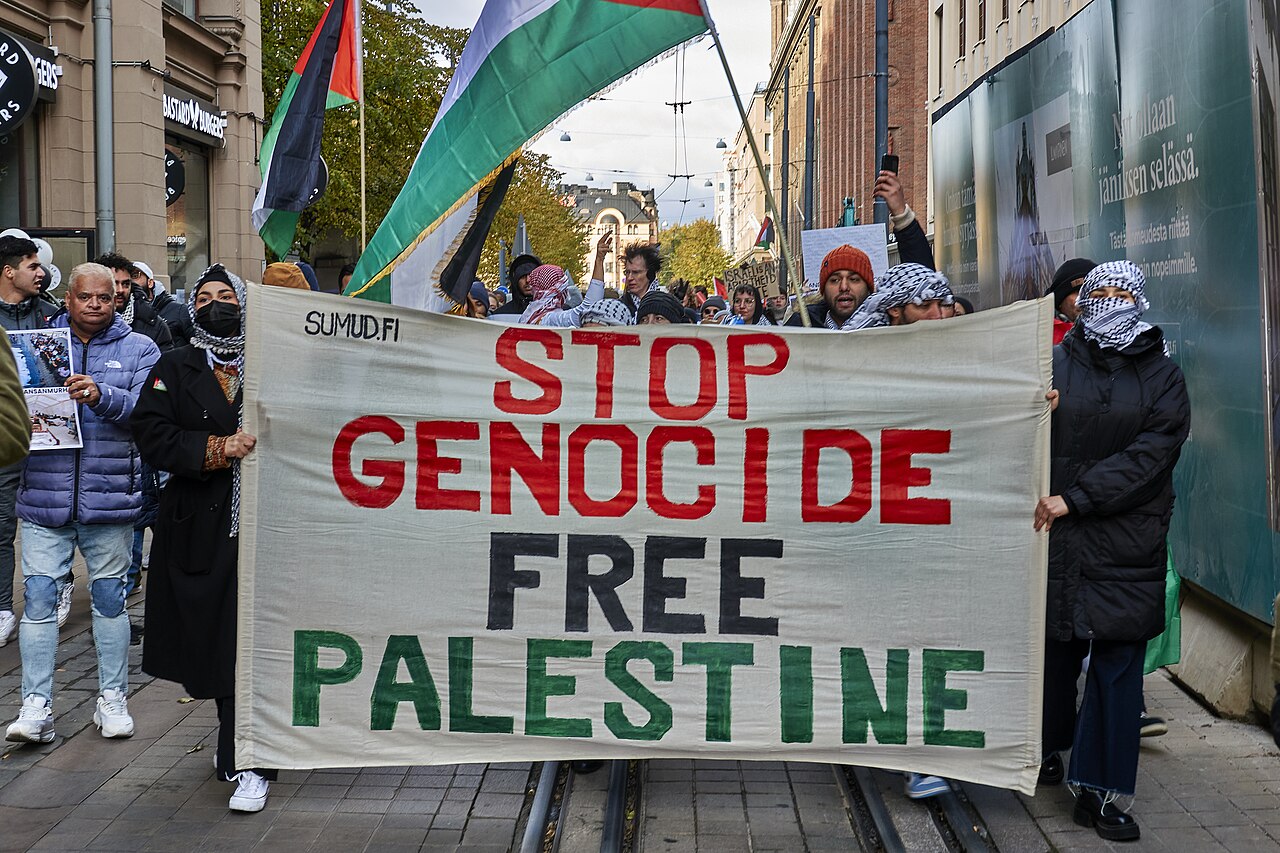
Anti-Israel protesters in Finland. Photo by rajatonvimma, licensed under CC BY 2.0.
Segal didn’t even wait that long. Just six days after Hamas’s massacre, he made his case that this was a “textbook” case of genocide. His evidence? First, the mundane: He insisted that Israel’s defense minister calling Hamas “animals” and Joe Biden saying their attack was “evil” is proof of genocide. Then a lie: Segal claimed the 6,000 munitions Israel dropped on Gaza in one week was nearly as many as the US dropped during the worst year of fighting in Afghanistan, though the US dropped 17,500 bombs on that country in a little over two months. Then a false prophecy: He insisted that Israel intended to systematically destroy Palestinians with a “complete siege” that, it turned out, was in place for only a few days after the Hamas attack. And finally, the irrelevant: He quoted the bellicose words of a few random Israeli citizens in the wake of the Oct. 7 massacre, which are dramatic but legally irrelevant to what Segal pretends to prove.
His disingenuous claims are not at all surprising, because far from an authoritative “genocide scholar,” Segal is known as a radical ideologue and anti-Zionist activist on the fringes. He calls Israel a “settler-colonial power” and denies Jewish history in the land of Israel or Jewish connection to ancient Judeans. Segal promotes the notion of “white supremacy in Israel” manifesting as “Jewish supremacy” and that Israel’s “creation” duplicated “the racism and white supremacy” of the Nazis.
In fact, his expressed views have been so fanatical and his campaign to promote the false genocide charge against the Jewish state so extreme that his authority as an academic has been compromised and challenged: The University of Minnesota rescinded its job offer to Segal to become the director of its Center for Holocaust and Genocide Studies after two longtime board members resigned in protest.
Hansen then deceives readers by flagrantly misrepresenting the signatories of a petition promoted by Segal, claiming “800 genocide scholars signed a letter warning of genocide” soon after he launched his anti-Israel genocide campaign.
Contrary to Hansen’s description of “genocide scholars,” though, the signatories were comprised of a sundry group of students, lecturers, associates and anti-Israel activists from a wide array of disciplines (art, anthropology, architecture, cultural studies, cinema, environmental studies, feminist studies, gender studies, geography, sociology and more) whose shared interest is animus toward Israel.
The “art historian of early modern South Asia” whose “research and teaching integrate Indian Ocean and Eurasian geographies and engage longue durée perspectives—from the medieval to the modern” might dazzle a lecture hall. But she clearly is not a genocide scholar. The same goes for the journalism professor who “specializes in using narrative non-fiction audio journalism to critique the ideology of American historical myths.” Or the retired professor of Indian cinema studies who specializes in "Bombay Cinema's Islamicate Histories." The computer science lecturer, the social psychology student, the “Abukhdeir family President,” and hundreds of other signatories are not, despite what Hansen claims, academic authorities on genocide.
And while there are some lawyers among the signatories, how credible is the 9/11 conspiracy theorist who wrote the promotional blurb for one of the more egregious antisemites in public life? Or the founder and general director of Adalah, an anti-Israel activist group that seeks to delegitimize the Jewish state through lawfare?
It appears that the primary commonality within this disparate group is the desire to demonize Israel. And so the deck is stacked throughout the piece.
Later, Hansen invokes other “esteemed experts” to argue that "Israel’s crimes qualify as genocide,” including UN Special Rapporteur Francesca Albanese and Omer Bartov, a professor of Holocaust and Genocide Studies. Here, too, she conceals their pre-existing bias and ongoing hostility toward Israel and/or Jews.
Thus, she hides from readers that Albanese has been condemned by multiple world leaders, government officials and NGOs for her antisemitic rhetoric and Holocaust inversion. Nor does she mention Albanese’s well-documented falsehoods or her legitimization of Hamas’ Oct. 7th massacre.
And she hides the fact that Bartov is not an impartial scholar but someone with a long and deep-rooted history of maligning Israel with inflammatory rhetoric: He speaks of “a poison” that was “distilled into the veins of the country [of Israel]" which "slowly but surely... proceeds toward savagery.” And he leads the list of signatories on a statement defaming Israel as “apartheid” and accusing it of “Jewish supremacism.” Indeed, his initial reaction to the October 7th massacre by Hamas was to blame it on the “repressed reality” of Israel’s “occupation.” Given his underlying malice toward Israel, it is hardly remarkable that Bartov is actively involved in the campaign to persuade people that Israel’s war on Hamas is not defensive but genocidal and a “crime against humanity.”
Indeed, Hansen would not be able to invert the truth were she to rely on impartial, scholarly sources.
So another authority she cites for evidence of the genocide claim is Lee Mordechai, a Byzantine environmental historian. “The Israeli historian Lee Mordechai,” she writes, “has a website called “Bearing Witness to the Israel-Gaza War,” a record of thousands of reports and evidentiary documents, much of which he found simply by browsing and collecting Israeli videos online.”
But this source, too, is neither credible nor reliable. Mordechai’s expertise, motives, and website have been challenged by former Israeli intelligence officer, counterterrorism advisor and Middle East Media Research Institute (MEMRI) founder Yigal Carmon, as have Mordechai’s supposed “evidentiary documents.” Carmon criticizes Mordechai’s lack of knowledge and experience in determining a genocide and points out that he created his own definition of genocide that contradicts that of the 1948 Convention by omitting the element of “intent.” The MEMRI founder also indicates that Mordechai does not disclose his financial and academic involvement with Princeton University’s Center for Iran and Persian Gulf Studies “headed by a vocal sympathizer of the Iranian regime and an active participant in anti-Israel campus protests.” As for the “evidentiary documents,” Carmon raises questions about the authenticity of many of these, observing that “AI-generated images and graphic footage from the Syrian conflict are often recycled on social media and news sites and labeled ‘Israeli atrocities’ in Gaza” and noting that Mordechai himself even stated in an interview that not everything “should be taken for a fact” and acknowledged that some reports might be invented.
Bogus or Compromised Medical Authorities and Questionable Statistics
Hansen is no more reliable when she appeals to the authority of medical professionals and journals. For example, she attributes to the peer-reviewed medical journal The Lancet a controversial casualty estimate of Gazans killed in the Hamas-Israel war:
“The British medical journal The Lancet estimated the cumulative number, including indirect deaths and the missing, could be more than 186,000 — and that was in July 2024, almost a year ago.”
Contrary to her claim, though, the figure was not an estimate by The Lancet itself. Nor was it even from a peer-reviewed article in the journal. Rather, it appeared as a conjecture in a letter posted in the magazine’s Correspondence section.
Even more disingenuous was Hansen’s suggestion that the statistic represented an estimate of the total number of deaths as of July 2024. In fact, as the letter itself makes clear, the figure counts 150,000 people who could theoretically die “in the coming months and years” as a result of “indirect” effects of war such as “reproductive, communicable, and non-communicable diseases.”
 Indeed, one of the authors later stated that the letter “has been greatly misquoted and misinterpreted,” and that the number provided was “purely illustrative.” When asked directly if the letter argued that 186,000 have been killed since the start of the war, he responded: “No.” Tellingly, the author later deleted his posts.

Also tellingly, Hansen failed to note that several subsequent letters published in The Lancet’s “Correspondence” section refuted the forecast she cites. One letter called it a “calumny” that hinges on “unsubstantiated assumptions.” Another quoted a former Special Adviser to the Director-General of WHO describing it as “tak[ing] one unreliable number and multiply[ing it] by another unreliable number to get a bigger unreliable number.” And a third criticized the publication of “claims that lead to biased interpretation of existing data," urging the depoliticization of dialogue in academic medicine. Hansen hides not only the rebuttals published in The Lancet, but makes no mention of the fact that even critics of Israel have slammed the 186,000 figure because it “lacks solid foundation” and is “implausible.”
Similarly implausible is the testimony from the doctors she chooses to cite. Dr. Mark Perlmutter levels sensationalistic and inflammatory charges of Israeli snipers murdering, incinerating and shredding toddlers. Hidden from Hansen’s telling is that Perlmutter is an anti-Zionist extremist who engages in tropes about the corrupting power of Jewish money and who insists the war with Hamas is “nothing more than a f***ing land grab.”
Perlmutter travelled to Gaza on a Palestinian American Medical Association mission, joining in Hamas’ propaganda war and upon his return to the U.S., he teamed up with Feroze Sidhwa, a fellow mission participant whose anti-Israel activities long predated his becoming a physician, and who is also cited by Hansen, no doubt because the two launched a media campaign to defame the Jewish state with a salvo of accusations: Israel is guilty of genocide, crimes against humanity, the worst cruelty imaginable and the US is complicit in Israel’s crimes — the same allegations Hansen was keen to promote.
The centerpiece of Perlmutter’s and Sidhwa’s campaign are their lurid allegations of deliberate murder by Israeli snipers of young toddlers, with tales that are neither credible nor consistent.
Elsewhere, she cites Khaled Al Ser whom she identifies as a Palestinian surgeon at Nasser Hospital with his tale about having been “tortured, humiliated, and denied medical treatment” when he was detained by Israel.
But how credible is a Hamas supporter and terrorist sympathizer? Al Ser has gone on record to celebrate Hamas’ “missile capabilities” and to pray for the terrorist group’s “victory, steadfastness, and creativity on the battlefield.” He has publicly joked about three boys abducted by Hamas in 2014, calling their kidnappers “#Heroes of Hebron.” And he went on record to mourn the death of PIJ leader Ramadan Shalah who “combined the Jihad fighter's thought and the politician's reasoning.”
There is no journalistic skepticism here about the reliability of a terrorist advocate who champions Hamas actions. Hansen prefers to repeat his words credulously as more evidence against Israel.
UNRWA
Hansen turns to a United Nations Relief and Works Agency (UNRWA) spokesperson to enumerate Israel’s alleged crimes against civilians in Gaza. The author presents UNRWA in positive terms as “practically serv[ing] as Gaza’s government in providing public services,” and implies that the US and other countries are to blame for withdrawing funding from UNRWA “over allegations that 12 of UNRWA’s 30,000 employees were involved in the October 7 attack.”
What she neglects to inform readers is that more than a thousand UNRWA employees, 10 percent of all of its Gaza staff, have connections to Islamist militant groups, according to intelligence reports reviewed by The Wall Street Journal. The Journal article quoted an Israeli intelligence officer noting that “UNRWA’s problem is not just ‘a few bad apples’ involved in the October 7 massacre. The institution as a whole is a haven for Hamas’ radical ideology.”
An investigation into the ties between UNRWA, Hamas and Islamic Jihad by UN-Watch, titled “The Unholy Alliance: UNRWA, Hamas, and Islamic Jihad,” demonstrates that far from a humanitarian agency, UNRWA “forged an unholy alliance with Hamas, Palestinian Islamic Jihad, and other terrorist organizations” that “allows the terrorist organizations to significantly influence the policies and practices of a UN agency with 30,000 employees, and a $1.5 billion annual budget that is funded primarily by Western states.” The report reveals how UNRWA officials and managers “routinely meet with terrorist groups in Lebanon and Gaza,” and cooperate with each other.
Hiding Hamas
Although Hansen acknowledges Hamas's Oct. 7 attack at the start of her essay, she proceeds to erase the group from the Gaza Strip until about halfway through her long essay, when she finally gets around to mentioning “alleged” Hamas tunnels. (Outside of the world Hansen constructs, there is no dispute about the group’s tunnels.) And while she notes in that paragraph that Hamas does “live and hide among the urban population in Gaza” and concedes the use of human shields would be a war crime, she then immediately insinuates that Hamas doesn’t use human shields.
Equivocation aside, her eventual admission of Hamas’s post-Oct 7 existence came too late. By this point, she had already erased Palestinian combatants from the battlefield in passage after passage:
“By early November, the Israelis had reportedly struck in the vicinities of Al-Shifa Hospital — so shocking at the time,” she states, without a word about Hamas’s well-documented misuse of the hospital.
“On October 25, Israel … struck seven residential towers in Yarmouk in northern Gaza,” she states, without sharing Israel’s reference to a terror tunnel beneath the structures; or third-party assessments of “a number of what are potentially secondary explosions” after the strike, something that would corroborate Israel’s claim; or the fact that Hamas had insisted residents ignore Israeli calls to evacuate the area.
“In July, Israel dropped eight 2,000-pound bombs on the southern coastal region of al-Mawasi, which was supposed to be a safe zone,” she states, without bothering to mention that the strike targeted and killed Mohammed Deif, the top Hamas terror leader and mastermind of the Oct 7 massacre, and Rafa’a Salameh, the commander of Hamas’s Khan Younis brigade, who were cynically meeting among Palestinian civilians sheltering in the humanitarian corridor.
There is a reason for the erasure of Hamas fighters. The war, Hansen insists, is “not really a war but rather the ceaseless pummeling of one side by the other.” It’s a curious description of a war whose opening salvo was the mass-slaughter of innocent Jews, but it’s less surprising given her previous admission that she “reflexively” looked past the massacre even as it unfolded.
It was many paragraphs later that the author finally got around to acknowledging Hamas’s presence (though not its guns) in Gaza. But then she quickly picked up where she left off, protesting that Israel had “aggressively bombed” Lebanon and Yemen after Oct 7, without even a hint that Israel had first come under attack from those countries.
Hansen makes several additional references to Gaza hospitals, each time concealing Hamas and insinuating that there could be no legitimate military objectives there. To say otherwise, she insists at the close of her piece, is “doublespeak”:
The media has also often abetted Israel’s and the U.S.’s degradation of language, parroting their legal euphemisms and doublespeak to the extent that journalists and doctors are labeled terrorists, hospitals and apartment buildings are called militant hideouts, and what we see with our own eyes is constantly cast into doubt.
It might seem strange that nothing is said about the European Hospital in southern Gaza, though Hansen lists several other hospitals by name in the essay. After all, the hospital grounds were the target of a precision strike just a month before her piece was published. Israel did call it a militant hideout. The media did report on those claims. What better example could there be of the “doublespeak”?
On June 8, a week before the piece was published, the reason for Hansen’s omission was unearthed. The bodies of Hamas terror chief Mohammed Sinwar and Rafah Brigade commander Mohammed Shabana were retrieved from under the hospital’s emergency room. They were the targets of the strike. The hospital was indeed a hideout. And so the doublespeak was Hansen’s, with New York magazine abetting her attempts to manipulate and mislead readers.
Conclusion
New York calls itself a magazine that “obsessively chronicles the ideas, people, and cultural events that are forever reshaping our world.” Readers might assume from this that the magazine delves into complex issues with extensive journalistic investigations to reveal the deeper truth about current events. They would be wrong.
Hansen is clearly obsessive in her research, but it is hardly the sort that aims to unravel complexities, uncover facts or provide a thorough understanding of events. It is just the opposite. The author cannily misrepresents, twists and falsifies the story, as she searches for those she can quote and cite most convincingly to support her falsehoods.
Hansen’s propaganda piece, under the heading “Crimes of the Century” vilifies Israel as genocidal and guilty of crimes against humanity. It is what one might expect from anti-Israel extremists and Hamas supporters who invert and project the evil of Israel’s enemies onto the Jewish state. Indeed, early on in the piece, the author applies a passage written by a philosopher referring to Nazi death camps to describe events in Gaza (“Wyschogrod had the Nazi camps in mind; today, the death world we know is Gaza”). What’s particularly disturbing is that New York magazine, part of Vox Media, is normalizing the sort of demonization that was once the purview of Nazis and radical antisemites.
For the Arabic version of this post, see CAMERA Arabic.
JULY 14 UPDATE:
New York magazine has corrected four of the issues discussed above in response to our outreach to the magazine.
The reference to a fake videographer was corrected, making clear that the views attributed to her were actually those of the author:
BEFORE: "In the background, the girl videotaping is crying as she holds the phone. She knows that those two people, perhaps briefly alive in the sky, have died, that Israel is bombing an already annihilated place, and that eventually those bombs may come for them all."
AFTER: "By the end of the 16-second clip, it’s clear those two people, perhaps briefly alive in the sky, have died, that Israel is bombing an already annihilated place, and that eventually those bombs may come for them all."
BEFORE: "…throw them into the sky like trophies, and scar a girl’s mind forever?"
AFTER: "…throw them into the sky like trophies, and scar a witness's mind forever?"
The reference to 800 genocide scholars was amended, though not corrected:
BEFORE: "800 genocide scholars signed a letter warning of genocide soon after."
AFTER: "800 scholars and practitioners of international law, conflict studies, and genocide studies signed a letter warning of genocide soon after."
The claim remains false. Many of the signatories are from irrelevant fields such as "museology and art and restoration criticism"; comparative literature; linguistics; computer science, and so on.
Finally, the claim that The Lancet itself predicted some inflated number of deaths as of July 2024 was corrected in two places:
BEFORE: "The British medical journal The Lancet estimated the cumulative number, including indirect deaths and the missing, could be more than 186,000 — and that was in July 2024, almost a year ago."
AFTER: "In a letter to the British medical journal The Lancet, three public-health researchers estimated the cumulative number, including indirect deaths and the missing, could eventually be more than 186,000."
Unfortunately, the corrections fail to redress the overarching problem. The same prejudice that lead the author to punctuate her piece with errors also affected text in between. Due to the wholesale omission of inconvenient facts and inconvenient views, which remains unchanged after the corrections, readers are exposed only to longstanding, extreme, controversial critics of Israel. This is not journalism that informs fully and fairly.
New York magazine's correction, appended to the bottom of their piece, reads:
Correction: After publication, New York learned that the audio of the video described at the beginning of this story was not original to the video. While the video itself has not been disputed, the audio cannot be attributed to the events portrayed and the article has been updated accordingly. The article also described the 800 signatories of a letter as genocide scholars and has been updated to clarify that the signatories also included international law and conflict-studies scholars and practitioners. The article also now specifies that research originally attributed to The Lancet was authored by three public-health researchers at separate universities and was published as a letter in The Lancet, and corrects the timeframe of their estimate of Gazan deaths.