

By Ted Eytan – NPR Headquarters Building Tour 33201Uploaded by AlbertHerring, CC BY-SA 2.0, https://commons.wikimedia.org/w/index.php?curid=29517774
NPR’s Ethics Handbook declares: “In our reporting, we rigorously challenge both the claims we encounter and the assumptions we bring.” By this standard, NPR fell far short in Michel Martin’s September 29 interview with Diana Buttu (“Former Palestinian peace negotiator on Trump meeting with Israel’s prime minister”). In just four minutes, Martin allowed the former Palestine Liberation Organization official to spew several significant falsehoods, all left unchallenged and uncorrected by NPR.
Buttu’s interview focused on President Trump’s recently unveiled 20-Point Plan for ending the conflict between Israel and Hamas, as well as addressing the future reconstruction and governance of the Gaza Strip. Why NPR chose to interview Buttu of all people is unclear. She has repeatedly expressed support for Hamas (calling it a “movement for freedom, for liberation”) and terrorism (calling Yahya Sinwar “a hero”).
Buttu also has a reputation for spreading bizarre falsehoods. True to form, the former PLO official made several false claims, listed below, in response to Martin’s questions.
False Claim #1: “It’s gotten to the point where there are three-quarters of a million Israeli settlers living in the West Bank, and there isn’t a different set of laws that’s applicable to them than there are, for example, Israelis living in Tel Aviv.”
As explained by Hebrew University of Jerusalem law professor Robbie Sabel, “Israel has not applied Israeli law to the West Bank, and the applicable law in the West Bank remains Jordanian law with the addition of military regulations issued by the military commander. Nevertheless, Israeli settlers are personally subject to Israeli law.” In other words, Israelis are subject to two different sets of laws, only one of which is also applicable in Tel Aviv (see also the State Department’s explanation).
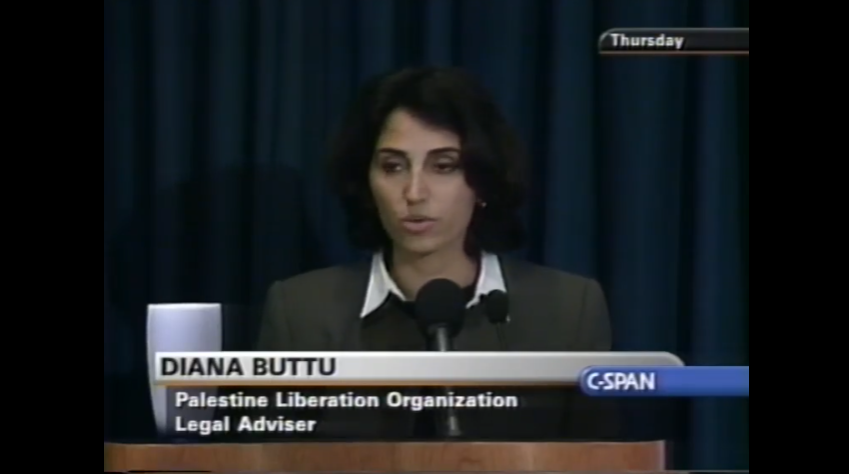
Diana Buttu speaking as a legal adviser for the Palestine Liberation Organization.
False Claim #2: “So back in July of 2024, there was a decision that came out by the International Court of Justice that says that all of these settlements are illegal…. And as a part of that decision, Israel was supposed to pull out all (sic) these settlements as of last week…”
This is also false, in multiple ways. First, it was not a “decision” issued by the ICJ, but rather an “advisory opinion.” The distinction is critical, since while the former can legally bind contentious parties if they accept jurisdiction (which is not the case here), the latter has no legally binding effect (see the ICJ). Advisory opinions do not create law and the ICJ’s past advisory opinions have been widely ridiculed for engaging in dubious legal interpretations. States are entirely free to ignore such opinions, as they regularly do (see, e.g., the regular invocation of “self-defense” by states in conflicts with non-state actors, notwithstanding the ICJ’s advisory opinion that claimed there is no right to self-defense against non-state actors).
Second, nowhere did the July 2024 advisory opinion state that Israel was “supposed to pull out all (sic) these settlements” by any specific date. Even if it did, such a demand would still be legally meaningless.
False Claim #3: “Hamas has said that they are willing to accept those conditions.” (In response to Martin’s statement: “But the 21-point plan, as far as we understand it, has conditions like amnesty for Hamas fighters who give up arms, no future strikes on Qatar and that no one will be forced to leave Gaza.”)
Hamas has never said it was willing to “give up arms” under these conditions. Just a few weeks ago, Hamas’s Bassem Naim reiterated the terror organization’s refusal to give up arms, calling them a “right” that “cannot be relinquished.” Hamas’s Ghazi Hamad echoed this sentiment even more recently.
Instead of “rigorously challenging” Buttu’s claims, NPR allowed its audience to be misled on critical issues. This is even more disturbing given that the interview featured Buttu calling for the ethnic cleansing of the West Bank: “So what the world should be doing now is imposing sanctions on Israel and making sure that, rather than these settlers moving in, that they move them out.” Instead of pushing back, Martin took the opportunity to advance the “genocide” libel against Israel, citing “leading human rights groups” and an “independent U.N. commission,” while ignoring the many compelling critiques of these dubious allegations.
Statements of ethics, such as NPR’s, matter most when it comes to the big stories. Unfortunately, it appears NPR and Martin think little of their own ethical commitments.