
NPR’s Aug. 22 “Morning Edition” broadcast, “Famine confirmed in northern Gaza, says U.N.-backed panel,” and the associated article with the same name, are a confirmed mess of chaotic misreporting.
The United Nations’-backed Integrated Food Security Phase Classification (IPC) Aug. 22 reports (the full publication and this shorter “Special Snapshot”), which stand at the center of the NPR broadcast and article, have come under widespread criticism from Israel (see the Ministry of Foreign Affairs and Coordination of Government Activities in the Territories) and independent analysts for significant problems in methodology and selective use of data.
But NPR fails to provide any insight about the IPC publications’ massive shortcomings. And further stacking the deck against NPR’s core principles “of honesty, integrity, independence, accuracy, contextual truth, transparency, respect and fairness for the people we serve and the people we cover,” NPR journalists eagerly burnish the IPC authors’ credentials while ignoring what should be disqualifying biographical information. “Morning Edition” refers to the “experts” no less than three times.
“A U.N.-backed panel of experts on starvation has declared,” opens host Leila Fadel. “So this expert panel is saying for the first time,” she repeats herself shortly later. And, in case, we missed it, her colleague Jackie Northam repeats: “the IPC, is an international panel of independent experts on food scarcity.” She adds: “they’ve been watching the worsening crisis in Gaza for many months now and had previously warned of famine conditions there.” The parallel article refers to the “experts” four times.
Among the so-called “experts” is report author Alex de Waal who heads an organization which has been “a leader of the ‘starvation as a weapon’ narrative against Israel” since the beginning of the war. As CAMERA UK’s Hadar Sela has noted, de Waal has “used a Qatari funded media platform to accuse Israel of ‘precisely engineered starvation,’ ‘genocidal starvation’ and ‘concealment of famine’ a month prior to the appearance of this IPC report and even before the publication of the IPC’s July 29 ‘alert.’“
His colleague, Andrew Seal, alleged a “genocide” in Gaza as early as Oct. 28, 2023, when the ground war was hardly underway. His credentials also entail responding to a video of Hamas leader Ghazi Hamad calling for the Oct. 7 massacre to be carried out “again and again” with indifference that Hamas should not be deposed because Israel also does bad things.
Meet Andrew Seal, one of the experts behind the IPC’s new “Gaza famine” report.
A Senior Lecturer at University College London, Andrew is a fanatical anti-Israel activist who was already crying “genocide” as early as October 28, 2023.
But that’s not all pic.twitter.com/QS1t2QcRuw
— Eitan Fischberger (@EFischberger) August 23, 2025
Contrary to the news outlet’s mission to “create a more informed public, one challenged and invigorated by a deeper understanding and appreciation of events, ideas, and culture within the United States and across the globe,” NPR also abysmally misinforms the public on the IPC reports’ contents. Thus, host Leila Fadel opens the broadcast: “A U.N.-backed panel of experts has declared that northern Gaza is in a full-blown famine, with half a million people facing, quote ‘catastrophic conditions.'”
Similarly, the related article, by Ruth Sherlock and Jackie Northam, alleges: “In a report published Friday, the United Nations-backed group of experts finds that over half a million people parts [sic] of northern Gaza are at risk of dying from starvation.”
But the IPC documents say no such thing. The reports divide the coastal territory into five sectors. About the northern sector, the report declined to make an official determination, stating:
Conditions in North Gaza Governorate are estimated to be as severe—or worse—than in Gaza Governorate. However, limited data prevents IPC classification of this area, highlighting the urgent need for access and comprehensive assessments
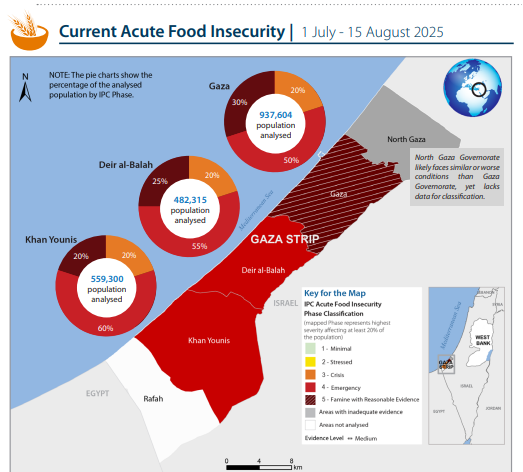 Similarly, IPC’s map of the sectors in its snapshots report indicates: “North Gaza Governorate likely faces similar or worse conditions than Gaza Governorate, yet lacks data for classification.”
Thus, while the IPC did classify (again, according to its flawed methodology) the (more southern) Gaza Governorate as suffering from famine, the international monitor acknowledges that it lacks sufficient data to make a determination about North Gaza. Thus, NPR’s assertion that IPC “has declared that northern Gaza is in a full-blown famine” is unfounded. It did not.
And what of NPR’s claim that “half a million people [in] parts of northern Gaza [are] at risk of dying from starvation”? According to the U.N.’s own data, there are not a half million people in all of north Gaza. Of the total 2.1 million Gaza Strip inhabitants cited in June, nearly 1.98 million are located in the three sectors with the largest population concentrations: Gaza, Deir al-Balah, and Khan Younis, according to IPC’s map (reproduced above.)
Moreover, IPC did not warn of half a million people “at risk of dying from starvation” in parts of northern Gaza, or even in all of the Gaza Strip. It warned: “After 22 months of relentless conflict, over half a million people in the Gaza Strip are facing catastrophic conditions characterised by starvation, destitution and death.” (Emphasis added.) Thus, the half a million figure refers to a population spread across the Gaza Strip, and not simply in a much smaller area within north Gaza. Moreover, the figure refers to the number of people “facing catastrophic conditions” marked by starvation, destitution and death, and not as, NPR claims, the number of people at risk of starving to death. All of these horrific conditions are indeed catastrophic. But by conflating them all with death by starvation, NPR presents an exaggerated and false picture of the threat of the food security problem, even in relation to IPC’s own deeply flawed conclusions.
And, in a reprise of the fabrication by U.N. humanitarian chief Tom Fletcher that there “are 14,000 babies that will die in the next 48 hours unless we can reach them,” NPR’s Northam reported on “Morning Edition” that the new IPC report “said that at least a hundred and thirty-two thousand children under the age of 5 are at risk of death from acute malnutrition in the coming year.”
Here’s what IPC’s snapshot actually said, at the top of its release: “An estimated 132,000 cases of children aged 6 to 59 months are projected to suffer from acute malnutrition through June 2026, including 41,000 severe cases.”
In the overview, the snapshot report expands and misleads: “Malnutrition threatens the lives of 132,000 children under five through June 2026, including 41,000 severe cases, doubling May’s numbers.”
But further down, a careful reading of the report’s more detailed explanation reveals that neither 132,000, nor even 41,000 children, are at risk of dying from starvation:
Through June 2026, at least 132,000 children under five are expected to suffer from acute malnutrition—double the IPC estimates from May 2025. This includes over 41,000 severe cases of children at heightened risk of death. [Emphasis added.]
As previously noted by CAMERA’s Gilead Ini, “Severe acute malnutrition, though certainly serious, is not the same as death.” According to the World Health Organization, approximately two percent of children suffering from severe acute malnutrition will die from it:
In children who are 6–59 months of age, severe acute malnutrition is defined by a very low weight-for-height/weight-for-length, or clinical signs of bilateral pitting oedema, or a very low mid-upper arm circumference. Severe acute malnutrition affects an estimated 19 million children under 5 years of age worldwide and is estimated to account for approximately 400,000 child deaths each year.
Early identification of severe acute malnutrition is important for initiating treatment and minimizing the risk of complications. This can be done in both community and health-care settings using appropriate indicators.
Nevertheless, according to IPC’s worst-case scenario which completely disregards the full data on indicators and ignores updated increased amounts of incoming food, the warning regarding death from acute malnutrition applies to 2 percent of the 41,000, or 820 children — and not 132,000 children, as NPR reported.
NPR’s inability — or unwillingness — to faithfully convey U.N. data isn’t limited to the Aug. 22 IPC publications. Thus, Michel Martin introduces the “Morning Edition” broadcast, stating:
Israel blames the food crisis on Hamas, which it accuses of hijacking aid. No evidence has been presented publicly to show that. Aid groups have also told NPR they haven’t seen that systematic theft.
NPR ignores that the U.N. itself has acknowledged that close to 90 percent of its aid is looted by either “armed actors” or “hungry people.”
Much like the U.N., which fails in its mission to deliver much needed humanitarian aid, NPR fails to fulfill its essential public service and deliver “news, information and other content that meet the highest standards of public service in journalism and cultural expression.”
See also “Where Is the Food Going? Understanding the Gaza Food Security Situation“