
What do you call someone who denies evidence of rape, equivocates about massacres, and repeatedly, unabashedly, compulsively lies — all in the service of an antisemitic terrorist organization?
In the pages of the New York Times, such a person is called an “optimist.”
 And a valiant one, at that. “Her Optimism Has Won Her Some of the Most Powerful Enemies in the World,” reads the glowing headline to a gushing column about Francesca Albanese, a controversial UN-appointed official. Albanese, the atrocity denier in question, has also claimed that “the Jewish lobby” subjugates America, championed promoters of nakedly anti-Jewish slurs as authorities on antisemitism, mischaracterized murdered Israeli civilians as soldiers, concealed the murder of dozens of Israeli civilians, delighted in anti-Jewish quotes by white supremacists, and spread a Holocaust denier’s conspiracy theory that Israel was behind the Charlie Hebdo attack.
That’s the shining star of the Oct. 16 essay by veteran New York Times columnist M. Gessen. The possibility that this optimist may have rightly earned opprobrium isn’t a consideration. This is a hagiography, after all. (Gessen does briefly mention Albanese’s slur about Jewish control of the U.S., before immediately coming to her defense: “She has since apologized repeatedly and said — including to me, more than once — that when she wrote the letters, she wasn’t aware that she was using antisemitic tropes.” In fact, Albanese denied her trope was antisemitic. While distancing herself from the comments after being exposed by the Times of Israel, she insisted the words were “wrongly mischaracterized as antisemitic” and attacked those who took offense. And when one of her colleagues later echoed her bigoted trope, charging that the “Jewish lobby” controls the media, Albanese insisted it is “preposterous” to call the trope antisemitic and took aim instead at those who condemned the remarks.)
With Gessen’s total exclusion of inconvenient truths, the paper’s portrait of Albanese appears as a film negative — dark tones all replaced by light.
And, as with a negative, the converse is also true. Readers are led to believe that Albanese’s detractors — the headline’s “Most Powerful Enemies in the World” — are limited to the Trump administration. It is red meat and a red flag for Times readers. In reality, though, Albanese’s critics come from both sides of the aisle and across national borders. Joe Biden’s UN ambassador declared that she is “unfit for her role.” Biden’s Special Envoy to Monitor and Combat Antisemitism Deborah Lipstadt slammed Albanese’s “blatant antisemitic rhetoric.” Lipstadt also shared that the UN secretary general called Albanese a “horrible person.” Biden’s ambassador to the Human Rights Council had choice words. They are joined by Members of Congress, Democratic and Republican alike; top officials of the Canadian Liberal Party; liberal and conservative parliamentarians in Germany; an assortment of French parliamentarians, attorneys, and officials; Labour Party parliamentarians in the UK; mainstream American Jewish organizations; and others.
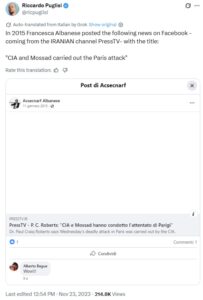
A social media account belonging to Francesca Albanese promotes Charlie Hebdo conspiracy theories.
True optimists among us might wonder how this could be. How could a UN-appointed official be so extreme and unfit?
There are structural answers to the first question. The United Nations hasn’t only elected extremists as rapporteurs. It has also elected Iran, at the bottom of the barrel when it comes to women’s rights, to the UN’s Commission on the Status of Women. The UN Human Rights Council, tasked with “the promotion and protection of human rights,” routinely includes many of the worst human rights violators in the world, to the point that multiple UN Secretaries-General have criticized the HRC and its predecessor organization, the Commission on Human Rights, for their bias, and in particular their anti-Israel bias.
Perhaps more telling, though, is the precedent. Albanese follows in the footsteps of her predecessors in the role, including Michael Lynk, who in his role endorsed as a “human rights defender” an extremist who has denied Jewish history, insisted Jews drink human blood on Yom Kippur, called for the expulsion and murder of every last Zionist, and shared antisemitic caricatures from Nazi websites.
And he is hardly the worst. Richard Falk, another of Albanese and Lynk’s predecessors, has spread 9/11 conspiracy theories and wrote the promotional cover blurb for a book on Judaism written by a Holocaust denier who calls Jews Christ-killers.
This is the pedigree concealed by Gessen, who approvingly describes Albanese as “by far the most publicly outspoken of the special rapporteurs.”
So how could a UN-appointed official be so extreme? It is part of the unofficial job description.
Which raises a second question: Why is the New York Times covering up extremism, and (not for the first time) beatifying a bigot? One can point to complex dynamics in the state of the media or the state of the Times.
But a simpler analogy might also be helpful: The UN promises “impartiality and objectivity” on the part of rapporteurs while delivering the opposite. The New York Times promises “fairness and integrity” in the pursuit of journalism “without fear or favor.” It is an open secret that both often deliver the opposite, particularly when it comes to pet causes like the Arab-Israeli conflict. In other words, the New York Times increasingly acts as the Francesca Albanese of newspapers: Predictable, partisan, and poisonous.
For the Arabic version of this article, please see CAMERA Arabic.