
March 23 UPDATE:
New York Times Corrects
CAMERA has prompted correction of The New York Times' erroneous claim that Israel's nuclear program is housed in the Israeli city of Dimona. See below for a detailed update.
"The coverage of wars and other conflicts presents difficult challenges if we are to respect our principles of providing accurate, fair and balanced coverage," Agence France Presse Editorial Standards and Practices rightly cautions about the fog of war. "Conflicts inevitably produce a flood of claims and counter-claims and we must do our best to present an accurate and truthful picture of events."
Sometimes, though, the facts are crystal clear despite competing war claims. In some cases, all it takes to learn the facts is looking at a map.
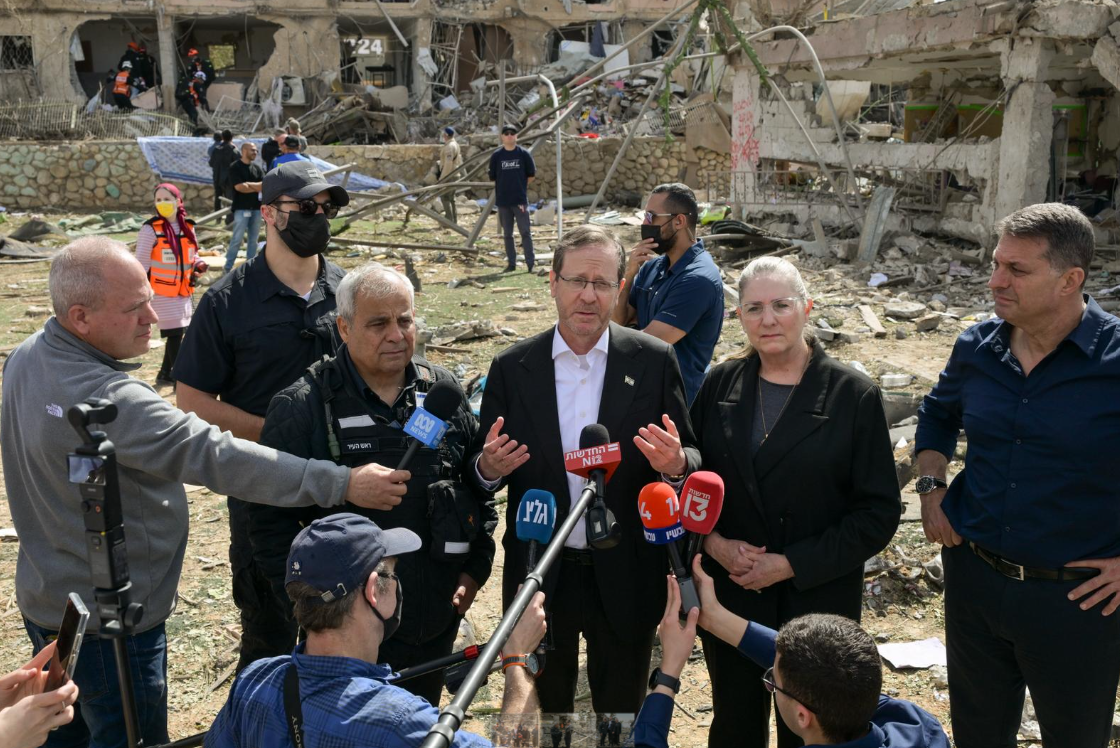
President Herzog at the site of the impact of an Iranian missile in a residential neighborhood in the southern Israeli town of Dimona, March 22 (Photo by Ma'ayan Toaf/GPO)
In covering the Islamic Republic's mass casualty attack on the Israeli city of Dimona yesterday, AFP reporters were among the journalists from multiple leading Western news outlets who failed to take even that critical baby step.
Thus, in a core falsehood parroting Islamic Republic's state-run Mehr News Agency propaganda meant to justify the attack, several major Western media outlets falsely relocated the Negev Nuclear Research Facility to Dimona.
Israel's military said an Iranian missile on Saturday struck the southern town of Dimona, home to a nuclear facility, after medics reported treating some 30 wounded people.
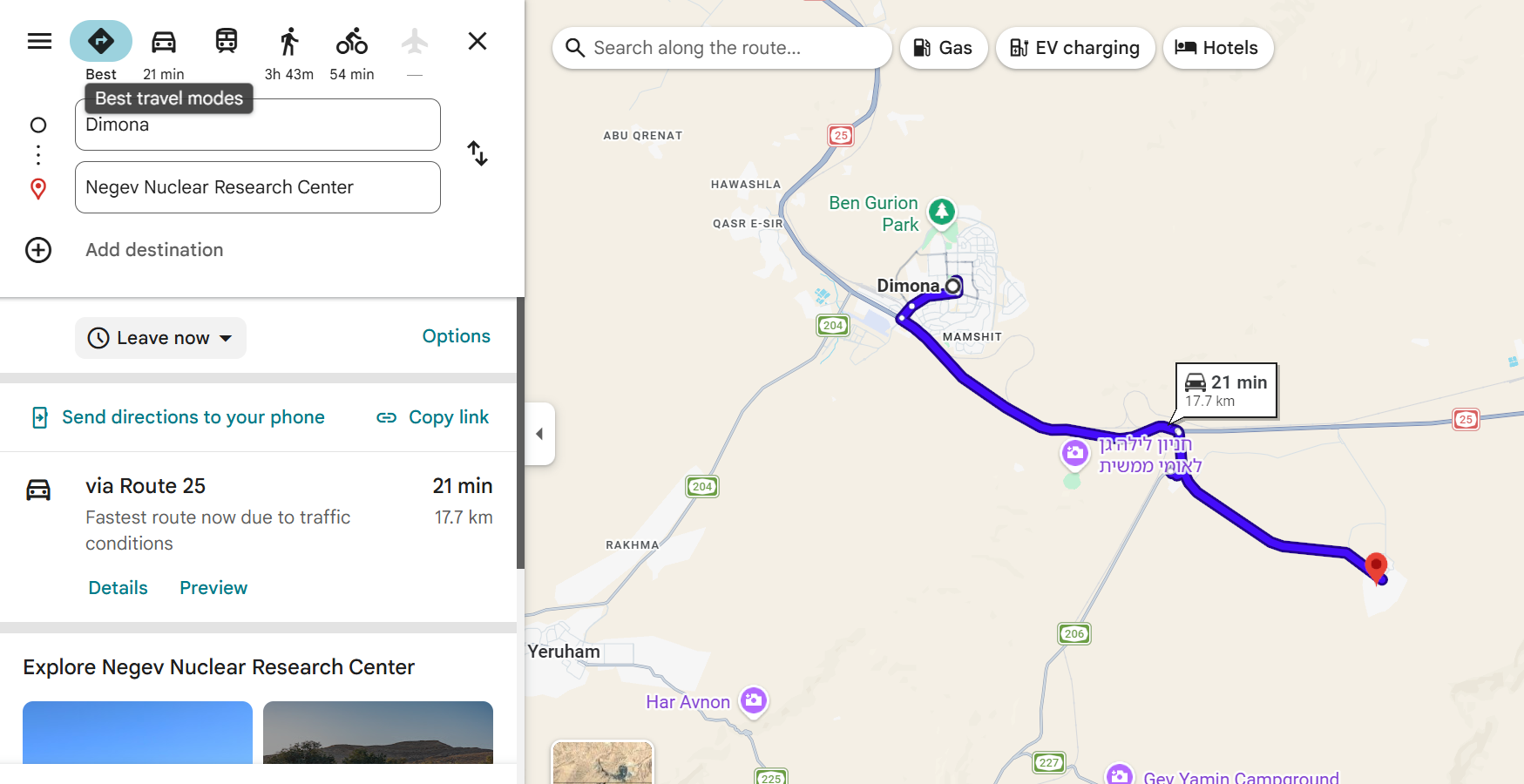
The Israeli town of Dimona is some 15 kilometers northwest from Israel's nuclear facility (Image from Google Maps)
Iranian missiles struck two communities in southern Israel late Saturday, leaving buildings shattered and dozens injured in dual attacks not far from Israel’s main nuclear research center, while President Donald Trump warned the U.S. will “obliterate” Iranian power plants if it doesn’t fully open the Strait of Hormuz within 48 hours. . . .
Dimona is about 20 kilometers (12 miles) west of the nuclear research center and Arad around 35 kilometers (22 miles) north. [Emphasis added.]
Reuters similarly made clear: "Israel’s secretive nuclear reactor is about 13 kilometers southeast of Dimona."
The third paragraph (which fewer readers see) of the aforementioned AFP story, one of several in the last day which misidentified the location of the nuclear facility, backtracks on the false claim and seems to contradict its own headline and lede that Dimona houses the facility: "Dimona hosts a facility just outside the main town, widely believed to possess the Middle East's sole nuclear arsenal, although Israel has never admitted possessing nuclear weapons." [Emphasis added.]
If the nuclear facility is outside the town, how exactly does the town "host" it, and in what way is the town "home" to the facility? Moreover, as explained above, the nuclear facility is not "just outside the town" — it's some 15 kilometers away.
Notably, the Guardian, which published AFP's article, amended the text and appended a correction to the bottom of the article. It states:
This article’s headline and introduction were amended on 22 March 2026 to make clear that the town of Dimona is near to the nuclear facility, not “home” to it as an earlier version said.
The Guardian's amended headline is: "Iran hits Israeli town near nuclear facility in retaliation for Natanz strike." The revised first sentence likewise removes AFP's false reference to Dimona as "home" to the nuclear site, stating:
An Iranian missile has hit the Israeli town of Dimona, near the site of a nuclear facility, in what Iran said was retaliation for strikes on its own nuclear site at Natanz.
CNN, another leading news outlet with all of the fancy investigative tools like Google Maps at its disposal, likewise failed to accurately navigate coverage of the attack. Thus, CNN's Jessica Dean erred on the Mar. 21 5 p.m. CNN Newsroom broadcast: "That attack hitting the city of Dimona that is home to Israel's nuclear program."
The New York Times, for its part, tried to have its (yellow) cake and eat it too.
In her March 21 report, Ashley Ahn erred with this bizarre and self-contradictory formulation ("Here's What Happened in the War in the Middle East on Saturday"):
Israel’s nuclear weapons program is widely believed to be headquartered in Dimona, which is near the country’s main nuclear research facility, making the area a prime target for strikes." [Emphasis added.]
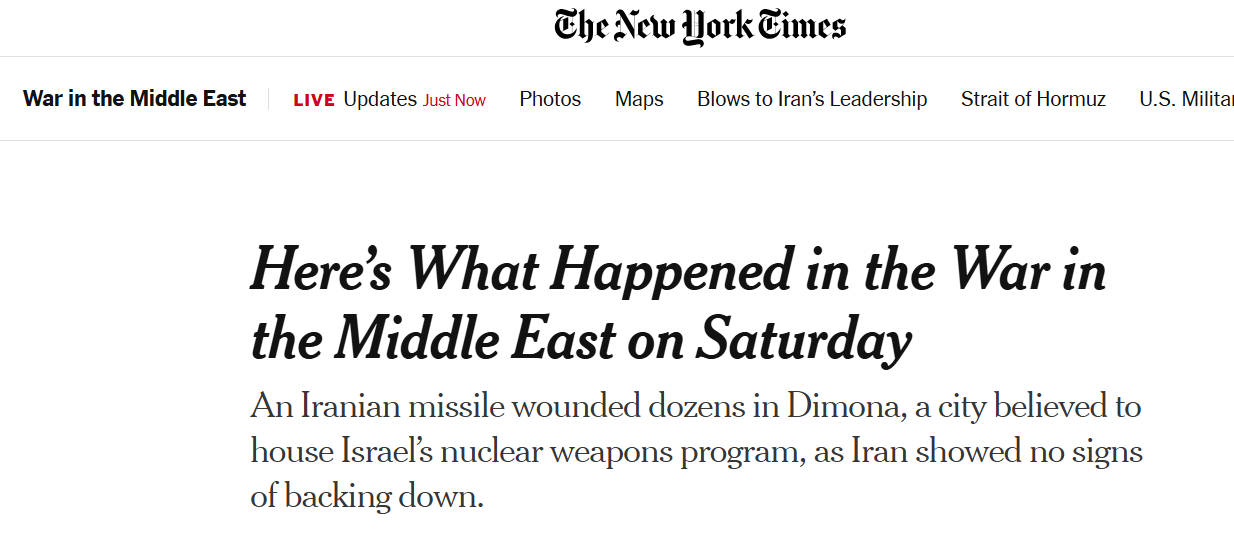 The nuclear facility is outside, but near, Dimona, as the second half of the confused sentence rightly indicates. As the facility is outside Dimona, how then can the nuclear site simultaneously "be headquartered in Dimona?" The accompanying subheadline for this article falsely reported: "An Iranian missile wounded dozens in Dimona, a city believed to house Israel’s nuclear weapons program, as Iran showed no signs of backing down." (Screenshot at left.)
The Times' Aaron Boxerman and Baskar correctly reported the distance between the city of Dimona and the nuclear facility elsewhere yesterday, stating: "Iranian missiles evaded Israel’s air defenses and hit Dimona, a city eight miles away from Israel’s nuclear facility . . . " ("Iran War Live Updates: Trump Threatens to Hit Power Plants Unless Strait Is Reopened, as Tehran Remains Defiant").
CAMERA has contacted AFP, CNN and New York Times to seek corrections. Will the media outlets set the record straight in accord with the actual geography, or will they continue to remain defiant of both geography and evade journalistic responsibility? Stay tuned for any updates about corrections.
For the Hebrew version of this post, see CAMERA Hebrew.
March 23 Update: New York Times Corrects
In response to communication from CAMERA, The New York Times has corrected a subheadline and article which misplaced Israel's nuclear program in the southern town of Dimona. Originally referring to Dimona as "a city believed to house Israel’s nuclear weapons program," the subheadline now cites "a city near Israel’s main nuclear research facility." In addition, the convoluted and contradictory wording in the body of the news item now accurately reports: Israel’s main nuclear research facility is widely believed to be near Dimona … " Moreover, a correction commendably appended to the bottom of the article makes clear:
A correction was made on March 23, 2026: An earlier version of this article misstated the location of Israel’s main nuclear research facility. It is near Dimona, not in Dimona.
CAMERA commends The Times' forthright correction.