

Screenshot of Reuters’ original text regarding the Oslo Accords.
CAMERA prompted Reuters to correct a revisionist claim on the Oslo Accords in both English and Arabic on Nov. 26, 2026.
Its Nov. 17, 2026, article, “Israeli settlers kill Palestinian woman, 72, in West Bank,” had described the Jordan Valley as “part of land envisaged in the Oslo peace accords as becoming the fertile heartland of an independent Palestinian state.”
The article now describes the Jordan Valley as “part of land Palestinians have long considered part of their state.” A clarification at the top states: “The Oslo Accords did not include provisions regarding the establishment of a Palestinian state.”
CNN’s Nov. 18 report on the same event repeated the same inaccurate narrative, adding that the Oslo Accords “were designed to pave the way” for a two-state solution. CNN declined to correct its article.
This framing of the Oslo Accords is relatively new, proliferating in news reports just in the last decade. Coverage published closer to the signing of the accords more accurately reflects their content. The text of the Oslo Accords does not contain any mention of a two-state solution nor a Palestinian state. Neither of the parties to the agreement even endorsed a two-state solution at the time.
The 1993 Declaration of Principles established a Palestinian Interim Self-Government Authority for a transitional period of no more than five years, “leading to a permanent settlement based on Security Council Resolutions 242 and 338.” It left final-status questions – including Jerusalem, refugees, settlements, security and borders – to later negotiations, without prejudging their outcome.
The State Department’s Office of the Historian describes the outcome of the interim agreement as Israel accepting the Palestine Liberation Organization (PLO) as the Palestinians’ representative, with the PLO renouncing terrorism and recognizing Israel’s right to exist in peace.
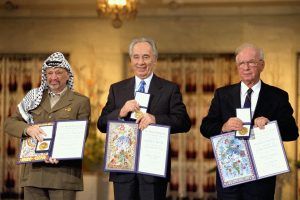
Nobel Peace Prize Laureates for 1994 in Oslo, Norway (R to L): Israeli Prime Minister Yitzhak Rabin, Foreign Minister Shimon Peres, and Palestine Liberation Organization Chair Yasser Arafat, Dec. 10, 1994. (credit: Government Press Office (Israel), CC BY-SA 3.0, via Wikimedia Commons)
Prime Minister Yitzhak Rabin revealed his opinion on a Palestinian state while presenting Oslo II to the Knesset on Oct. 5, 1995, stating that Israel sought an “entity which is less than a state.” PLO Chair Yasser Arafat had a different goal entirely.
In a Sept. 2, 1993, interview on French-government-owned Radio Monte Carlo (translated and transcribed by the U.S. Foreign Broadcast Information Service), he said the agreement “will be a basis for an independent Palestinian state in accordance with the Palestine National Council (PNC) resolution issued in 1974.” He added that the resolution called for “a national authority on any part of Palestinian soil from which Israel withdraws or which is liberated.”
Later assessments have also noted that there were no hints in the Oslo Accords of Palestinian statehood or a two-state solution.
Asked what his message would be to Palestinian factions opposed to Oslo, Arafat responded: “We will take the rest of the land gradually at the end of the transitional period,” again citing the 1974 PNC resolution.
A Palestinian state was Arafat’s stated goal. That aspiration does not, by itself, establish that he sought a lasting Palestinian state alongside Israel. His mention of the English phrase “two-state solution” in connection with the 1988 PNC meeting in Algiers must be read alongside his repeated invocation of the 1974 resolution in the same interview.
Article 2 of the resolution called on the PLO to “establish the independent combatant national authority for the people over every part of Palestinian territory that is liberated” – a combatant entity even after that authority exists and still aimed at taking over the rest of the territory.
The resolution rested on the 1968 Palestine National Charter, described Palestine within its British Mandate boundaries as “an indivisible territorial unit.” It also rejected Security Council Resolution 242, which the Oslo Declaration of Principles affirmed.
Even in Reuters’ 1993 and 2007 coverage described the accords as outlining limited Palestinian self-rule. Just in 2013 did it call Oslo an “interim deal intended to lead to an independent Palestinian state in the West Bank and the Gaza Strip within five years.”
Later assessments of the accords have drawn the same conclusions. Former U.S. Ambassador to Israel Martin Indyk wrote in a September 2023 Economist article, that in the Oslo Accords, “there were no provisions for the establishment of a Palestinian state.”
Henry Siegman, president emeritus of the US/Middle East Project and a past senior fellow at the Council on Foreign Relation, expressed a similar sentiment in the New York Times.
So did anti-Zionist professors Rashid Khalidi and Avi Shlaim, who similarly wrote in the New Yorker and in the Guardian respectively that “Palestinian statehood and self-determination are never mentioned in the text” and that the accords “did not promise or even mention an independent Palestinian state at the end of the transition period.”
CAMERA commends Reuters for following in the footsteps of the New York Times, the Financial Times, and MSNBC in correcting this inaccurate historical narrative that turns one possible outcome of these negotiations into their stated purpose.