
In the wake of a shareholder lawsuit alleging anti-Israel bias at The New York Times, the paper sought to understand how it could do better – with those who think the paper is not anti-Israel enough. The Times’ 12-minute video, “A Palestinian American on Our Headlines” (Nov. 19), was an embarrassing exercise in brown-nosing. Rather than vigorously defend journalistic principles, assistant managing editor Patrick Healy offered milquetoast responses to someone who wanted The Times to ignore its stated purpose and practice in service of his activist mission.
In what the outlet sought to present as an opportunity to hear from those who provide feedback and criticism of its journalism – including “a lot of readers” about coverage of Israel, the Palestinians, and the Middle East – The Times interviewed Omar Baddar, who it described simply as a political analyst.
“Analyst” is an egregiously insufficient and inaccurate description of a hardcore activist.
Baddar is a former digital producer and presenter for Al Jazeera, the Qatari-owned, anti-Israel media outlet. While he was deputy director of the Arab American Institute, he wrote an opinion piece for Al Jazeera which included revisionist history surrounding the creation of the State of Israel and support for Palestinians’ continued “resistance” [violence] against Israel.
In fact, he tweeted in support of “dismantling the Zionist project [Israel] entirely” and reflexively denies, in absolute terms, Hamas’ atrocities committed against Israelis. He labeled Hassan Nasrallah (former secretary general of Hezbollah) a hero throughout the Arab world and described Israel and the Israeli military as terrorist organizations worse than Hamas.
Baddar’s support for terror and desire to dismantle the State of Israel should have been enough for The Times to think twice before providing him an unchallenged platform to spout anti-Israel libels. But if that were insufficient, perhaps a basic search of his social media would have informed the paper that elevating Baddar to the role of fair arbiter of journalism was a reckless idea.
Baddar has shown that he favors agenda-setting over proper word choices. In his social media posts, he repeatedly referred to Palestinian prisoners in Israeli jails as “hostages,” a vile tactic to try and create moral equivalency between Palestinian terrorists imprisoned in Israel with hostages who were savagely kidnapped from Israel during Hamas’ Oct. 7, 2023, atrocities in Israel. But maybe that was a point in Baddar’s favor with The Times, as the paper previously described the release of hostages and Palestinian prisoners as an “exchange of hostages.”
ATTN @nytimes:
Innocent people who were abducted from their homes are not the same as murderers and terrorists who were imprisoned for their crimes.
Let’s be clear – Israeli hostages and Palestinian prisoners are fundamentally not the same. This is not a prisoner exchange.
To lump them together is an injustice. To describe the release of terrorists as anything but a necessary evil is abhorrent.
— American Jewish Committee (@AJCGlobal) October 13, 2025
In the interview with Healy, Baddar claimed Israel’s “illegal occupation” and an alleged consensus that the Jewish state was guilty of “apartheid” and “genocide” represented “critical context” The Times was reluctant to include in its coverage.
Healy said nothing. He did not counter that no western government has adopted this apartheid designation. He also did not point out that Israeli Arabs enjoy equal rights in Israel, voting and sitting in Israel’s parliament, the Knesset, and working in all professions that Jewish Israelis do. Healy also did not push back on the fact that many western governments, in addition to Israel, vehemently reject the genocide libel, nor has there has been any legal determination to that effect.
Healy also remained silent when Baddar referred to Israel Defense Forces (IDF) soldiers as “Israeli occupation soldiers.” (Perhaps that’s because the paper also used Hamas’ preferred language back in Dec. 2023, when it referred to the “Israeli occupation forces” instead of the IDF.)
Baddar’s complaint was that the paper did not “frame the correct context” for the headline ‘Palestinian Gunmen Open Fire on Israelis in the West Bank’ because for him, context should be provided when Palestinian terrorists attack Israelis. He argued that without framing the shooting as a response to an “illegal Israeli military presence,” readers might mistakenly view the Palestinian gunmen as the aggressors.
Rather than call out Baddar whitewashing violence or reminding Baddar that under international law (which Baddar loves to invoke when it serves him), force cannot be used to resolve territorial disputes, Healy asked Baddar how he would have written the headline. This is akin to asking a defense attorney to craft the prosecutor’s closing argument.
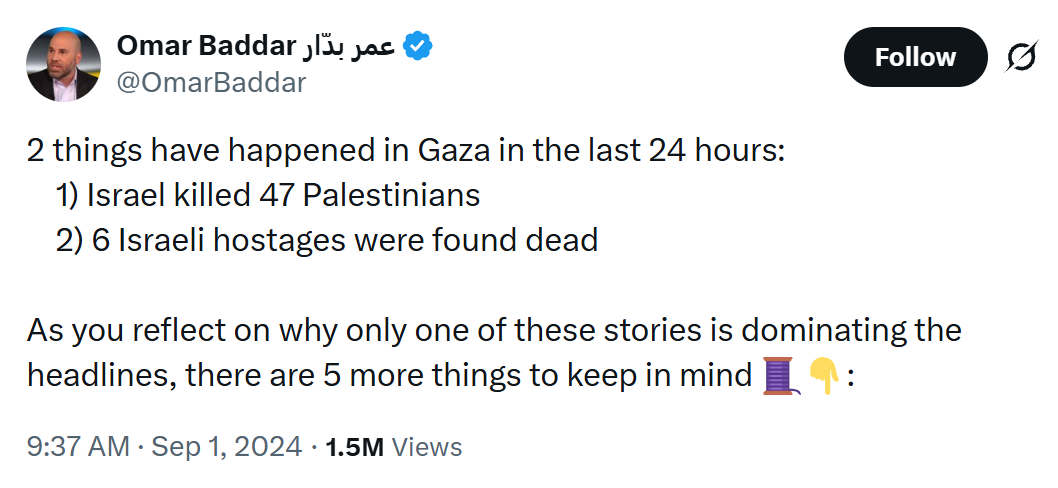
Healy’s mistaken belief that Baddar could be evenhanded in his suggestion of how to craft a headline could have been avoided by looking at his social media. Baddar used the active voice to describe Israel killing Palestinians, but the passive voice when it involved Israelis who, to Baddar, were “found dead,” by which he means they had been brutally murdered, point-blank, by Hamas terrorists.
Baddar also complained that when Hamas attacks Israelis, it always makes headlines, but that there is not the same humanization of Palestinians in Gaza. This is demonstrably untrue. A recent study by Yale University’s Edieal Pinker revealed that of 1,559 Times articles about Israel-Hamas fighting from Oct. 7, 2023, through June 7, 2024, more than 33 percent included personal accounts of Palestinian suffering, while under four percent included personal accounts of Israelis affected by war who were not direct victims of Oct. 7. In addition, of the 244 days he studied, Pinker found that an IDF soldier was killed on 128 days, but The Times reported on Israeli casualties on only 74 days after Oct. 7, 2023, directly contradicting Baddar’s statement.
Healy reassured Baddar that despite challenges of international reporters being barred from Gaza, The Times had relied on a Palestinian reporter on the ground to powerfully cover issues of “hunger, of famine, of death, mass casualties there.”
The irony, of course, is that The Times has bent over backwards to humanize Palestinians – often engaging in fake news as a result. The paper was quick to wrongly blame Israel for a misfired Palestinian Islamic Jihad rocket that hit the Al-Ahli Hospital [parking lot] and even used an image of a distraught Palestinian family on the front page of the paper accompanying the false headline. And in its bid to spread Hamas’ message and convince the world that Gazan children were starving to death, the paper misled millions of viewers by posting a photo of an emaciated child, falsely claiming he had no preexisting medical conditions when that was the opposite of the truth.
One prominent example of The Times’ unique “humanization” of Palestinians was when, in May 2021, The Times posted an interactive piece called “They Were Only Children,” with thumbnail photos and short biographies of 67 Palestinian and two Israeli children killed in the fighting (one Arab-Israeli). [Though The Times had to acknowledge it used a random stock photo for one of the Palestinians and later replaced it with a photo from her family.] As CAMERA wrote at the time, there was no such equivalent Times piece featuring the names, ages and photographs of Iraqi or Afghani children killed during battle with the United States.
Baddar also criticized The Times for normalizing Israeli Prime Minister Benjamin Netanyahu, who Baddar called “a pretty monstrous character” who “enacted a policy of mass murdering Palestinian journalists in Gaza by the hundreds . . .” Rather than push back on this wild, false claim, Healy said that The Times had a range of headlines on Netanyahu, and that the paper had “done pretty powerful accountability journalism on him.”
What was Baddar complaining about, really? The Times even recently invented quotes by Netanyahu – something that certainly would have satisfied Baddar’s desire to see the paper make the Israeli prime minister look as “monstrous” as possible.
Ultimately, this video interview was less self-reflection and more self-abasement to appease Baddar. In doing so, The Times handed a pro-terror activist an unchallenged platform to spew anti-Israel libels and demand even harsher characterizations of the Jewish state.