
“We published Palestinian testimony about the suffering and destruction in Gaza that few other Israeli media outlets were willing to carry,” Haaretz editor-in-chief Aluf Benn boasted in a Sept. 24 marketing letter to readers. “You have made our journalism possible.”
Among the Palestinian writers who wrote for Haaretz readers in both English and Hebrew about hardship in the Gaza Strip is Yousri Alghoul. His published work at the Israeli daily includes an April 2022 short story, a May 2025 an opinion piece headlined “I write so as not to die,” and a September 2025 article about the death surrounding him. Additionally, a September 2024 Haaretz review of “The Book of Last Wills” highlighted his contribution to the anthology: a speculative essay starring a fictional superhero who fights the perpetrators of the destruction.
In all these cases, Haaretz presented him as a writer coping with the reality of life in Gaza. There is no mention, neither in the texts themselves nor in the author’s biography, of his repeated statements about the murder of Jews, of his support for terrorism, or of his blatant antisemitism.
Alghoul, despite a troubling record of extremism, is no stranger to the Western press. Last April, a segment aired on BBC Arabic under the headline “Thought, culture and books – the silent victims of the Gaza war.” The piece, which is approximately nine minutes long, deals with the war’s impact on cultural life in the Gaza Strip and advances allegations regarding the destruction of schools, universities and libraries, and about residents who are reportedly forced to burn books to light a fire.
One of the main interviewees was Alghoul, whom BBC described as an “intellectual and writer.” He spoke about torn books, claimed that Israel Defense Forces deliberately targeted schools and libraries in bombings, and said that he was forced to burn his memoirs because he could not find other fuel, and so that the occupation forces would not find them.
Raed al-Waheidi, the chairman of the Gaza Municipality Public Library, also appeared in the BBC broadcast, claiming that culture in Gaza is “far [removed] from political issues.”
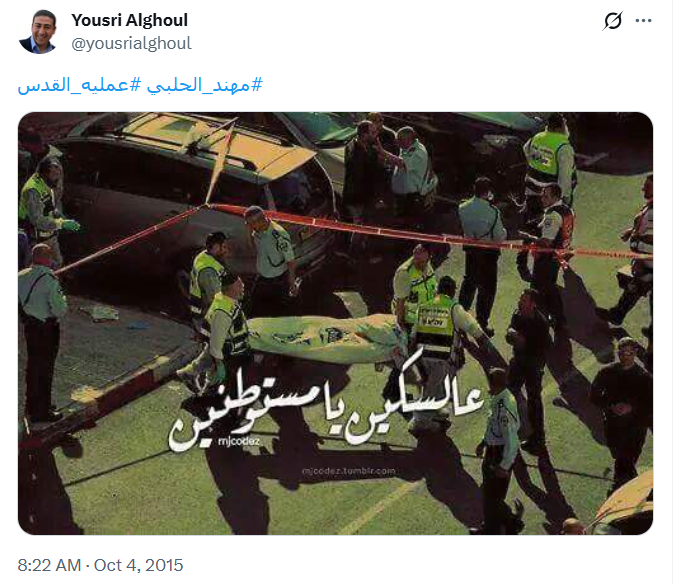
A screenshot of Alghoul’s 2015 tweet following a fatal terror attack in Jerusalem’s Old City: “On the knife, settlers,” posted the writer whose work appears in Haaretz
A study by CAMERA’s Arabic department covered by the Jewish Chronicle revealed that both interviewees had previously published explicit antisemitic statements. Alghoul, for example, tweeted on Oct. 13, 2015 – on a day when several stabbing and ramming attacks were carried out in Israel, in which four civilians were murdered – the following:
O people of the West Bank, kill the Jews. Before you are gas cylinders, gasoline, screwdrivers, cars, buses, tractors, and trucks – terrify them.
On the same day, he also called on the Palestinian security services: “Do not return the settlers to their homes safely, kill them and burn their flesh as they do to our children.” Following the terrorist attacks that day, he responded to Israeli media reports of a “black day” in Israel with the words: “With the help of Allah, may your days always be black.”
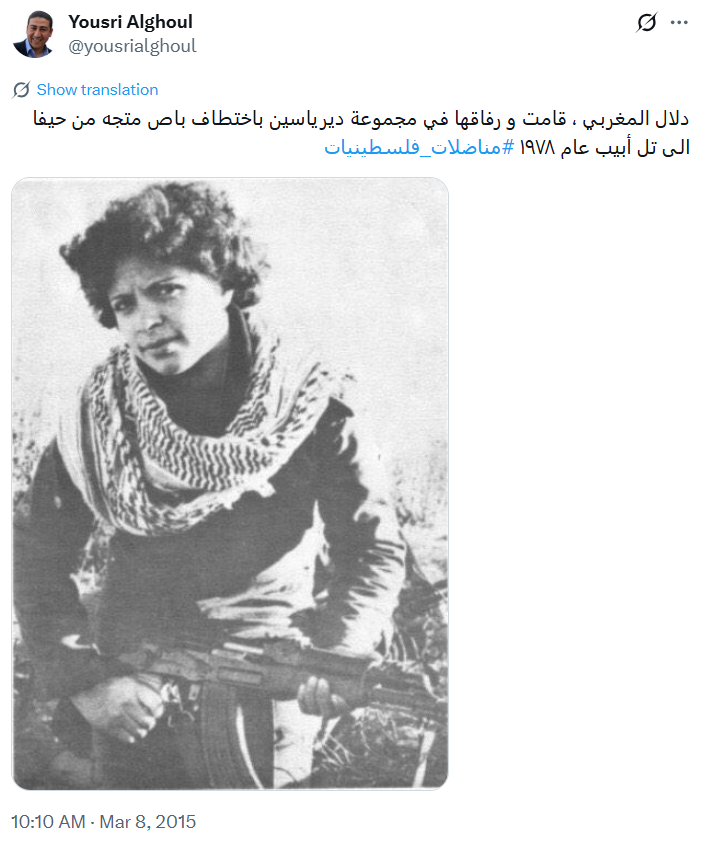
Alghoul’s March 2015 posted stated (CAMERA’s translation): “Dalal Mugrabi, together with members of the Deir Yassin group, hijacked a bus on its way to Tel Aviv in 1978. #Palestinian_Women_Fighters.” Thirty-eight people were murdered in that massacre, including 13 children.
These are not isolated statements. Here are a few more from his online history:
- In October 2015, after a terrorist attack in the Old City of Jerusalem in which two civilians were murdered, he used the operation’s hashtags and added: “On the knife, settlers.”
- In November 2014, after a shooting attack in a Jerusalem synagogue in which five civilians and a police officer were murdered, he wrote: “O people of the West Bank, you too are capable of doing this, even from point-blank range.”
- In January 2015 he wrote: “The Jews have succeeded – since the beginning of history – in sowing division among the nations.”
- In June 2016, after a shooting attack in Tel Aviv in which four civilians were murdered, he wrote: “Condemning the resistance is a disgrace.”
- In August 2014, after Operation Protective Edge, he called Israelis “descendants of pigs” and wrote that “you will never enjoy security from now on.”
- In November 2012, during Operation Pillar of Defense, he wrote: “God, thwart the plans of the Jews and nullify their aggression.”
Over the years he also repeatedly praised terrorists who murdered Israeli civilians as “heroes” and “martyrs,” and supported “armed resistance.”
Al-Waheidi, for his part, wrote in 2021: “God, deal with the Jews! God, turn their plots into their destruction!”
Though CAMERA informed the BBC of this history, editors refused to remove the segment. This stance contradicts statements by senior officials in the organization, who claimed last January that the vetting system for contributors had been significantly improved following similar cases in the past.
One could, of course, argue that these hateful sentiments were ripped from the distant past, or that the person has changed. But these statements did not erase themselves. They were available online for years, and the accounts were only deleted recently, after CAMERA Arabic exposed them. Before presenting the translated works of a writer as authentic testimony about the situation in the Gaza Strip, the media outlet should check what that same writer said about Jews elsewhere.
The case of Alghoul is not unusual for BBC Arabic, which has previously provided a platform to people with a similar history. But it does raise a simple question regarding Haaretz: Do Israeli readers deserve to know who the Jew-hating, pro-terror history of an author whose translated words appear in the newspaper, or is presenting him as a “Gazan writer” sufficient?
“Over the past year, Haaretz has sought to fulfil its journalistic mission to challenge power and expose the misdeeds of the powerful,” Haaretz editor Benn maintained in his letter to readers.
“This is our journalism at Haaretz,” Benn wrote. “Journalism that tells readers what other media outlets soften, ignore or suppress.” To the contrary, Haaretz journalism entails extending unearned legitimacy to an antisemitic supporter of terror.
CAMERA Hebrew presented Haaretz editors with Alghoul’s troubling statements, requesting that they consider his background before choosing again to translate and publish his musings. As always, we will continue to monitor.
For the Hebrew version of this post, please see CAMERA Hebrew.