
Far-right Israeli National Security Minister Itamar Ben-Gvir does not need anyone to make his statements more extreme. His political record and his own words provide more than enough material for those who wish to challenge them. But criticizing what a politician says is one thing; inventing his words is quite another.
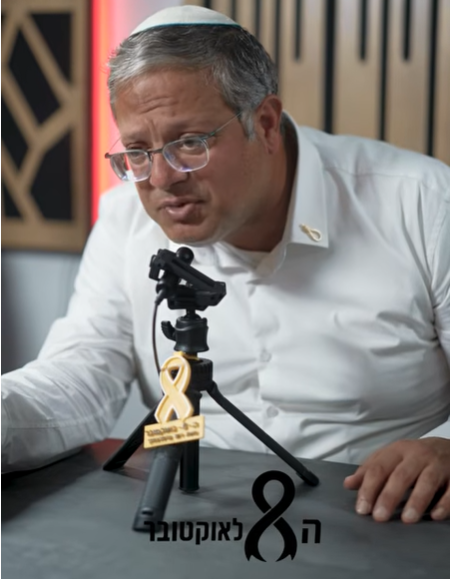 That is precisely what numerous Spanish-language media outlets did with statements by Ben-Gvir on the inaugural episode of “October 8,” the podcast hosted by Rom Braslavski, a survivor of two years of captivity at the hands of Palestinian Islamic Jihad.
During the conversation, Ben-Gvir addressed numerous controversial ideas which are in no way consensus within Israel. Among other things, he advocated the occupation of Gaza, the establishment of Israeli settlements in the Strip, and encouraging its residents to emigrate. He also discussed the policy of sikulim memukadim, a Hebrew expression referring to targeted operations or targeted killings against members of terrorist organizations, ant-terror activity which in post-Oct. 7 Israel has much broader support than the more fringe aforementioned ideas.
Most media outlets highlighted a segment of the program in which Ben-Gvir said:
It’s no secret that I disagree with the prime minister. I think sikulim memukadim should be carried out in Gaza… Every night, eliminate 30 or 40. Not only those who pose a danger to you at that precise moment. There are people there who are not worthy of living. They shouldn’t live. They aren’t even people.
But the conversation did not end there. Toward the end of the podcast, Ben-Gvir returned to the subject and this time specified unequivocally: “I repeat: every night, 30, 40, 50 terrorists in Gaza should be killed.”
The Hebrew word he uses is mechablim (מחבלים): terrorists.
That crucial word disappeared entirely in much of the international coverage, including the Associated Press, which grossly misled: “Israel’s Ben-Gvir advocates killing ’30 to 40′ people in Gaza nightly while speaking to ex-hostage.” Harper’s Magazine described Ben-Gvir as “advocating that the country kill 30 to 40 people nightly in the region.”
Spanish-language media exceeded Harper’s and AP’s omissions and decontextualization, resorting to invention.
Numerous outlets placed the word “people” in journalism’s sacred quotation marks, though Ben-Gvir clearly referred to terrorists. In doing so, these reports turned a call to kill terrorists into a call to kill people in general. By assuming the role of “completing” the sentence with terms the source did not use in that passage, the media engaged in invention as opposed to factual reporting.
For example, El País published a video that added the term “people” to the translation.
Mal subtitulado @el_pais
Minuto 0:22. No dice “personas”. Viene de hablar de eliminaciones selectivas (contra terroristas se entiende) y despues dice ” matar 30, 40″. Punto.
Nadie habla hebreo por ahí que os lo pueda confirmar?
No creeis que deberíais corregir?
O ya da igual? https://t.co/XGksA1SvYT— Masha Gabriel 🇦🇷 🇫🇷 🇪🇸 (@MashaGabriel) August 19, 2026
It is worth noting that in the body of the article, the Jerusalem correspondent did not mention that Ben -Gvir explicitly identifies those targets as terrorists when he repeats his proposal toward the end of the podcast.
EFE, the most influential news agency in the Spanish-speaking world, likewise placed “people” in quotation marks in its headline: “Israeli minister Ben-Gvir calls for killing ‘between 30 and 40 people every night’ in Gaza.”
EFE’s report also failed to clarify that Ben-Gvir was referring to terrorists and inserted “people” into what it presented as a direct quotation of his remarks: “I think targeted killings should be carried out in Gaza, eliminating between 30 and 40 people every night.”
(EFE also incorrectly attributed Rom Braslavski’s captivity to Hamas, when he was in fact held by Palestinian Islamic Jihad.)
Germany’s publicly funded Deutsche Welle Español similarly inserted the term “people” into its transcription of the video and added it in quotation marks to its headline: “Israeli minister calls for killing ’40 people’ a day in Gaza.”
Ministro israelí llama a matar entre 30 y 40 palestinos por noche en Gaza
Itamar Ben Gvir, el ministro de Seguridad Nacional israelí, pidió en un pódcast matar a entre 30 y 40 palestinos cada noche en Gaza.
Declaraciones similares del ministro israelí han sido condenadas e… pic.twitter.com/rUHlRnVXm5
— DW Español (@dw_espanol) August 17, 2026
Meanwhile, The Objective, an independent digital news outlet in Spain, supplied its own purported clarification in parentheses: “I think targeted killings should be carried out in Gaza and between 30 and 40 (Gazans) should be taken out every night. Not only those who represent an immediate threat.” (Emphasis added.)
This outlet deserves special mention because its original headline —”Israel’s Security Miniter Recommends the Indiscriminate Killing of Palestinians: Ben Gvir proposes a quota of ‘between 30 and 40 targeted killings’ every night in the Gaza Strip” —amounted to an absurd oxymoron in which it claimed Ben-Gvir called for indiscriminate attacks, and one sentence later it stated the minister was calling for targeted attacks. If the attacks are targeted, they obviously cannot be indiscriminate.
Following pushback from CAMERA Español and others, The Objective, replaced the headline with new wording which likewise failed to clarify the intended targets of the proposed killings: “Israel’s security minister recommends killing Palestinians.”
La Razón, a Madrid daily, followed the same formulation: “Israeli minister Ben Gvir calls for killing ‘between 30 and 40 people every night’ in Gaza.”
Clarín, Argentina’s largest daily, likewise stuck to the pattern: “War in the Middle East: Israeli minister Ben Gvir calls for killing “between 30 and 40 people every night” in Gaza.”
Thus, like in a game of Mad Libs, Spanish-language media completed the phrase “Every night, eliminate 30 or 40” as they pleased, ignoring that the concept of “terrorists” runs throughout the interview, including Ben-Gvir’s explicit reference. Thus, a call to systematically kill dozens of terrorists becomes a proposal to systematically kill “people,” “Palestinians,” or “Gazans.”
Others went even further. A presenter on Argentina’s Infobae en Vivo, for example, took the argument to its extreme, using the inaccurate quotation as the basis for comparing Jews to Nazis. The presenter stated:
It is truly appalling because it reflects the same level of dehumanization that the Nazis used to commit crimes against the Jews more than 80 years ago. That is why it is a tragic twist of fate that now a Jewish Israeli minister is using the same argument of dehumanizing Palestinians in order to kill them in this way, saying, “They aren’t even people.”
Within hours, television and radio broadcasts and headlines across different countries presented Ben-Gvir as calling for the daily killing of “people,” “Gazans,” or “Palestinians,” once again demonstrating the speed with which an inaccurate formulation can become accepted media consensus.
But “Palestinians,” “Gazans,” “people,” and “terrorists” are not synonyms, nor are they interchangeable terms.
This factual point is not tantamount to a defense of Ben-Gvir or an endorsement of what he said. Correcting this kind of reporting error does not amount to defending a public figure or whitewashing his radical positions. Journalism does not lose its ability to condemn or scrutinize by maintaining textual accuracy; on the contrary, its strength lies precisely in accuracy.
The original podcast is in Hebrew. Verifying what was actually said requires more work than simply reproducing an already published news report, which is precisely why news organizations employ correspondents, agencies, and editorial staffs.
When journalists repeat a false claim this systematically, perhaps media organizations should reconsider the purpose of maintaining so many foreign correspondents unwilling to make even the minimal effort required to verify information.
For the Spanish version of this article, please see CAMERA Español. For the Hebrew version, please see CAMERA Hebrew.