
NBC’s veteran international correspondent Keir Simmons should, at this point in his career, possess the tact and journalistic know-how to provide contextual, responsible reporting to viewers. This is especially true when reporting on an issue driving public discourse in the United States, such as the Islamic Republic of Iran — a regime that is openly hostile to Western values, including freedom of speech and a free press.
Disappointingly, Simmons’ July 15 report on NBC News Now failed in this regard. Instead, he left viewers with a skewed image of events in the Persian Gulf and Strait of Hormuz, uncritically amplifying the narrative of Iranian extremists.
Simmons spoke to NBC News Now on July 15, outlining overnight and daytime U.S. strikes in the region against regime targets in Iran. He also outlined the Iranian response to those strikes, which was to hurl missiles toward Gulf countries.
But late in the interview, Simmons references an interview with a former Islamic Revolutionary Guard Corps commander, who had told Simmons that a resumption of negotiations over the Strait of Hormuz was unlikely. Through this, Simmons uncritically amplifies Iranian propaganda divorced from reality, and fails to explain to viewers the context surrounding ongoing hostilities in the Strait of Hormuz.
For context, since June 17, when the United States and Iran signed the latest memorandum of understanding (MOU), Iran has been continually launching missiles and drones at civilian commercial ships in the Strait of Hormuz, Gulf of Oman, and Persian Gulf. In fact, since the MOU went into effect, Iran has attacked commercial vessels on at least nine occasions, according to the United Kingdom Maritime Trade Organization (UKMTO). The United Arab Emirates (UAE) reported that a strike on a commercial ship killed a crew member.
Separately, Iran’s proxy terrorist organization, the Houthis in Yemen, have illegally boarded and attacked vessels off the Yemeni coast and near the critical Bab-el-Mandeb Strait, the gateway to Red Sea shipping lanes. The attacks, which followed the MOU’s signing, demonstrate Iran’s unwillingness to accept anything less than full control of the Strait of Hormuz. On July 13, Iranian Foreign Minister Abbas Araghchi stated that “Iran has always been the guardian of the Strait and will remain so forever (capitalization in original).”
POTUS is absolutely right. Whoever provides secure and safe passage of commercial vessels through the Strait of Hormuz should be compensated for this service.
Iran has always been the GUARDIAN of the Strait and will remain so FOREVER.
20% is of course too much. We will be fair
— Seyed Abbas Araghchi (@araghchi) July 13, 2026
That statement came roughly two-and-a-half weeks after Araghchi called counterparts in Oman to define control over the narrow waterway. The MOU had required Iran to “make arrangements using its best efforts for the safe passage of commercial vessels” via dialogue with the Omani government. The only problem, of course, was that the same day, Iran attacked a vessel in Omani territorial waters, 7.5 nautical miles southeast of Dahit, Oman, according to the UKMTO announcement. The Islamic Republic was trying to have their cake and eat it too.
Iran’s attempts at controlling the Strait of Hormuz through wanton attacks on commercial shipping were unacceptable to the United States. They were also a clear violation of the MOU. The unsurprising result is where we are today: renewed fighting.
The problem with Simmons’ report is that he mentions none of this context. Instead, he pins blame on the United States, stating: “[What] we’re seeing here is a disagreement between the U.S. and Iran over what was actually agreed.” Then, Simmons asserts that the situation came about because of a “failure of diplomacy.” However, the fifth point of the MOU reads:
Upon the signing of this MoU, the Islamic Republic of Iran will make arrangements using its best efforts for the safe passage of commercial vessels, with no charge for 60 days only, from the Persian Gulf to the Sea of Oman, and vice versa. The traffic of commercial vessels will immediately start and considering the need for removing the technical and military obstacles, and de-mining by the Islamic Republic of Iran, will be instated within 30 days. The Islamic Republic of Iran will conduct dialogue with the Sultanate of Oman, to define the future administration and maritime services in the Strait of Hormuz…
The context Simmons left out, of course, is that Iran began attacking vessels that transited anywhere in the Strait of Hormuz the regime deemed unacceptable, effectively extorting maritime traffic.
Simmons asserted that the MOU “gives the Iranians the right …. to talk to neighbors here and agree to terms for the Strait of Hormuz.” While this may be true, the timeline laid out here shows that Iran was striking commercial vessels and negotiating with Oman at the same time. Launching missiles at civilian ships is Iran “using its best efforts” to facilitate safe passage. The missiles are the problem, not the U.S. objecting to the missiles.
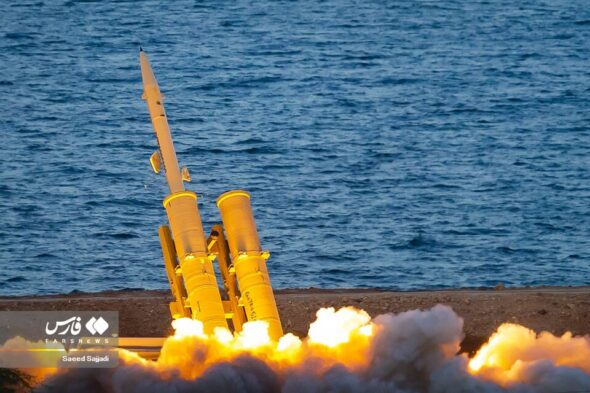
Iranian anti-ship missile launched from shore, Saeed Sajjadi 2021, retrieved via Wikimedia Commons July 16, 2026
Notably, according to a video on NBC’s Instagram page posted one day earlier, the regime figure Simmons spoke to was Hussein Kanani Moghadam. If that name rings any bells, it’s because Moghadam bragged on July 13 that the Islamic Republic could kill U.S. President Donald Trump “in the White House” if the regime desired to do so. He also ruled out any negotiations for peace in the current conflict, while asserting that “revenge and retaliation” remained “firmly on the table.”
By painting Moghadam as merely a “former IRGC commander,” and not explaining his vitriolic rhetoric regarding the sitting president of the United States, Simmons withholds from his viewers important information related to his interlocutor – impairing viewers’ ability to adequately evaluate the information they receive.
Going forward, Simmons and NBC have an obligation to provide viewers with crucial context, both about events leading up to current hostilities, and about sources. Otherwise, the public is left with a one-sided story with talking points straight from the regime’s propaganda machine in Tehran.