
CNN’s coverage of the disputed West Bank territory, also known as Judea and Samaria, is demonstrably biased against Israelis. One need only contrast how the network covered two recent attacks carried out there – one perpetrated by Israelis and the other by Palestinians.
CNN’s Zeena Saifi and Ibrahim Dahman covered the Israeli attack in their Nov. 13 article, “Israeli settlers torch mosque and spray graffiti in latest West Bank attack.” The article addresses an attack carried out by extremist Israelis who “torched” and vandalized a mosque in the Palestinian community of Salfit.
Dana Karni and Catherine Nicholls covered the Palestinian attack in their Nov. 18 article, “At least one killed and three injured after attack at West Bank junction.” This article addresses an attack carried out by two Palestinians who rammed their vehicle into a crowd of Israelis “before exiting and attempting to stab those nearby.” Explosive materials were also found in the vehicle. One Israeli was killed and three others were wounded.
The bias is evident from the headlines alone. One clearly identifies the attackers and uses active voice; the other uses passive voice and identifies neither the attackers nor the victims, obscuring what happened.
But a handful of basic statistics about the two articles exposes the clear bias.
| Attack on Palestinians | Attack on Israelis | |
|---|---|---|
| Length of Article | 780words | 433words |
| Identification of Perpetrators | First twowords | Nevermentioned |
| Identification of Victims | 32words in | 389words in |
| Visuals | 4 | 1 |
| Words on Other Side’s Violence | 0words | 100words |
| Space Given to Victim Community* | 255words | 62words |
*Excluding purely informational statements by Israeli or Palestinian officials.
The clear contrast, shown by the numbers, tells the story of CNN’s bias. CNN devoted nearly twice as much ink to the moderate damage inflicted on a mosque as it did to the murder of an Israeli civilian. It’s a less-than-subtle devaluation of Israeli life that is noticeable in other ways, too.
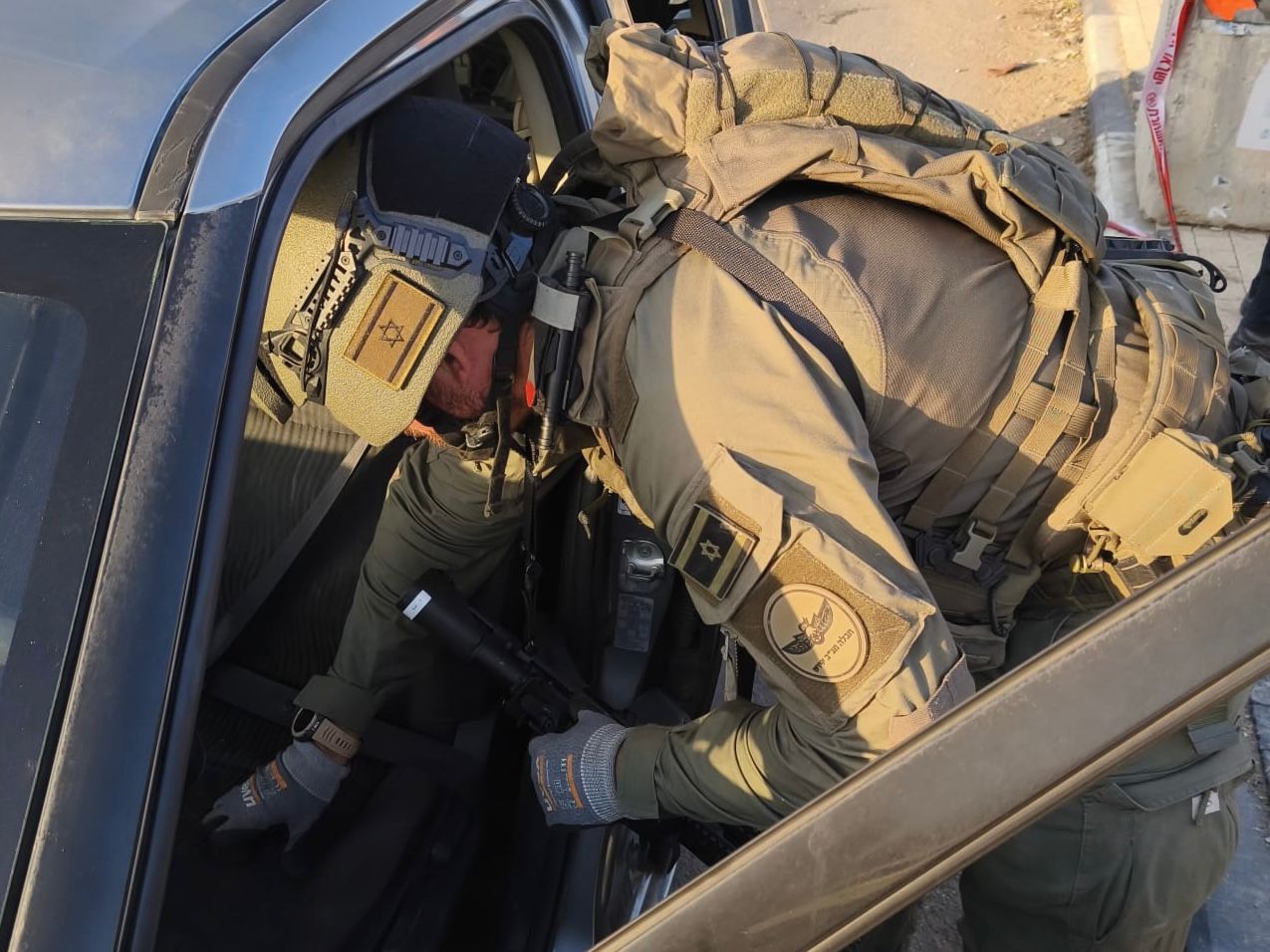
Israeli forces at the scene of the attack in Gush Etzion. Courtesy: Israel Police
That the victims of the Israeli attack were Palestinians is mentioned in the very first sentence – just 32 words in – while the Israeli identity of the victims of the Palestinian attack isn’t mentioned until the third-to-last sentence, 389 words into the article. Notwithstanding that they were attacked precisely because they were Israeli and Jewish, only one of these descriptors is mentioned, and only passingly in a quote toward the end of the piece. Instead, CNN uses vague language such as “one person was killed,” “[t]he people were attacked,” and “[t]he person killed” in such a way as to hide or obscure their relevant identities.
But when Israelis are the perpetrators, their identity seemingly cannot be emphasized enough. The network found it important to identify Israelis as perpetrators in the very first two words when reporting on the Israeli attack, but never once mentioned the Palestinian identity of those who attacked the Israeli civilians.
The minimizing of harm to Israelis is also apparent from the relative space devoted to hearing from the victims. More than four times as much space is given to statements by the victimized Palestinian community as for the victimized Israeli community. Three named Palestinians are quoted by CNN in the context of the Israeli attack, along with a couple of narrative-crafting statements by Palestinian officials. Meanwhile, only Yair Lapid, an Israeli politician, is given limited space to remark on the Palestinian attack. None of the Israeli victims, their family members, or local community members are quoted.
But if the biased narrative-crafting still isn’t apparent enough, consider how the respective articles deal with the wider context. Exactly 100 of the 433 words in CNN’s article on the Palestinian terror attack are devoted to talking about Israeli settler violence. Exactly 0 of the 780 words in CNN’s piece on the Israeli attack on the mosque refer to Palestinian violence and terrorism against Israelis.
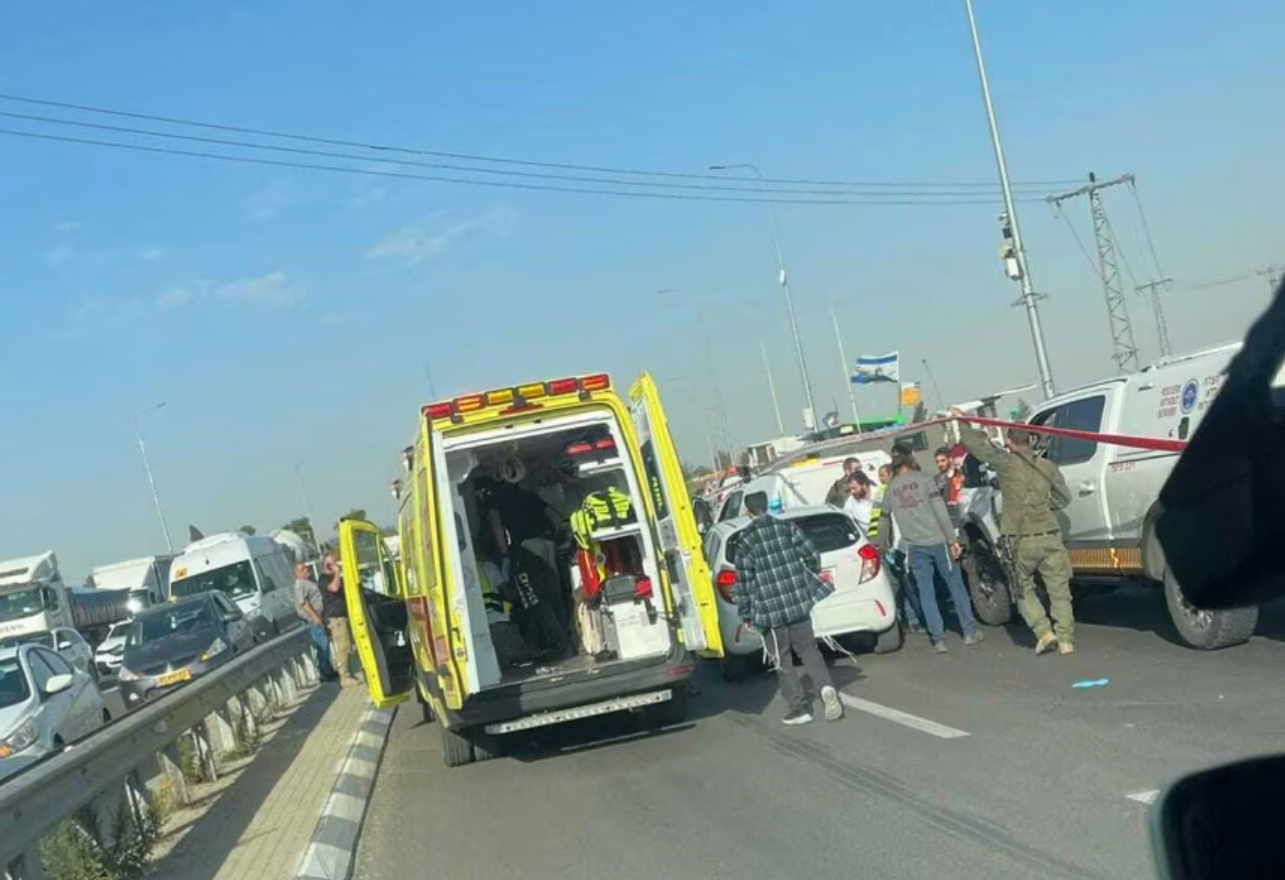
An image from the scene of the Palestinian terror attack in Gush Etzion. Courtesy: MDA
Preempting any suggestion that the different treatment might be justified by the relative level of seriousness of Israeli and Palestinian violence, consider a few more numbers. In 2024, there were 6,828 attacks carried out by Palestinians in the West Bank, including 231 “significant attacks.” Add on to those figures the 1,040 “significant” terrorist attacks that were thwarted by Israeli security services during that period. Meanwhile, according to the United Nations Office for the Coordination of Humanitarian Affairs, there were “about 1,400 incidents involving Israeli settlers across the West Bank” (emphasis added) during the same period, a figure which notably includes incidents initiated by Palestinian attackers.
In other words, even taking OCHA’s figures at face value and assuming each “incident” was initiated by Israelis, Palestinian attacks are nearly five times as frequent as Israeli attacks.
One would likely come to the exact opposite conclusion based on CNN’s reporting, however. CNN inflates the level of settler attacks, claiming there is “a surge of increasingly brazen settler attacks against Palestinians” and even including a sub-section within the article on the Israeli attack titled, “Record number of settler attacks.” Meanwhile, in reference to Palestinian violence, we’re told only that “[s]tabbing and ramming attacks…are not uncommon” and occur “with some regularity.” The asymmetry in tone is matched only by the notable asymmetry in the actual data.
This isn’t the first time CAMERA has used data to illustrate CNN’s biased narrative-crafting in its coverage of violence in the West Bank. It is a pattern of misleading coverage that is doing a tremendous disservice to the network’s audience. CNN’s coverage, with all its demonstrable biases, simply does not reflect reality. Media consumers concerned with truth and accuracy should demand more from the network.