
The Media Platforms BDS Campaign
On Sept. 8, 2025, Variety published an item about workers in the film and TV industry who signed “a pledge saying they will refuse to work with Israeli institutions and companies that are ‘implicated in genocide and apartheid against the Palestinian people.’” The story focused on platforming and amplifying the list of signatories —“1,200 Industry Names Pledging Not to Work With Israeli Film Institutions ‘Complicit in War Crimes’”— and the statement demonizing Israel rather than on exposing the BDS (Boycott, Investment and Sanctions) activists spearheading the statement as part its larger pro-Hamas propaganda campaign. The article reproduced the statement without comment or challenge to the falsehoods that are routinely employed within the echo-chamber of pro-Hamas activism. For example, the declaration claimed that:
The world’s highest court, the International Court of Justice, has ruled that there is a plausible risk of genocide in Gaza, and that Israel’s occupation and apartheid against Palestinians are unlawful.
In fact, the International Court of Justice (ICJ) is neither “the world’s highest court” – it has no appellate jurisdiction over national courts – nor has it ruled that there is a plausible risk of genocide in Gaza.” The ICJ weighed in on a procedural finding and made no determination on whether or not genocide was taking place. As Joan Donoghue, president of the ICJ at the time, Joan Donogue, explained:
The court decided that the Palestinians had a plausible right to be protected from genocide and that South Africa had the right to present that claim in the court … But it did not decide … that the claim of genocide was plausible. (Donoghue on BBC HARDtalk, April 25, 2024)
A New York Times article on the same day headlined “Hollywood Actors and Directors Pledge to Boycott Israeli Film Institutions” similarly emphasized the number of celebrity signatories and played up their vilifying message. Rather than providing a journalistic exploration of who and what are behind the biased propaganda campaign and exposing its flaws, the story promoted it as mainstream and factual. To that end, NY Times reporter Derrick Bryson Taylor underscored, rather than refuted, the falsehoods in the pledge statement and amplified them by invoking a statement by similar activists, certain members of the International Association of Genocide Scholars (IAGS), who, he said, declared “Israel’s actions in Gaza met the legal definition of genocide.” Taylor attempted to grant authority and legitimacy to the declaration by referring to those behind it as a “group of academic experts” even though membership in the IAGS requires only a fee and form to fill out and even includes parody members, like “Mo Cookie” (with a profile image of Sesame Street’s Cookie Monster) and “Palestinian Adolf Hitler.”
He did not make it clear that those who voted in favor of the declaration represented only slightly more than a quarter of IAGS’ listed members and that there was no way of knowing whether or not they were “academic experts.” Nor did he point to the much larger group of more than 500 experts who sent a letter to the IAGS urging it to retract the resolution “amid clear misapplication of law and history.” He certainly did not indicate that there were irregularities behind the vote to condemn Israel that had been exposed by a member of the IAGS who was an actual genocide scholar. She described both the lack of transparency regarding the identity of the declaration’s authors and the blocking of dissenting voices and debate. The description of the IAGS vote evokes the subterfuges regularly employed by BDS activists, of which the film celebrity signatories are just the most recent examples.
Three days earlier, on September 5, the Wall Street Journal published an article, “In the Music World, Gaza Becomes a Flashpoint for Artists” about how “the debate over the [Hamas-Israel] conflict” is “dividing musicians and fans as the humanitarian toll grows.”
“As the war in Gaza approaches its two-year mark,” reporters Anvee Bhutani and Roya Shahidi wrote, “the debate over the conflict has taken center stage in the music world. More artists are waving Palestinian flags, chanting slogans or accusing Israel of genocide. Those who stay silent face growing pressure to pick a side.”
Indeed, the pressure to weigh in on the Hamas-Israel war has come entirely from the pro-Hamas/BDS campaign; there is no similar campaign by Israel supporters to coerce musicians to promote Israel’s perspective. Nor is the pressure by BDS aimed at forcing musicians to express their opinion of the conflict, but to project Hamas’ crimes and motives onto Israel and brand the Jewish state as genocidal – what the terrorist group has called upon its supporters to do.
The BDS Movement Behind the Campaign
Although it masquerades as a pro-Palestinian human rights group that encourages “non-violent” criticism of Israeli policy toward Palestinians, the BDS movement’s inherent anti-Semitic nature has long been documented, evidenced by the anti-Jewish actions and inflammatory rhetoric of the movement’s leadership and activists—who have endorsed, incited, or directly participated in violent discourse and even physical acts of aggression targeting Israelis, Jews, or Jewish supporters of Israel.
BDS’ association with Hamas and other Palestinian terrorist groups is also well-established. At the forefront of the 29 Palestinian NGOs that make up the BDS National Committee (BNC) leadership is the Council of National and Islamic Forces in Palestine, which counts among its members Hamas, the Popular Front for the Liberation of Palestine (PFLP), the PFLP-General Command, the Palestine Liberation Front (PLF), and Palestinian Islamic Jihad—groups that are officially designated as foreign terrorist organizations.
BDS Since the October 7, 2023 Massacre
What about the movement’s activities since the worst massacre of Jews since the Holocaust, perpetrated by Hamas and affiliated terror groups on October 7, 2023?
As the world reeled in horror at Hamas’ savage massacre—slaughtering 1,200 people and abducting around 250 more— and as global condemnation of Hamas and sympathy for Israel surged, the BDS movement issued its first official statement—not to distance the movement from the atrocities unleashed by its member organizations, but to express solidarity with the perpetrators and to brazenly flip the script.
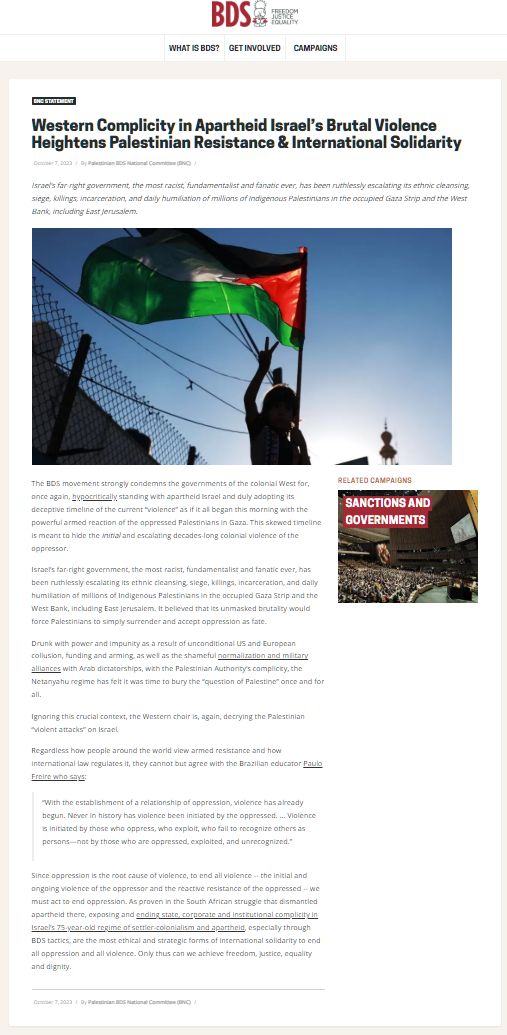 “Western Complicity in Apartheid Israel’s Brutal Violence Heightens Palestinian Resistance & International Solidarity” proclaimed the headline.
The statement began by condemning those who sympathized with Israel while celebrating and justifying Hamas’ butchery.
The BDS movement strongly condemns the governments of the colonial West for, once again, hypocritically standing with apartheid Israel and duly adopting its deceptive timeline of the current “violence” as if it all began this morning with the powerful armed reaction of the oppressed Palestinians in Gaza.
The statement was in direct contradiction to the BDS movement’s official guise of adherence to “non-violent” protest, tearing the mask from the antisemitic group. In fact, the initial BDS reaction echoes Hamas’ efforts to reverse the narrative and encapsulates the methodology used in its propaganda campaigns ever since: Vilify Israel as evil, brutal and genocidal and present the brutal terrorist murderers as “resistance” heroes. Reversing the roles of perpetrator and victim, BDS/Hamas propaganda turns Israel into the “oppressor” guilty of “ruthlessness” and “unmasked brutality” and Hamas into the “oppressed” victims who “react” with “resistance.”
In the days that followed, the BDS movement’s website intensified its pro-Hamas rhetoric with a now deleted “urgent action alert” calling on followers to support “the Palestinian freedom fighters [Hamas terrorists] in their struggle against Israeli apartheid.” The message went on to describe “ the heroic actions of Hamas fighters” on October 7 as “reasonable in their quest to liberate their stolen lands” and to justify the massacre as a “deserved response” to “the aggression of the Zionists occupiers.” Contrary to its earlier official guise as a non-violent movement, the BDS movement now “justified” the use of “armed resistance against the oppressors’ military and civilians.”
“ We support the armed resistance of the brave Palestinian fighters,” the message continued. “The BDS movement calls on all its supporters to spread this information and continue to support the BDS and the Palestinian people in their efforts.”
The BDS message paralleled attempts by the Hamas leadership to reframe the events of October 7th.
On October 10, 2023, Hamas leader Khaled Mash’al called for a general mobilization in order to stage global protests and send out “a message of rage.” He presented Hamas’ actions on October 7 not as a massacre of civilians but as legitimate “resistance” against decades of Zionist occupation, siege, and desecration of Muslim holy sites, and as the beginning of a broader “Islamic battle” for the liberation of Jerusalem and Palestine.
On October 12, 2023, Hamas’ political bureau member Husam Badran repeated the leadership’s calls for mobilization and further reframed the story, denying that Hamas terrorists had slaughtered civilians and claiming their actions were “defensive.” He also unveiled the anti-Israel lies that the propaganda campaign would advance and amplify around the globe — that Israel was carrying out “a genocide” and “barbaric aggression on the innocent civilians in Gaza.”
The BDS movement website quickly followed suit with an article by radical anti-Zionist activist Raz Segal who immediately labelled Israel’s efforts to eliminate Hamas’ infrastructure “a textbook case of genocide” for which he invoked bogus evidence and lies. BDS chapters and activists continued to promote this narrative.
Campus Activities
The BDS movement’s infiltration of U.S. campuses was documented even before October 7, 2023. BDS asserted its presence on campuses through various groups: Palestinian Campaign for the Academic and Cultural Boycott of Israel (PACBI) — the founding and steering member of the BNC; the US Campaign for the Academic and Cultural Boycott of Israel (USACBI); Palestine Youth Movement (PYM); Jewish Voice for Peace (JVP); Within Our Lifetime (WOL); Students for Justice in Palestine (SJP) and its parent body, Americans for Muslims in Palestine (AMP), as well as campus-specific BDS groups, like Columbia University Apartheid Divestment (CUAD).
Since October 7, these groups have been at the center of the pro-Hamas rallies, storming and taking over buildings, roiling campuses around the country with a surge of antisemitic incidents, bullying of Jewish students, threats of violence, intimidation, and distribution of Hamas literature. As a result of their actions, several SJP and/or JVP chapters were suspended, sanctioned or put on probation, including at Brown University, Columbia University, Adelphi, George Washington University, Rutgers, University of Washington-Madison, University of Vermont, Tufts University, and Pomona College in Claremont.
The explosion of antisemitic campus actions began with the distribution of a “Day of Resistance” toolkit by the National SJP to its chapters. The toolkit paralleled the public call for mobilization from the Hamas leadership. It provided guidance, talking points, and graphics to help local SJP chapters organize rallies and protests on college campuses across the U.S. starting with a “national day of resistance.” Directly reflecting BDS/Hamas messaging, it called for the reframing of the Hamas massacre as a “historic win for the Palestinian resistance” and attributed full blame to “the Zionist entity.” It referred to Israelis as “settlers” unworthy of protection as civilians under international law. The recommended graphics include a paraglider motif to celebrate Hamas’ use of powered gliders to enter Israel and the recommended language included slogans that justify Hamas atrocities and encourage further violence: “When people are occupied, resistance is justified”; “liberating colonized land … requires confrontation by any means necessary”; “resistance comes in all forms — armed struggle, general strikes, and popular demonstrations.”
A federal lawsuit under the Antiterrorism Act and Alien Tort Statute was brought by survivors and relatives of those killed or kidnapped by Hamas in the October 7 attacks. It claims NSJP and other BDS-affiliated student organizations coordinated with Hamas and its affiliates to distribute its propaganda, organize demonstrations and engage in acts of intimidation and physical assault, especially targeting Jewish students, Columbia University employees, and public or private university property.
There is also currently an ongoing investigation by the U.S. Senate’s Health, Education, Labor, and Pensions committee into the BDS group’s role in organizing, supporting and facilitating the violent, antisemitic demonstrations that have disrupted college campuses around the country.
Antisemitic BDS Actions Intensify
In the year after the Hamas massacre, antisemtic attacks skyrocketed: Between October 2023 and October 2024, ADL recorded more than 10,000 antisemitic incidents in the U.S. alone — the highest number of incidents recorded in any single year since ADL began tracking such data. Almost a third of these incidents occurred within the context the anti-Israel rallies organized by BDS activists that expressed support for terrorist groups that target Israel including Hamas, Hezbollah, the Houthis and the Popular Front for the Liberation of Palestine (PFLP).
Since October 7, 2023, BDS campaigns have only escalated, targeting not only Israeli institutions but also Jewish individuals, businesses, and cultural organizations worldwide. While framed as political protest, these actions are outrightly antisemitic, singling out Jews on the basis of identity and perceived association with Israel. They increasingly focus on rejecting and marginalizing anyone seen as “Zionist” or supportive of Israel.
Below are just a few of numerous examples:
- A coalition of BDS groups (including Writers Against the War on Gaza, Arts & Culture Workers Coalition for Palestine, Art Against Displacement, and others) published a public “NYC Cultural Institution Index” listing New York cultural institutions and annotating their “stance on Palestine,” including whether they had “Zionist funders.” The list was explicitly intended to guide cultural pressure and boycott campaigns.
- The International Federation of Medical Students’ Associations voted to suspend the Israeli member association (FIMS) in August 2024 the association of students from Israel for two years because of the war in Gaza and accusations of genocide and “a lack of morals and humanitarian values.” That suspension later faced review and criticism from medical groups and IFMSA later issued clarifications about procedural errors — but the episode demonstrates a professional/medical-association level targeting of an Israeli/Jewish organization.
- Authors and publishing professionals signed a petition targeting Israeli and Jewish-affiliated cultural institutions (publishers, book festivals, literary agencies) because they were deemed complicit in violations of Palestinian rights by virtue of their religious or national identity.
- Jewish-owned restaurants have been targeted around the U.S. and Canada for boycott, vandalism, and violence. (Also see also here, here, and here.)
- BDS campaigns and letters target festivals and presenters to exclude artists or board members identified as “Zionist” or “complicit” as part of an organized attempt to push cultural organizations to blacklist individuals for their perceived Zionist affiliations. For example, an Instagram campaign called “Zionists Out of Newport” has accused the nonprofit that runs the Newport Folk and Jazz festivals in Newport, Rhode Island, of having a history of Zionist influence and pushes for the festivals to cut ties with Zionist organizations.
- The Palestinian Campaign for the Academic and Cultural Boycott of Israel (PACBI) called for boycott of Disney’s Snow White movie because it stars Israeli actress Gal Gadot whose vocal support of her home country is described as “whitewashing genocide.”
- BDS activists petitioned Alamo Drafthouse to cancel screenings of the film September 5, a docudrama about the Munich Olympics.
- A BDS group, Musicians for BDS, keeps a database of DJ’s and musicians from all over the world who are either Israeli or performed in Israel following the Hamas massacre for boycott, charging them with complicity in alleged genocide.
- Individual performers and performing groups have been targeted for cancellation, including Matisyahu, Radiohead guitarist Jonny Greenwood and Israeli musician Dudu Tassa, the Batsheva Dance Company which by dint of it being based in Israel was labelled a “cultural ambassador for genocide.”
- Beyond formal boycotts, activists have gone after companies not officially on BDS lists—such as McDonald’s and Starbucks— and others over perceived support for Israel or Israel’s military. While these are not always Jewish-owned businesses, the targeting reflects attempts to pressure or stigmatize companies seen as allied or supportive of Israel.
The ADL gives more examples of BDS activists’ attacks on Israeli and Jewish businesses and individuals since October 7, 2023.
What is undeniably clear is that the BDS movement has become even more aggressively antisemitic since Oct. 7, 2023 and with less need to pretend otherwise. But as long as the media refuses to challenge the underlying falsehoods of BDS campaigns and continues to maintain the fiction that the BDS movement is just a non-violent, pro-Palestinian advocacy group, antisemitism will become increasingly normalized and will continue to rise.