
Famously, the slogan “All the News That’s Fit to Print” graces the front page of every New York Times edition. The slogan was coined at the end of the 19th century by the paper’s publisher, Adolph Ochs. Of course, in today’s hyper-globalized world, the slogan is wishful thinking. No paper could realistically cover all the important news stories of the day.
Still, it would be hard to argue that outlets like the New York Times, the Washington Post, CNN, and others adequately cover even those stories they do print. They often devote precious space to emotive or opinionated claims, while omitting highly material and relevant information that sheds important new light.
Provided below are three important, but underreported, stories from the week bearing on Israel and the Middle East that media consumers should know.
1) Hotel Cairo – A Luxurious Stay for Humanity’s Worst
As part of the ceasefire agreement with Hamas, Israel released hundreds of convicted terrorists in exchange for the hostages held captive by Palestinian terrorist organizations. Over 150 of those terrorists, deemed too dangerous to remain in the West Bank or Gaza, were deported to Egypt. While the freed hostages must now pick up the pieces of the lives from which they had been so cruelly taken away, the released terrorists are now living a life of luxury.
The released terrorists were found living among unsuspecting tourists at the Marriott Renaissance Cairo Mirage City hotel, just miles from the airport. When news of this broke, the terrorists were “rushed out” by Egyptian authorities before being relocated to a five-star resort in Egypt, featuring “a large outdoor swimming pool, two football pitches, a wellness center with jacuzzis, saunas, steam rooms, a fitness center, and tennis courts.”
Among the terrorists being treated to such luxury, according to the Daily Mail, are “Isis member Izz a-Din al-Hamamrah, 47, who recruited suicide bombers and planned hijackings; bus bomb mastermind Samir Abu Nima, 64; ambusher Muhammad Zawahra, 52; kidnapper Ismail Hamdan, 57; and murderer Yousuf Dawud, 39.” There’s also “Mahmoud Issa, 57, who founded Special Unit 101 of the Izz a-Din al-Qassam Brigades, a Hamas special forces unit in Hamas which specialises in kidnap.”
Suffice it to say, a world in which the worst of humanity are so handsomely rewarded for their crimes is one where morality has been turned upside down.
Other than the Daily Mail, which broke the story, only the New York Post and a handful of Israeli and Australian outlets covered the story.
2) Lebanese Foot-Dragging Threatens Northern Ceasefire
Lebanon’s prospects are not looking good. The country, which was dragged into conflict by the terrorist organization Hezbollah, is now failing to uphold its commitments to disarm the group. The consequences are becoming clearer by the day.
In November 2024, a ceasefire deal was inked after over a year of Hezbollah attacks on Israel’s north, followed by a devastating Israeli response, resulting in approximately 4,000-5,000 dead Hezbollah terrorists. As part of the deal, the Lebanese government is required to disarm Hezbollah and all other terrorist organizations.
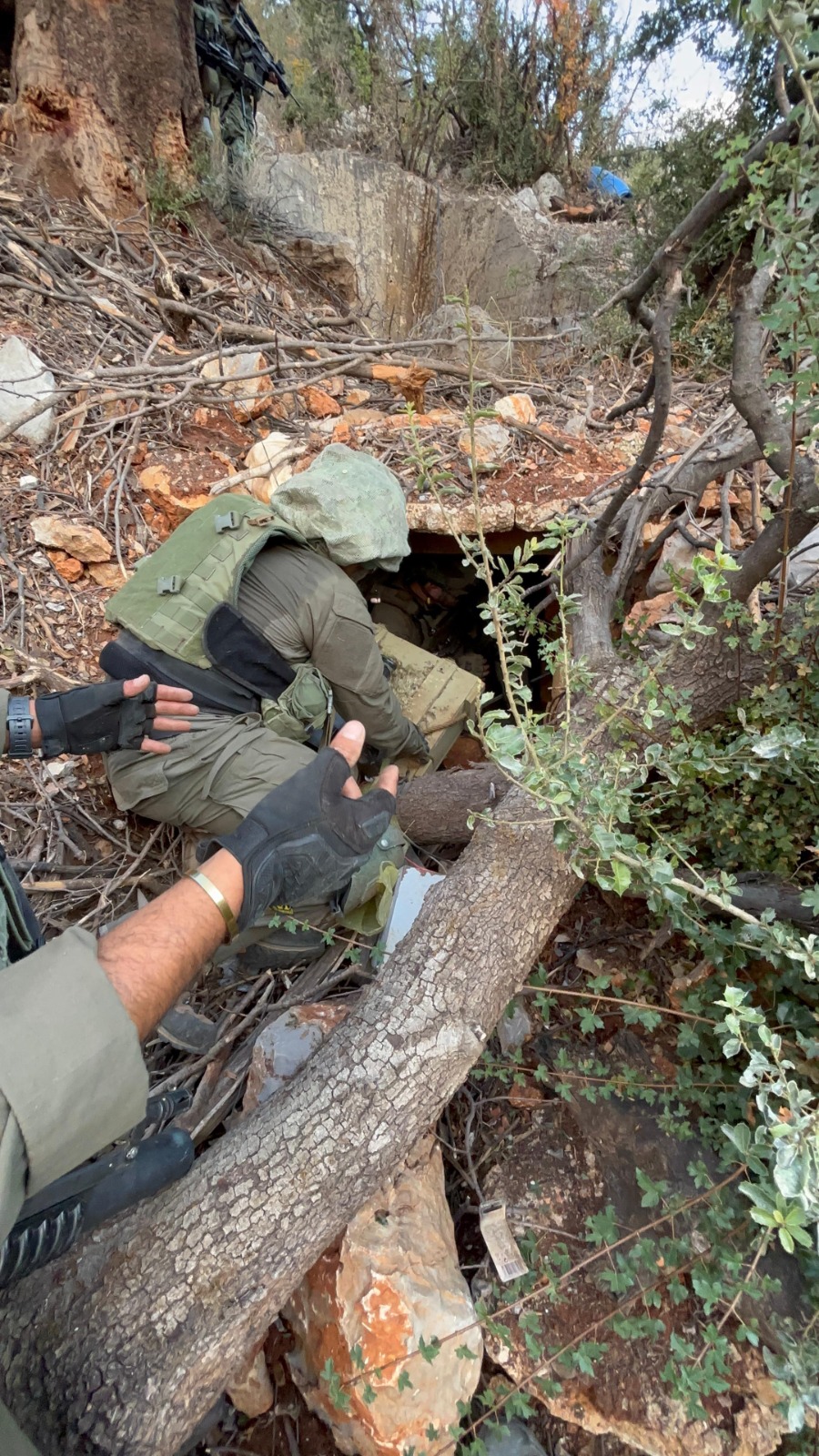
Israeli troops removing weapons from an underground Hezbollah bunker in southern Lebanon in November 2024. Courtesy: IDF
A year later, Lebanon has utterly failed to take meaningful steps toward Hezbollah’s disarmament. The cause appears to be that the terror group, through attacks and threats, has deterred the Lebanese Armed Forces from carrying out the mission. Hezbollah’s leaders have threatened to drag the nation into another civil war. Just earlier this month, senior Hezbollah leader Ali Damoush declared, “whoever confronts us will enter the battle of Karbala,” a reference to an ancient battle between opposing Islamic forces. Hezbollah has also resorted to terrorism against its fellow Lebanese to deter disarmament, killing six Lebanese soldiers as they attempted to dismantle a Hezbollah ammunition dump.
Meanwhile, according to the Wall Street Journal, Hezbollah “is rebuilding its armaments and battered ranks, defying the terms of a cease-fire agreement and raising the prospect of renewed conflict with Israel, according to people familiar with Israeli and Arab intelligence.”
Lebanese leaders are now trying to talk their way out of their commitments. President Joseph Aoun recently suggested that “weapons are not the main issue; it is the intention to use them that matters.” It’s a “profoundly disappointing” backtracking from Aoun’s “inaugural address pledge to work to ‘ensure the state’s right to hold a monopoly on weapons’,” wrote the Washington Institute for Near East Policy’s David Schenker in the National Interest.
The failure of Lebanese authorities is now testing the patience of those who would aid the Lebanese people. U.S. Special Envoy Thomas Barrack is expected to arrive in Lebanon to warn its leaders that “they have one last chance to enter direct negotiations with Israel on a timetable for Hezbollah’s disarmament, or Lebanon will be left without external support.” Saudi authorities are also losing patience and threatening to pull financial support for the Lebanese Armed Forces. “Now is the time for Lebanon to act,” wrote Barrack on X last week, adding: “If Beirut fails to act, Hizballah’s military arm will inevitably face major confrontation with Israel at a moment of Israel’s strength and Iran backed Hizballah’s weakest point.”
Other than the Wall Street Journal and Israeli and Arab news outlets, Western media coverage has largely been limited to the New York Times and Reuters (which notably treat the Lebanese government with kid gloves).
3) A Violent Antisemite Gets Prison – And Adoring Fans
Tarek Bazrouk, a fan of Hamas and self-professed “Jew hater,” has been sentenced to 17 months in prison for his violent attacks on Jewish people in New York City. Amidst the anti-Israel, and often antisemitic, demonstrations that plagued New York City over the last two years, Bazrouk attacked multiple identifiably Jewish individuals at multiple demonstrations, including while wearing a Hamas headband. After his arrest, it was revealed that he was “a member of a chat group that received regular updates from Abu Obeida,” the Hamas spokesperson until his elimination in August. A search of his home also uncovered “an airsoft gun that appeared to be an actual firearm, bullet casings, brass knuckles, four knives, including a switchblade and $750,000 in cash, the source of which remains unclear.”
But while Bazrouk was forced to surrender his weapons and cash, he did gain a following of adoring fans for his antisemitic violence. Prior to his sentencing, more than 12,000 people signed a letter to the judge describing Bazrouk as “a beloved member of the New York City community.” At his sentencing, some 200 supporters were in the courtroom and overflow room. Major anti-Israel organizations, including National Students for Justice in Palestine, called on supporters to pressure the judge into giving a lenient sentence for Bazrouk. So, too, did the Palestinian Youth Movement, Within Our Lifetime, Pal-Awda, and Columbia University Apartheid Divest.
Coverage of Bazrouk’s sentencing, and his popular support among the anti-Israel protest movement, has been limited mainly to Fox News, the New York Post, and Jewish outlets.
Historical Context for Current Events
Twenty years ago yesterday, then-Iranian President Mahmoud Ahmadinejad delivered a notable speech at the Islamic Student Association’s “World Without Zionism” conference in Tehran. Ahmadinejad’s speech portrayed Israel’s unilateral disengagement from the Gaza Strip as a “trick,” and declared to those present that they “cannot allow this historical enemy to exist in the heart of the Islamic world” and that Israel “must be wiped off the map.”
Two decades later, and the Islamic Republic of Iran is reeling from Israel’s Operation Rising Lion, which devastated its nuclear and ballistic missile programs. Wiped off the map during the war, as Israeli forces commanded complete control of the skies over Iran, were 30 top Iranian commanders, 13 top nuclear scientists, over 200 missile launchers, 70 anti-aircraft radars, 80 anti-aircraft missile launchers, seven combat aircraft, and eight attack helicopters.
Ahmadinejad could not be reached for comment.