
Historical rewriting does not always require inventing facts out of thin air; sometimes, all that is needed is to cut a historical sentence in the middle and omit the context. The April 1 Haaretz Op-Ed by Hagai El-Ad, a former executive director of B’Tselem, demonstrates the danger of this type of manipulation (“The Strategy Behind the West Bank Pogroms: Deir Yassin“). Arguing that violence against Palestinians is an integral part of the Zionist vision, El-Ad relies on a 1949 speech by David Ben-Gurion. However, an examination of the original protocol reveals a completely opposite picture from the one presented to the readers.
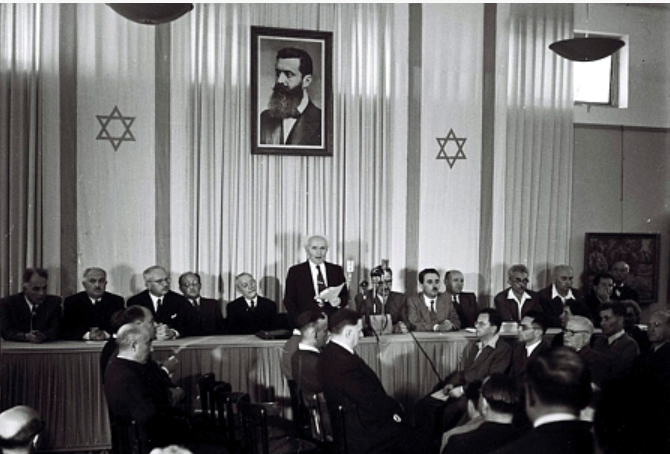
David Ben-Gurion reading the Declaration of Independence in Tel Aviv, May 14, 1948 (Photo by Zoltan Kluger/Government Press Office)
Hagai El-Ad writes:
For years now, liberal Zionists have liked to posit Israel as being in a dilemma, forced to choose between a “Jewish and democratic” state in part of the Land of Israel and a binational state in Greater Israel. Thus the third option – ethnic cleansing – is denied, both as a part of Zionist history in the form of the 1948 Nakba and as a still-viable option for the present and the future. As such, David Ben-Gurion’s remarks in the Knesset in April 1949 are fondly quoted: “When we were faced with the choice between the entire Land of Israel without a Jewish state or a Jewish state without the entire Land of Israel, we chose a Jewish state without the entire land of Israel.”
But, El-Ad claims, it turns out that this same speech harbors the seeds of calamity, and the meaning of Ben-Gurion’s words is different from what is commonly believed. El-Ad maintains:
But the truth is that in a rarely quoted part of the very same speech, Israel’s founding prime minister and defense minister in fact explained well the borders of the land while weighing in on a different topic – Deir Yassin. Ben-Gurion said: “A Jewish state without Deir Yassin in the entire country can only be in a dictatorship of the minority.”
The reference is, of course, to the Arab village in the Jerusalem area, which was captured by Irgun and Lehi forces during the 1948 War of Independence. Many historians and the leadership of the Jewish Yishuv in the Land of Israel accused them of carrying out a massacre against the village’s residents. Others, including eyewitnesses, later disputed claims of atrocities.
According to Hagai El-Ad, the meaning of Ben-Gurion’s words is quite clear:
In plain words, Ben-Gurion explained that there is no effective ethnic cleansing without massacres like the one that took place in Deir Yassin in 1948. He told his critics in the Knesset that if they wanted both “the entire Land of Israel” and “a Jewish state,” more massacres were needed.
We must perpetrate “Deir Yassin throughout the country” to expel the Palestinian population from more and more parts of the Land of Israel: “A Jewish state in the current reality, even just in the western part of the Land of Israel, without Deir Yassin, is impossible if it is to be democratic, for the number of Arabs in the western part of the Land of Israel is larger than the number of Jews.”
In other words, according to El-Ad, Ben-Gurion expressed support for indiscriminate massacres of the Arab population, to maintain the Jewish majority in the State of Israel.
The problem is that El’Ad’s interpretation is an absolute distortion of what Ben-Gurion said in that speech. Anyone who reads the speech in its entirety will conclude as much. Below are several quotes from the same speech proving Hagai El-Ad intentionally ignored Ben-Gurion’s intent with the aim of presenting a false picture of history.
Ben-Gurion, Israel’s first Prime Minister, delivered the April 4, 1949 speech at the 20th session of the First Knesset, shortly after the end of the War of Independence. It deals, among other things, with the armistice agreements signed then in Rhodes. After clarifying that the young state did not want the war and that it was forced upon it, he said:
But our role and desire in the Arab world was not Deir Yassin. Our role was not to destroy the Arab people; the enemy who fought us – yes, without mercy! And whoever fights us, we will strive to destroy. But the goal of our war was not to destroy the Arab nations, not Egypt, not Iraq, nor any other Arab state.
Then Ben-Gurion moved on to discuss the issue of the land’s borders, saying the sentence that Hagai El-Ad quotes: “A Jewish state without Deir Yassin in the entire country can only be a dictatorship of the minority.” He then elaborated:
…and a Jewish state in all of the Land of Israel, and even just in the western Land of Israel [meaning on all the territory west of the Jordan River, S.B.M.], a democratic state is not possible… a Jewish state in the existing reality, even just in the western part of the Land of Israel, without Deir Yassin, is impossible if it is to be democratic, because the number of Arabs in the western Land of Israel is greater than the number of Jews.
To the reasonable reader, Ben-Gurion’s intention is clear: since we are interested in a democratic state, and also do not wish to murder innocent Arabs (“without Deir Yassin”), we must settle for a Jewish state in only a part of the Land of Israel. But perhaps in anticipation of anti-Israel propagandists who would attempt to distort his words decades later, the Prime Minister then explicitly added:
And Deir Yassin – is not our policy! Although acts were committed and not only by them, but we condemned those acts! We do not accept this as a policy.
In other words, in the very same speech in which Hagai El-Ad claims that Ben-Gurion expressed support for massacres in order to create a Jewish majority, Ben-Gurion condemned the killings and explicitly stated, twice, that massacres were neither his intention nor his plan. Therefore, because he does not want a “Deir Yassin,” an undemocratic state, or a non-Jewish state, he concluded:
Well, when the question arose of the entirety of the land without a Jewish state, or a Jewish state without the entirety of the land – we chose a Jewish state without the entirety of the land.
In a desperate attempt to prove that Zionism is based on expulsion and massacre, Hagai El-Ad achieved exactly the opposite: he unwittingly reminded us that Israel’s first prime minister preferred to give up parts of the homeland, so as not to compromise the nation’s humanity and the democratic character of the state. History, it turns out, is stronger than any selective quotations.
For the Hebrew version of this post, see CAMERA Hebrew.