
Introduction
In a recent episode of The Tucker Carlson Show (“Origins of Christian Zionism, How It Corrupted American Christianity and Why It’s Finally Collapsing”), Tucker Carlson interviewed J. D. Hall, an ex-pastor who reportedly was removed from his role by church leadership after he showed up high to Sunday service, was found guilty of embezzling church funds, and was accused of domestic violence. Like other episodes of the show, this interview features false claims, historical distortions, misrepresentations of the State of Israel and Christian Zionism, and the villainization of Jews. The episode:
Falsely claims:
- All Jewish practices revolved around the Temple.
- Zionists considered Ohio as a “safe space for Judaism.”
- The Scofield Reference Bible was published in 1907.
- Oxford University Press published the Balfour Declaration.
Distorts history by suggesting:
- Jesus’ lack of emphasis on his Jewishness indicates it was not important.
- Jesus refrained from observing Jewish practices not found in the Old Testament.
- Palestinians are descendants of the ancient Philistines.
Misrepresents the State of Israel by suggesting:
- Ottoman rulers treated Holy Land Christians better than Israeli governments.
- The State of Israel does not allow Messianic Jews to be citizens of the Jewish State.
- The State of Israel prohibits Christian evangelism.
- The IDF has a policy of sodomizing prisoners.
- The IDF has acknowledged eight out of ten Gazans killed by the IDF were civilians.
Misrepresents Christian Zionism by suggesting:
- Its proponents believe it has always been the de facto Christian position.
- Its belief that Christians owe a debt to Jews has no biblical basis.
- Its belief in Israel’s importance to God has no biblical basis.
- Its belief in Jewish return to the land before repenting has no biblical basis.
- Its “children of Abraham” and “promises” beliefs lack biblical bases.
- Its Jews-as-chosen people belief contradicts most Christian confessions.
- It is identical with dispensationalism while excluding alternative forms.
- A belief in blessing Jews is inconsistent with the New Testament.
- A belief that non-Jesus-believing Jews can teach Christians spiritual truths is invalid.
Villainizes Jews by:
- Portraying Pharisaic forerunners of Rabbinic Jews as uniformly hostile to Jesus.
- Idealizing the New Testament’s depiction of Gentiles at the expense of Jews.
- Describing Jews as deliberately rejecting Jesus as Messiah.
- Presenting one negative rabbinic view of Jesus while excluding positive views of him.
- Claiming Jews pray for the damnation and destruction of the nations at Passover.
- Claiming Jews murder Gentiles to produce bloodshed to achieve atonement.
False Claims
Carlson and Hall Falsely Claim All Jewish Practices Revolved Around the Temple
In describing the form of religion God gave the Jewish people, Carlson asserts: “[T]hat faith required the presence of the Temple where God lived.” Hall responds: “Yes, absolutely. It’s in the architecture of the religion. God designed it so that it could not endure without a Temple […] [H]e created a religion that would be temporary. It all revolves around the Temple.”
In contradistinction to what Carlson and Hall suggest, not all practices found in the Old Testament and observed by Jews have revolved around the Temple, including the biblical commandments regarding male circumcision, Sabbath rest, and kosher eating.
The Old Testament itself attests to periods of time in which the Temple in Jerusalem did not exist and yet God’s covenant with the people endured both before the First Temple was built and after it was destroyed by the Babylonians in 586 BCE. Historically, the Jewish religious “architecture” to which Hall refers evidently persisted without a Temple building.
In describing how this view is also consistent with the New Testament Epistle to the Hebrews, the University of British Columbia Associate Professor Emeritus of Theology Charles P. Anderson states:
With the one fundamental exception relating to the cult, the Torah is still valid for those to whom it was given by Moses […] Torah is a larger category, and apart from priesthood and other cultic aspects, is left untouched by the critique of Hebrews […] Judaism was more than the temple cult, as it demonstrated following the destruction of the temple and the cessation of its services (Apocalyptic and the New Testament, pp. 273-274).
While some modifications of Jewish practice were introduced in the wake of the destruction of the Second Temple, such changed practice retains fundamental continuities with that which preceded it.
Hall Falsely Claims Zionists Considered Ohio as a “Safe Space for Judaism”
Zionists considered locations other than the land of Israel, but Hall errs in claiming that Ohio was one of these. Also, given that many Zionists historically were not religious, it is misleading to claim that they sought to find a “safe space for Judaism” rather than a “safe space for Jews.”
Hall Falsely Claims the Scofield Reference Bible Was Published in 1907
In the interview, Hall falsely claims that the Scofield Reference Bible was published in 1907. In fact, as The Lumen Center Director and historian of Christian Zionism Daniel G. Hummel has observed, the book went on sale in 1909, and a revised edition of the text was published in 1917.
Hummel also points out how the Carlson-Hall exchange “failed to capture the longer arc of Scofield’s life or convey his significance in turn-of-the-century American evangelical circles.” Hall suggests a conspiracy of Zionists in the UK lies behind the publication of the Scofield Reference Bible when, in fact, it was “the Plymouth Brethren, who aided, supported, funded, and ultimately helped publish the Scofield Reference Bible—not because it was Zionist but because Scofield’s notes aligned with their own understanding of Scripture.”
Similarly, Hall indicates that it “would not be reasonable to presume someone of Scofield’s lack of employment would be able to afford” the cost of dues of the Lotos Club, “an elite group” of which Scofield was a member. However, Hummel notes that “Scofield was employed throughout the era, and he was also a successful author and speaker,” so Scofield could have afforded the dues he would have needed to pay as a member of the group.
Hall Falsely Claims Oxford University Press Published the Balfour Declaration
Hall also incorrectly claims that Oxford University Press, which published the Scofield Reference Bible, was “the same institution that published the Balfour Declaration within a year.” However, the British government, not Oxford University Press, was responsible for publishing the Balfour Declaration.
Historical Distortions
Hall Suggests Jesus’ Lack of Emphasis on his Jewishness Indicates It Was Not Important
In the interview, Hall suggests Jesus does not emphasize his Jewishness because he understood himself as a global messianic figure, indicating that to emphasize his Jewish identity would be to reduce the expansive scope of Christianity to something tiny:
Jesus did not emphasize his own Jewishness. Jesus came as a savior of Mankind, and so he called himself Son of Man, which was a term from the prophet Isaiah, and so it not only reduces the big picture of Christianity to something that is much, much smaller. It reduces Jesus from a global Messiah to, well, he’s a Jewish Messiah that they loan us for a while.
While the New Testament never features Jesus explicitly identifying himself as a Jew, it does not follow from this argument from silence that Jesus’ Jewishness was insignificant. The Hartford International University for Religion and Peace Rabbi Stanley M. Kessler Distinguished Professor of New Testament and Jewish Studies Amy-Jill Levine has remarked on the perils of overinterpreting the apparent absence of a subject in New Testament texts:
The argument from silence is not as strong as its proponents suggest […] [O]ne might observe that the New Testament does not speak of loving the stranger […] and therefore conclude that the followers of Jesus care only for themselves. As one critic of the argument from silence trenchantly states, “One might just as well argue against the validity of repentance from the absence of the term in the Gospel of John, or against the importance of love from the term’s absence in the Acts of the Apostles” (Horner 255) (Peace and Faith: Christian Churches and the Israeli-Palestinian Conflict, p. 143).
In speaking with the Samaritan woman at the well, Jesus is depicted as expressing his identification with the Jews: “You Samaritans worship what you do not know; we worship what we do know, for salvation is from the Jews” (John 4:22). Also, Jews have frequently referred to themselves as “Israel,” so New Testament identifications of Jesus as “King of Israel” (e.g., Mark 15:32; John 1:49; 12:13) can be another way of referring to the same basic identification.
Even though Jesus does not seem to have publicly identified himself as King of the Jews, it is historically plausible that Jesus identified as such in private. The University of North Carolina at Chapel Hillel James A. Gray Distinguished Professor Emeritus of Religious Studies and New Testament scholar Bart Ehrman has argued that all the sources agree that “Jesus was executed by the Romans specifically for calling himself the King of the Jews.” The title “King of the Jews” is only found in the New Testament in the context of the trial and the crucifixion by the Romans of Jesus, which Ehrman calls “the best attested event of his entire life.” Since there is no evidence of Christians historically applying the title to Jesus, Ehrman considers it unlikely that Christians would have fabricated the title:
The charge is specifically that he [Jesus] called himself “king of the Jews.” Evidence that Jesus really did think that he was the king of the Jews is the very fact that he was killed for it. If Pilate asked him whether he were[,] in fact[,] calling himself this, Jesus could have simply denied it, and indicated that he meant no trouble and that he had no kingly expectations, hopes or intentions. And that would have been that. The charge was that he was calling himself the king of the Jews, and either he flat-out admitted it or he refused to deny it […] The reason Jesus could not have denied that he called himself the king of the Jews was precisely that he did call himself the king of the Jews (How Jesus Became God: The Exaltation of a Jewish Preacher from Galilee, p. 123).
Ehrman believes that one New Testament passage does feature Jesus alluding to his role as Jewish king in private to his disciples: “Truly I say to you, in the renewed world, when the Son of Man is sitting on the throne of his glory, you (disciples) also will be seated on twelve thrones, judging the twelve tribes of Israel” (Matthew 19:28; cf. Luke 22:30). According to Ehrman, since Jesus here seems to include Judas Iscariot, whom the narrative will later depict as betraying Jesus, among the twelve enthroned in the future—an eschatological expectation that would have been embarrassing to later followers of Jesus—it is likely that this statement is historical. As Ehrman concludes: “Jesus believed he was the apocalyptic king of the future state of Israel.”
The identification of Jesus as king of the Jews is central to the biblical text, as Fuller Theological Seminary Associate Professor of New Testament J. R. Daniel Kirk observes: “Jesus is due worship precisely because he is king of the Jews. Matthew’s readers have already learned that Jesus is son of David and son of Abraham. The roles Jesus plays in the narrative are thus laid out in terms of Israelite sovereignty over the world” (A Man Attested by God: The Human Jesus of the Synoptic Gospels, p. 375).
While Hall sees the title Son of Man as emphasizing Jesus’ role as global savior, the aforementioned statement by Jesus connects this title with the twelve tribes of Israel specifically. Hall claims that Jesus borrows his Son of Man language from Isaiah, but most scholars believe that Jesus’ use of the title indicates he had the term’s use in Daniel in mind.
Just as Jesus in the passage above appears to connect the Son of Man to the people of Israel specifically, the University of California, Berkeley Hermann P. and Sophia Taubman Professor Emeritus of Talmudic Culture Daniel Boyarin has noted that the term Son of Man as it appears in Daniel is also used in connection with the people of Israel:
Daniel’s vision itself seems to require that we understand “the one like a son of man” as a second divine figure. The angelic decoding of the vision in the end of the chapter seems equally as clearly to interpret “the one like a son of man” as a collective earthly figure, Israel or the righteous of Israel (The Jewish Gospels: The Story of the Jewish Christ, p. 43).
The Near Eastern Studies scholar Mark S. Kinzer argues that the Gospel writers intend for readers to understand Jesus in light of the term’s corporate significance regarding the people of Israel:
Yeshua’s [Jesus’] identity as Son of God and servant of the Lord imply his role as one-man Israel. This is also true of his identity as the Son of Man of Daniel 7. While New Testament scholars disagree about the intent of the historical Yeshua in calling himself the “Son of Man,” it is clear that the Gospels see the term as an allusion to the heavenly figure of Daniel 7. That figure represents Israel, “the holy ones of the Most High,” particularly those who suffer as martyrs (Daniel 7:14, 18, 22, 27). It is likely that the Gospel writers remain fully conscious of the corporate significance of the term “Son of Man” in Daniel 7, and expect their readers to understand Yeshua in light of that usage. Thus[,] Yeshua’s suffering sums up and includes within itself all the suffering of Israel’s martyrs, who are themselves but the priestly representatives of the entire community; and his resurrection anticipates the vindication and glorification of God’s covenant people (Postmissionary Messianic Judaism: Redefining Christian Engagement with the Jewish People, p. 220).
Jesus’ Jewishness is also evident in his earthly ministry that is depicted as emphasizing his mission to fellow Jews. For example, he states: “I was sent only to the lost sheep of the house of Israel” (Matthew 15:24). Jesus is portrayed as prioritizing Jews before Gentiles in his mission when he states: “Permit first to be fed the children,” with the turn of the gentiles coming afterward (Mark 7:27).
This prioritization of Jews is echoed by Paul: “For I am not ashamed of the gospel, because it is the power of God that brings salvation to everyone who believes: first to the Jew, then to the Gentile” (Romans 1:16).
Whereas Hall sees Jesus’ Jewishness as relatively insignificant in the context of Jesus’ global mission, Paul seems to understand Jesus’ Jewishness as essential to his mission when he describes Jesus as “born of a woman, born under the law, in order to redeem those who were under the law.” The King’s University Director of Messianic Jewish Studies and Professor of New Testament and Jewish Studies David Rudolph summarizes the meaning of this verse:
In short, Christ became a Jew to the Jews to redeem Jews […] Christ entered the life experience of human beings and identified with them, as the second Adam (1 Cor[.] 15:22, 45), so human beings could enter into his life. He entered into the life experience of Jews as a Jew so that Jews could enter into his life (A Jew to the Jews: Jewish Contours of Pauline Flexibility in 1 Corinthians 9:19-23, p. 177).
The New Testament describes Jesus in both universal and particular terms. For example, the Song of Simeon describes Jesus as having a dual mission to be “a light for revelation to the Gentiles, and the glory of your people Israel” (Luke 2:32). This biblical passage features an intertextual allusion to Isaiah 49:5-6, where one of the tasks of God’s servant is “to raise up the tribes of Jacob”—suggesting the restoration of the Jewish people to their ancestral homeland is envisioned—even as God’s servant is also called to be “a light to the nations, that my salvation may reach to the end of the earth.” Although for Hall, emphasizing the Jewish task of the Messiah is to limit Christianity, these New Testament texts suggest that Scripture presents both the universal and particular dimensions of Jesus’ mission as important.
Hall Suggests Jesus Refrained From Observing Jewish Practices Not Found in the Old Testament
Hall describes “most of Rabbinic Judaism” as “a complete manufacture of new rites and rituals that aren’t in the text at all.” After providing this description of “most of Rabbinic Judaism,” Hall acknowledges that Jesus was a Jew, but only insofar as “he was a physical descendant of David and of Abraham,” not in terms of observing Jewish “rites and rituals” not found in the Old Testament.
However, the New Testament features multiple examples of Jesus promoting or observing Jewish practices not found in the Old Testament. For example, Jesus is depicted as promoting proto-rabbinic halakha in stating: “Woe to you, scribes and Pharisees, hypocrites! For you tithe mint and dill and cummin, and have neglected the weightier matters of the law, justice and mercy and faith. It is these you ought to have done, without neglecting the other” (Matthew 23:23-24).
In their analysis of this biblical text, Princeton Theological Seminary Richard J. Dearborn Professor of New Testament Dale C. Allison Jr. and former Duke Divinity School Professor of Biblical Theology W. D. Davies have noted that Jesus is depicted as upholding ritual practices that are not present in the text of the Torah, but rather derive from a Pharisaic extension of it (A Critical and Exegetical Commentary on the Gospel According to Saint Matthew, vol. 3, p. 295).
Jesus urges his followers to observe what the Pharisees teach: “The scribes and the Pharisees sit on Moses’ seat: therefore, do whatever they teach you to follow it” (a literal translation reads: “carefully observe all that they say to you”) (Matthew 23:2-3).
In the New Testament, Jesus is also depicted as embracing postbiblical Jewish institutions, like the synagogue, where he reads Scripture publicly (Luke 4:16-21). Similarly, the New Testament portrays Jesus as reciting blessings before consuming bread (e.g., Matthew 14:19 and John 6:11) and wine (e.g., Mark 14:23 and Luke 22:17) even though the Old Testament only features an expectation of giving thanks to God after having eaten (Deuteronomy 8:10).
Some scholars, like Asbury Theological Seminary F. M. and Ada Thompson Professor of New Testament Craig Keener, have also understood the New Testament reference to the “Festival of Dedication” (Chanukah) in describing Jesus “walking in the temple” (John 10:22-23) as indicating Jesus observed this Jewish festival not found in the text of either the Jewish Bible or the Protestant Old Testament.
Scholars have also argued that Jesus might have observed the Pharisaic practice of ritual handwashing based on the specific language of the question that Pharisees direct to Jesus: “Why do your disciples not live according to the tradition of the elders” (Mark 7:5), which does not single out Jesus as refusing to engage in the practice, but rather his disciples.
Similarly, scholars have noted how the New Testament distinguishes Jesus from his disciples while suggesting Jesus upheld contemporary interpretations of Sabbath observance not found explicitly in the Old Testament. Thus, McMaster University Associate Professor of Religious Studies and New Testament scholar Matthew Thiessen observes:
[T]he Pharisees ask Jesus why his disciples are doing what is unlawful on the Sabbath. Mark’s narrative distances Jesus both from the actions and from the accusation; it is Jesus’s disciples, not Jesus, who pluck grain. In their rewriting of Mark, Matthew and Luke similarly focus on the disciples’ behavior (Matt. 12:1-8; Luke 6:2)” (Jesus and the Forces of Death: The Gospels’ Portrayal of Ritual Impurity within First-Century Judaism, p. 155).
Thiessen notes that the prohibition that Jesus’ disciples were regarded as having violated was “not a blatant infraction of Sabbath observance as mandated by Sabbath legislation (such as Exod. 20:10 and 34:21),” but rather “common contemporary interpretations of what such observance entailed” (Ibid.). In describing how Jesus responds to the Pharisees’ query, Thiessen observes: “Jesus […] shares in common with the Damascus Document, Philo, and the early rabbis the belief that, as a rule, harvesting food is prohibited on the Sabbath” (Ibid., p. 156).
Whereas Hall creates the impression that Rabbinic Judaism promotes ideas completely distinct from those of Jesus, Kinzer has observed parallels between the Jesus and rabbinic movements:
[S]ome of the rabbinic extensions of kedushah [(holiness)] parallel certain tendencies seen in the Yeshua tradition and in the life of the ekklesia [(church)]. Just as the Apostolic Writings portray the ekklesia as a holy people in and among whom the Holy One resides as he did in the Mishkan [(tabernacle)] and the temple, so rabbinic tradition sees Israel as a holy people among whom the Shekhinah (Divine Presence) rests. Just as the Yeshua tradition treats each member of the community as a priest, so does the rabbinic tradition (though a few distinctive priestly prerogatives remain). Just as the Yeshua tradition sees prayer, tzedakah (charity), and good deeds as equivalent to temple sacrifices, so does the rabbinic tradition. Just as Yeshua’s approach to kedushah was expansive and invasive, involving contact with the impure in order to mediate to them his own holiness, so the Hasidic movement has taken as its mission the transformation of the profane into the holy (Israel’s Messiah and the People of God: A Vision for Messianic Jewish Covenant Fidelity, p. 112).
As a Messianic Jewish theologian, Kinzer views these parallels as resulting from Jesus being “at work not only in the ekklesia[,] but also among the very rabbis who reject his claims” (Ibid., p. 113). According to Kinzer, Jesus has at least blessed the emergence of the rabbinic tradition:
The hidden rule of the resurrected Messiah over Israel can only be viewed as that of the servant-lord who washes the feet of his disciples. He is the king who empowers his subjects to share in his rule. Such a vision fits well with the audacious rabbinic conception of authority which asserts the independence of the sages, even from God (or at least from a bat kol, i.e., a heavenly voice), while at the same time including all of their ostensibly “independent” rulings within the divine revelation to Moses at Sinai (e.g., b. Bava Metzia 59b; Exod. Rab. 28.6; 47.1)! Like the government of the God depicted in rabbinic literature, the royal rule of the resurrected Messiah unleashes Jewish agency. If Jesus is the living King of the Jews who has ruled the Jewish people since his death and resurrection, his hidden messianic government has generated, or at least blessed, the emergence of that very tradition which has so boldly re-envisioned the relationship between divine sovereignty and responsible human action. The fact that his messianic government is veiled from those he governs only reinforces the servant-character of his rule (Jesus – the Messiah of Israel?: Messianic Judaism and Christian Theology in Conversation, p. 205).
Thus, Hall’s suggestion that Jesus only observed practices found in the Old Testament contradicts New Testament depictions of him, while Hall’s insistence that Jesus and rabbinic tradition completely diverge from one another fails to grapple with the significant parallels between them.
Hall Suggests Palestinians Are Descendants of the Ancient Philistines
In the interview, Hall states: “[T]he ancient Philistines […] are modern-day Palestinians.” However, even such a harsh detractor of the State of Israel as the Palestinian-American Columbia University Edward Said Professor Emeritus of Modern Arab Studies Rashid Khalidi has dismissed “a predilection for seeing in peoples such as the Canaanites, Jebusites, Amorites, and Philistines the lineal ancestors of the modern Palestinians” (Palestinian Identity: The Construction of Modern National Consciousness, p. 253) as an example of an “anachronistic read[ing]” of Palestinian history (Ibid., p. 149). According to Khalidi, those who display such a predilection fail to recognize that “a [Palestinian] nationalist consciousness and identity […] are[,] in fact[,] relatively modern” (Ibid.).
Misrepresentations of the State of Israel
Hall Suggests Ottoman Rulers Treated Holy Land Christians Better Than Israeli Governments
Hall misleadingly suggests that Ottoman rulers historically treated Christians better than Israeli governments have:
When the Ottomans were in control of the Promised Land for 400 years, in the millet system, they didn’t charge churches tax. Israel started just a few years ago […] They [the Ottomans] were very kind to Christians. As a matter of fact, they took care of our holy sites. Islamic authorities rebuilt the Church of the [Holy] Sepulchre three different times over the centuries […] A lot of those sites have started to decay since 1948.
In fact, the Ottoman Empire heavily taxed Christians, requiring them to pay the jizya to live and observe their faith. Israel has not imposed a comparable tax on Christian citizens of the State of Israel. While Jews and Christians living under Ottoman rule were granted internal autonomy, their legal status was inferior to Muslims. Hall’s claim about Ottoman “kind[ness]” toward Christians completely omits Ottoman rulers’ genocide of Armenian Christians that began in 1915.
Contrary to Hall’s claims that “Israel is not a friend of Christianity, not at all,” and “Christians are not treated well in Israel at all,” Israel’s Declaration of Independence accords equal rights to all Israelis regardless of religion, race, or sex while ensuring freedom of religion for all Israeli citizens. In addition, Israel’s Protection of Holy Places Law ensures that holy places are legally protected from desecration and that access to holy places is granted to members of different religions.
Israel’s Central Bureau of Statistics reported that the Christian population in Israel grew by 0.7 percent in 2024. A December 2025 analysis by The Jerusalem Post of data on Israel’s Christian population released by Israel’s Central Bureau of Statistics concluded: “The statistics paint a picture of a small but established community, one marked by high educational attainment, strong female workforce participation, and demographic patterns that mirror trends seen in Christian communities across the developed world.”
In terms of education, “84% of Christian 12th-grade students were eligible for a matriculation certificate, a higher percentage than the general population.” In addition, “Students who graduate from Christian schools consistently score highest on the country’s matriculation exams.” Moreover, the percentage of female Christian students (61.1%) enrolled in private and public school in the 2024-2025 school year exceeded the percentage of female Jewish students enrolled (58.3%). The number of Christians serving in the IDF has also increased, “tripling in 2025 compared to previous years.” A majority of Israel’s Christian population (60%) “reported being satisfied with life in Israel in 2024, and 24% very satisfied.”
By tracing the “decay” of the Church of the Holy Sepulchre back to 1948, Hall misleadingly suggests the State of Israel, which was established in 1948, is responsible for the building’s state rather than acknowledging that internal Christian disputes have historically delayed renovations due to lack of agreement on changes between various Christian sects overseeing the holy site. In contradistinction to the deteriorating impression created by Hall and Carlson, major renovations of the site have been conducted over the past decade to provide significant structural reinforcement of Jesus’ Tomb and restore the basilica’s floor, plumbing, and electrical systems.
Hall Says the State of Israel Does Not Allow Messianic Jews to be Citizens of the Jewish State
In the interview, Hall states: “The right of return […] gives Jews permission to come back, no matter their blood quantum, they don’t have to be a certain portion Jewish […] They’ll let you immigrate and become a citizen […] If you’re a Jew who believes in Jesus, you’re not welcome back.”
Contrary to Hall’s suggestion, while Messianic believers are not eligible to make aliyah under the law of return, these believers can still apply to immigrate to and become citizens of the State of Israel. While a number of Jewish believers in Jesus, like Brother Daniel (Oswald Rufeisen), have argued that Jewish believers in Jesus should be eligible to make aliyah under the law of return, other Jewish believers in Jesus, like Father Elias Friedman, who attached importance to the survival of the Jewish people, have acknowledged the strong basis for the reasoning employed by the Israeli Supreme Court Judge President Moshe Silberg in denying that Father Rufeisen should be regarded as a Jew under Israel’s law of return:
“The Jewish converts, as experience teaches us, have cut themselves off completely from their people, for the simple reason that their sons and daughters marry into other peoples.” In consequence, guided by a healthy instinct for survival, the Jewish people was convinced that conversion was destructive of Jewish identity and closed its doors on the convert […] It was a weighty argument, based on irrefutable observations (Jewish Identity, p. 19).
According to a clause in the law of return, Gentiles who have Jewish ancestry, like fathers or grandparents who are considered Jews according to the definition of the term under the law of return, can be granted oleh (immigrant) status with all the rights and privileges granted to Jewish olim (immigrants), and an oleh’s non-Jewish spouse is entitled to the status of oleh.
Hall argues that Messianic Jews identify as such because they fear that were they to identify as “‘Christian,’ they might have to leave [the State of Israel],” suggesting widespread Israeli hostility toward Jewish conversion to Christianity and fear among Messianic Jews. However, polling and demographic data paint a different picture. According to polling conducted in 1988 by the Dahaf Research Institute, 78% of Israelis expressed support for granting aliyah rights “to the believer in Yeshua who pays his taxes, serves in the army, celebrates Jewish festivals, etc., etc.,” determining that “each point adds more reassurance [to Israelis]” (Messianic Judaism, p. 198).
In assessing the polling data from the Dahaf Report, the University of Wales at Lampeter Professor Emeritus of Judaism Rabbi Dan Cohn-Sherbok concludes: “[T]he general public in Israel is little concerned about the beliefs of Messianic Jews as long as they see themselves as loyal citizens of the State of Israel” (Ibid.).
Similarly, the University of North Carolina at Chapel Hill historian of religion and leading expert on the subject of Messianic Jews Yaakov Ariel has observed how Messianic Jews have successfully made inroads in most of Israeli society, where traditional aversion toward conversion to Christianity has significantly receded:
[T]his Israeli evangelical movement had been making converts in almost all segments of society. Much of the stigma surrounding conversion to Christianity had faded away, at least in the non-Orthodox community, as Israeli culture became more inclusive and tolerant and as new religious movements became part of the Israeli scene. For many secular Israelis, Messianic Jews had become just a friendly new religious movement, not a threat to Israeli society (An Unusual Relationship: Evangelical Christians and Jews, p. 236).
Ariel has also noted how the Messianic Jewish community has grown in the State of Israel:
The community of Messianic Jews in Israel grew considerably from the 1970s on. From no more than a few hundred people in the mid-1960s, it grew to over fifteen thousand by the 2010s […] By the 2010s, the demography of the Messianic congregations was a far cry from the realities of the earlier years (Ibid.).
Israel College of the Bible President Dr. Erez Soref noted in June 2026 that the number of Messianic Jews in the State of Israel today is conservatively estimated to be “well over 30,000 to 50,000.” Ariel has remarked that Messianic Jews are “perhaps the fastest-growing religious movement in the country” (Evangelizing the Chosen People: Missions to the Jews in America, 1880-2000, p. 275). These data hardly resemble the picture Hall paints of a community of believers in Jesus under siege in the Jewish State.
Hall Says the State of Israel Prohibits Christian Evangelism
Hall states: “[T]here are laws on the books in the State of Israel that forbid evangelism over the airwaves, that forbid evangelism to minors.” In fact, believers in Jesus are free to share their faith in and beliefs about Jesus in the Jewish State. The Israeli Messianic Jewish leader David H. Stern indicated that those who “think evangelism is illegal here [in Israel]” hold “a false belief” (Voices of Messianic Judaism: Confronting Critical Issues Facing a Maturing Movement, p. 196). As Stern has explained:
Israel is a democracy […] [where] we [believers] can tell anyone we want about Yeshua […] We publish full-page advertisements about him in the Hebrew newspapers. We pass out pamphlets about him on the streets. We sell books explaining him. Joe Shulam’s organization, Netivyah, produces a nightly radio program about him in Hebrew […] Periodically, religious members of the Knesset introduce legislation to curb evangelism, but these bills have always failed” (Ibid., pp. 196-197).
Ariel has observed how Israeli efforts to cultivate positive relations with Christian groups have contributed to the Jewish State ensuring that Christian groups are able to carry out their activities, including missionary work, in the State of Israel: “Trying to build good relations with Christian groups, the Israeli government considered it essential to assure them that the Israeli state would not interfere with their work,” with police tasked with “protecting missionary centers” (An Unusual Relationship, pp. 193-194). In 1996, a first-round legislative proposal “to outlaw missionary activity [passed the Knesset vote],” but the Israeli government ultimately opposed “the proposed law in exchange for a promise by Christian groups not to evangelize” (Ibid., pp. 195-196). However, as Ariel explains, Christian groups involved in missionary activity in the State of Israel made no commitment to stop missionizing Jews: “The Christian groups that promised not to evangelize Jews were not engaged in such activity anyway, and those who made it their goal to missionize Jews made no promises to stop their activity” (Ibid., p. 196).
Hall Suggests the IDF Has a Policy of Sodomizing Prisoners
In the interview, Hall suggests that the IDF has a systematic policy of sodomizing prisoners:
The IDF got caught on camera sodomizing a prisoner so badly his large intestine fell out. He went into critical condition, and he almost died in the hospital. Then, they just let him go back to Gaza and said he couldn’t return, and that way, they couldn’t have the trial of the IDF soldiers who did that because the victim can’t come back to testify.
Hall’s assertion that “[t]he IDF got caught on camera” suggests Israel has a systematic policy of committing sexual violence against prisoners, one instance of which was captured on camera. Hall further argues that Israel let this prisoner return to Gaza to prevent the victim from testifying, an accusation for which he provides no evidence. One example of IDF soldiers committing sexual violence against one prisoner is unacceptable and should be condemned, but it does not justify the more expansive charge that the IDF has a systematic policy of committing acts of sexual violence against prisoners.
Hall Says the IDF Has Acknowledged Eight out of Ten Gazans Killed by Israel Were Civilians
He also states: “Almost eight people out of ten that are being killed in Gaza, at least that, are civilian noncombatants […] Israel admitted those figures in February.” He seems to be referring to a report from 2025 claiming that 83% of the total deaths in Gaza were civilians.
In fact, Israel denied this figure when the report was released, explicitly calling the claim “incorrect.” In commenting on the figures presented in the report, the Israeli military stated: “The figures presented in the article are incorrect and do not reflect the data available in the IDF’s systems.”
Misrepresentations of Christian Zionism
Hall Suggests Its Proponents Believe It Has Always Been the De Facto Christian Position
Hall suggests that Christian Zionists believe that Christian Zionism has always been the de facto Christian position. If by “de facto Christian position” Hall means a position accepted by most people professing to be Christians historically, that is not the case. In fact, many Christian Zionists are aware of the history of Christian anti-Jewish attitudes and persecution for which Christian Zionists have sought to make amends.
The Stony Brook University scholar Stephen Spector, who conducted ethnographic fieldwork among Christian Zionists, observed “a strong refrain of Christian repentance over the historic mistreatment of Jews in Christian Europe and its full manifestation in the Holocaust” (A Short History of Christian Zionism: From the Reformation to the Twenty-First Century, p. 310), noting: “My evangelical informants repeatedly expressed their deep remorse for the Church’s abuse of Jews in the name of Christ for nearly 2,000 years” (Evangelicals and Israel: The Story of American Christian Zionism, p. 32). In his book on the subject, Spector references a “plea for forgiveness” (Ibid.) acknowledging this history that was shared by a delegation comprised of two hundred evangelicals and read before the Knesset in 2007:
On behalf of millions of Christians who love Israel and pray for her, we would like to repent before you for crimes committed against the Jewish people throughout history in the name of Christianity. We have sinned against God and against you. We have not lived according to the mandate given to us by the Scriptures; to love God with all our hearts and to love our fellow man as we love ourselves. May God grant you the ability to forgive us, and may we be brothers and sisters again” (Ibid., p. 33).
The historian of Christian Zionism Donald M. Lewis has highlighted the significant impact on mainline Protestant Christian Zionist leadership of the British Anglican minister James Parkes, who began to campaign against antisemitism in the 1920s (A Short History of Christian Zionism, p. 212). Catholic supporters of the State of Israel, like Father Edward H. Flannery, have also highlighted this history in their writing (e.g., The Anguish of the Jews: Twenty-Three Centuries of Antisemitism).
The widespread adoption of supersessionist biblical interpretations among many of the Church Fathers has likewise been acknowledged by many of these individuals, including the Catholic theologian, Catholics for Israel Director, St. Paul Center for Biblical Theology senior fellow, and Sacred Heart Major Seminary Associate Professor of Old Testament & Biblical Languages André Villeneuve:
[M]ost of the Fathers had a striking “blind spot” regarding Israel as a nation. Most of them expected Israel to remain in exile indefinitely. Their supersessionist presuppositions led them to treat the Old Testament’s hundreds of prophecies about Israel’s return to the land as either already fulfilled in the return from Babylon, spiritually fulfilled in the Church, or pointing to a heavenly Jerusalem rather than an earthly one. The allegorical method of exegesis, so powerful in unlocking the Christological dimensions of Scripture, was here turned against the plain sense of the prophets. The result was a tradition that acknowledged Israel’s spiritual future but denied its national one.
Despite this history, Christian Zionists maintain their beliefs are consistent with Scripture, and a significant minority of Church Fathers and scholastic theologians, like the Venerable Bede in his Commentary on Luke 21:24 and Saint Thomas Aquinas in his Commentary on Jeremiah 31:37, considered theologically legitimate the expectation that Jews would return to the land of Israel in the eschatological future.
Hall Suggests Its Belief that Christians Owe a Debt to Jews Has No Biblical Basis
In the interview, Hall suggests that there is no biblical basis for the belief that Christians owe a debt to Jews:
[US Ambassador to Israel] Mike Huckabee said […] that we have an eternal moral debt to the Jewish people. That line frustrated me so much. What do you mean we have “an eternal moral debt to the Jewish people?” Jesus paid my debts. I’m a Christian. I don’t have any debt to anyone, especially not on ethnic grounds. That’s absurd […] The eternal moral debt is actually an affront to what Jesus accomplished.
The New Testament, though, depicts Jesus as highlighting in the present tense: “Salvation is from the Jews” (John 4:22) and depicts Paul as insisting that Gentiles provide monetary compensation to poor Jewish believers in Jesus in recognition of the “spiritual blessings” Jews have provided Gentiles:
Macedonia and Achaia were pleased to make a contribution for the poor among the Lord’s people in Jerusalem. They were pleased to do it, and indeed they owe it to them. For if the Gentiles have shared in the Jews’ spiritual blessings, they owe it to the Jews to share with them their material blessings (Romans 15:26-27).
The University of Kansas New Testament scholar Mark D. Nanos has described how this collection serves for Paul as “the demonstration of gentile indebtedness to Israel and as the center of his apostolic ministry” (The Mystery of Romans: The Jewish Context of Paul’s Letter, p. 244). Similarly, the Wheaton College New Testament scholar and archaeologist John Robert McRay maintained Paul’s collection conveyed Gentile indebtedness to Jews and the importance for Gentiles to recognize this fact:
This contribution was especially important in Paul’s ministry[,] since it was a gift from Gentiles to Jews and was regarded as a sacrificial offering and an expression of appreciation for the initial role the Jews had played in providing the gospel for them (Romans 15:16, 25-27). The Gentiles were in debt to the Jews and needed to acknowledge it (Paul: His Life and Teaching, p. 187).
Moody Bible Institute and Theological Seminary Associate Provost, Dean, and Professor of New Testament J. Brian Tucker explains the nature of this Gentile indebtedness to Jews: “This indebtedness also includes the historical faithfulness of the Jews to Torah, which made the God of Israel visible to them, along with scriptures that attested to a coming Messiah” (Reading Romans After Supersessionism: The Continuation of Jewish Covenantal Identity, p. 188).
Hall suggests a lack of spiritual contribution by non-Jesus-believing Jews. However, Paul suggests that the lack of recognition of Jesus among many Jews has played a significant role in the redemptive process for Gentiles, describing non-Jesus-believing Jews in the following terms:
[B]ecause of their transgression, salvation has come to the Gentiles to make Israel envious. But if their transgression means riches for the world, and their loss means riches for the Gentiles, how much greater riches will their full inclusion bring! […] [D]o not become proud, but stand in awe. For if God did not spare the natural branches, perhaps he will not spare you (Romans 11:11-12, 20-21).
The former Duke Divinity School Dean and Professor of New Testament Richard B. Hays has drawn attention to the fact that the language Paul uses to describe the redemptive role played by non-Jesus-believing Jews here echoes the language Paul uses to describe the redemptive work of Jesus:
This language of “not sparing” should trigger a chain of reminiscences for Paul’s readers. In Rom. 8:32, Paul had already written, “He who did not spare [ouk epheisato] his own son but gave him up for us all, will he not also give us all things with him?” By describing the fate of unbelieving Israel in the same language that he had used to describe Jesus’ death, Paul hints at a daring trope whose full implications subsequent Christian theology has usually declined to pursue. What Paul has done, in a word, is to interpret the fate of Israel christologically. If Paul can write in Galatians that Jesus “became a curse for us…in order that in Christ Jesus the blessing of Abraham might come upon the Gentiles” (Galatians 3:13), he can say in Romans 11 something very similar about Israel’s role in the drama of salvation. Israel undergoes rejection for the sake of the world, bearing suffering vicariously (Echoes of Scripture in the Letters of Paul, p. 61).
During his discussion of Romans 11 in the interview, Hall claims that “believing Gentiles” have been “grafted in their [cut off unbelieving Jews’] place.” However, Nanos suggests that “broken,” rather than “cut off,” would be a more appropriate translation given the language Paul uses in the immediate context of this passage emphasizing that some Israelites have “stumbled,” but not “fallen”: “Again I ask: Did they stumble so as to fall beyond recovery? Not at all” (Romans 11:11)! In addition, Nanos argues that the translation adopted by the NASB and the KJV translations (“you…were grafted in among them”), not Hall’s language of “in their place,” more closely approximates the Greek wording and nicely fits the grammatical construction of the verses and the olive tree metaphor Paul employs:
Note that the wild olive shoot is feminine as well as singular, but this wild shoot is described as placed among “them [αὐτοῖς],” which is masculine (or neuter) and plural. The nearest antecedent for this pronoun is the broken branches (masculine and plural). If they had been broken off, this would be nonsense, since the grafting is not among branches no longer attached to the root; but if the branches have merely been broken, as suggested above, then these branches would be the natural referent of αὐτοῖς. The wild shoot would then be placed among the broken branches” (Reading Romans within Judaism: Collected Essays of Mark D. Nanos, Vol. 2, p. 131).
Hall, thus, fails to see how New Testament texts understand Gentiles as indebted to Jews while misinterpreting Romans 11.
Hall Suggests Its Belief in Israel’s Importance to God Has No Biblical Basis
Paul seems to believe that the “stumbling” of some Israelites has enabled the salvation of Gentiles: “[T]hrough their stumbling[,] salvation has come to the Gentiles, so as to make Israel jealous” (Romans 11:11). While Hall decries those who “act like we’re [Christians are] some kind of summer fling for Jesus and that, you know, it’s really about Israel,” Fuller Theological Seminary Assistant Professor of Bible and Mission Collin Cornell observes that Paul seems to believe that his work among Gentiles represents God’s pursuit of a lover with the intent of regaining the devotion of God’s beloved Israel:
The scenario that Paul envisions is, in the words of one scholar, an amorous “game of jealousy.” “The lover pursues the beloved, the beloved is resistant, and so the lover turns to someone else to provoke the beloved to jealousy. Just so, God pursues Israel the beloved (agapētoi, 11:28). All day long[,] God stretched out the divine hands to ‘a disobedient and contrary people’ (Rom[.] 10:21). But Israel remained largely ‘resistant’ (Rom[.] 11:25), and so God opened the covenant to gentiles in order to provoke Israel’s jealousy (Rom[.] 11:11).” If we try to map Paul’s discourse with the binary concepts of means and end, or instrumental and ultimate, it seems that Israel here occupies the far, preferred side. Israel remains God’s first love. Outreach to gentiles is a means to God’s end of regaining Israel’s devotion (God Draws Near: Rethinking the Biblical Theology of Mission, p. 176).
Hall, thus, fails to grapple with how Paul conceived of his mission to the Gentiles as serving a central aim of God: namely, to regain the devotion of God’s people Israel. It is precisely a hermeneutic focused on Israel’s centrality in the biblical narrative that not only “make[s] much of the Bible’s sprawling ‘middle’ more theologically meaningful” (Ibid., p. 174), but also explains why the phenomenon of gentile inclusion is described in the New Testament in terms that suggest the development was perceived as a “genuine surprise” (Ibid., p. 175). As Cornell explains:
A further result of recentering the Bible onto Israel is to make the New Testament mission to the gentiles a genuine surprise. Instead of inevitability, the geometric Bible can lean more fully into texts that describe gentile inclusion as unforeseen. Ephesians 3, for instance, calls the announcement of the gospel to gentiles a “mystery hidden for ages” (v. 9). Past concealment contrasts with present disclosure: “So that…the wisdom of God…might now be made known” (v. 10). It strikes me that the dramatic paradigm can only partially affirm this hiddenness of gentile inclusion; mostly it is concerned to point out that God’s purpose to bless all nations was already known (or already knowable) from Abraham onward (Ibid.).
Cornell explains how this “Israel-centricity” also helps to explains why Paul describes gentile inclusion as something unnatural and, therefore, requiring a divine miracle:
[T]he apostle Paul appeals to the image of grafting to articulate the relationship between Israel and gentile devotees of Israel’s Messiah. He addresses these gentiles: “Now I am speaking to you gentiles” (Rom. 11:13). He calls Israel an “olive tree” (v. 17) and later a “cultivated olive tree” (v. 24). God has cultivated this olive tree over the generations. Its branches are kata physin, “according to nature”: in an Israel-centric Bible[,] they are the expected, default covenant partners; they fit the grain of the whole story. By comparison, gentiles are shoots from a wild olive tree, grafted onto the cultivated tree para physin, “contrary to nature” (v. 24). It is, quite literally, unnatural for gentiles to participate in the promises and the heritage of Israel. This adoption, this glorious presence, these covenants, this law, these promises—naturally speaking, they have nothing to do with gentiles. They belong to Israel. Only by a miracle—a pneumatic or spiritual miracle—can gentiles participate in them. Again, the dramatic paradigm can affirm all this only to a limited extent. The upshot of its thoroughgoing gentile-centricity is to make gentile inclusion seem absolutely natural rather than impossible, bizarre, or miraculous (Ibid.).
In overlooking the centrality of Israel in the biblical narrative, Hall, thus, not only fails to adequately grapple with significant portions of the Old Testament, but also divests important New Testament passages of their full force and meaning.
Hall Suggests Its Belief in Jewish Return to the Land Before Repenting Has No Biblical Basis
When Hall does talk about God’s promises to the Jewish people in terms of the land, he only focuses on exilic punishment for the people’s misbehavior: “God is always promising the Jewish people in the pages of the Old Testament that if they misbehave, He will have the land vomit them out. He will bring them into exile. He will wipe the land free of them.” To be sure, one strand of prophetic tradition does speak of residence in the land as conditional on covenantal faithfulness, with biblical texts attesting to the exile of the people from the land when the people behave unfaithfully.
However, prophetic writings consistently speak of the people’s restoration to the land in the eschatological future, with some texts intimating such a return is not contingent on Israel’s prior repentance, which follows rather than precedes God’s forgiveness and redemption (e.g., Is. 44:22). In Ezekiel, God speaks of restoring the people of Israel to the land of Israel “not for your sake,” but rather “for My holy name’s sake, which you have profaned among the nations where you went” (Ezekiel 36:22). According to Emory University Candler School of Theology Professor of Systematic Theology R. Kendall Soulen, it is precisely this end-time glorification of God’s name for which Jesus yearns as evidenced through his distinctive and hyperscrupulous avoidance of the name of God:
Jesus’s name reticence is not an incidental feature of the first petition but a clue to its meaning. It helps us understand Jesus’s use of the passive voice: “Hallowed be your name!” […] The first petition is an appeal to God’s own zeal on behalf of God’s name. This zeal is attested throughout the Old Testament and is especially apparent in passages such as this from Ezekiel […] The first petition of the Lord’s Prayer is a human counterpart to Ezekiel 36, spoken with eschatological urgency […] Jesus’s “reticence before the name of God,” while consistent with the practice of Second Temple Judaism, has a distinctive theological significance of its own. Jesus’s hyperscrupulous practice of name avoidance is the outer token of his messianic zeal for the end-time glorification of God’s name (Irrevocable: The Name of God and the Unity of the Christian Bible, pp. 104-105).
The Anglican theologian and Reformed Episcopal Seminary and Jerusalem Seminary Distinguished Professor of Anglican Studies Gerald R. McDermott notes that a belief in a return of Jews to the land prior to their repentance is evident among Anglo-American Protestant theologians in the seventeenth century: “[O]ne of [Increase] Mather’s innovations was to charge that the Jews would regain their ancient land before they would convert. It would be only [‘]after the Israelites shall be returned to their own Land again[’] that the Holy Spirit would be poured out on them” (The New Christian Zionism: Fresh Perspectives on Israel & the Land, p. 61). Kinzer argues that this reading is consistent with how Luke-Acts conceives of the redemptive process:
First, God acts (in accordance with the teaching of Ezekiel and Isaiah) to partially restore Israel to its own land. Only afterward does God give Israel a new heart, so that the people are able to receive Jesus as the prophet like Moses (Acts 3:22). This second redemptive act then opens the way for the full restoration of Israel, and of all creation with it (Acts 3:19-21) (Jerusalem Crucified, Jerusalem Risen: The Resurrected Messiah, the Jewish People, and the Land of Promise, p. 254).
The Catholic priest, Father Antoine Lévy, has similarly argued that the land and State of Israel play an indispensable role in enabling Jewish people to recognize Jesus in the eschatological future:
[T]he recognition of Yeshua the Jew by his own as one of their own, alive in the Church, is the eschatological endpoint of Israel’s long journey of exile. It can only take place in a Land where Jews are entirely free to make such a move. Jewish political sovereignty is the guarantee that this recognition is sincere[,] as it can no longer have been caused by external social pressure (Jewish Church, p. 342).
By only mentioning one strand of prophetic tradition featuring exilic punishment, Hall leaves viewers with the misimpression that biblical texts do not speak of the restoration of the people to the land while precluding the return of Jewish people to the land before they have repented.
Hall Suggests Its “Children of Abraham” and “Promises” Beliefs Have No Biblical Bases
Hall claims that “the apostle Paul [in Romans 9] says that Jews who do not believe in Jesus are not children of Abraham,” but Paul nowhere makes this claim. Later in the same letter, Paul describes Jews who do not believe in Jesus in terms of election and the patriarchs (including Abraham): “as far as election, they are loved on account of the patriarchs, for God’s gifts and his call are irrevocable” (Romans 11:28-29). Many scholars have argued that when Paul states: “[N]ot all Israelites truly belong to Israel” (Romans 9:6), he likely means that some Jews are not faithfully fulfilling Israel’s vocation, but this belief is consistent with Paul’s belief in Israel’s irrevocable election.
Hall suggests that the biblical promises only belong to Christians, not Jews who do not believe in Jesus: “We [Christians] are the children of Abraham—those who believe— […] We are the heirs of the promises […] the apostle Paul very clearly explains [in Galatians 3:7] that that promise [in Genesis 12] is not for the Jews. It never was for the Jews,” but Paul never makes this claim. In fact, Paul states regarding Jews in the present tense (including those who do not believe in Jesus):
[T]he people of Israel. Theirs is the adoption to sonship; theirs the divine glory, the covenants, the receiving of the law, the temple worship, and the promises. Theirs are the patriarchs, and from them is traced the ancestry of the Messiah, who is God over all, forever praised! Amen (Romans 9:4-5).
When Paul states: “Understand, then, that those who have faith are children of Abraham,” he is not excluding non-Jesus-believing Jews from the category “children of Abraham” given that he identifies Abraham as the father of these Jews in Romans 4:10-17.
Similarly, Hall understands Paul’s identification of “seed” with Jesus in Galatians 3:16 as necessarily excluding the term’s identification with non-Jesus-believing Jews, but Paul applies the term to non-Jesus-believing Jews in Romans 9:7-8 and 11:1.
Nanos has constructed the following chart that helpfully illustrates how Paul in Romans uses many of the same words to describe both followers of Jesus and Jews who do not follow Jesus:
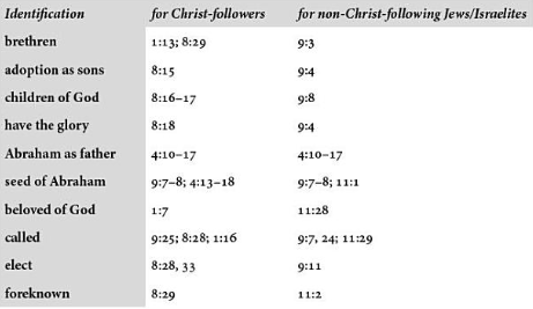
Reading Romans within Judaism, p. 225
Nanos explains how Paul applies such language to both groups:
The idea that Paul sees these as two distinct identity groups, as former versus current family, so central to the idea of replacement theology, is not in keeping with the way that Paul’s reasoning reveals itself on these matters—he argues for this and that, not this or that. These non-Jews (non-Israelites) who become members of the people of God through Jesus Christ join together with Jews (Israelites), who remain the people of God, whether Christ-followers or not; they do not displace them (Reading Romans within Judaism, p. 225).
Hall similarly understands 1 Peter 2:9-10 as indicating that “we’re [Christians are] the chosen nation,” insisting that the passage is “talking about the Christian Church, which is chock-full of Gentiles” and “not talking about Jews.” This New Testament passage reads:
But you are a chosen people, a royal priesthood, a holy nation, God’s special possession, that you may declare the praises of him who called you out of darkness into his wonderful light. Once you were not a people, but now you are the people of God; once you had not received mercy, but now you have received mercy (1 Peter 2:9-10).
However, LeTourneau University Professor of Biblical Studies and Theology Kelly D. Liebengood has argued that this passage does not mean that the Church has replaced Israel:
Peter welcomes his gentile addressees into what the God of Israel is doing in and through his Davidic shepherd king, Jesus. This welcome entails an entirely new way for gentiles to orient themselves to the world. This helps explain the “people, race, and nation” language of 1 Pet[.] 2:9-10. Peter draws on such terms, not in order to suggest that these gentile followers of Jesus replace Israel, but instead to illustrate the profound change that is required for these gentile addressees to align themselves with Israel’s Messiah (Reading 1 Peter After Supersessionism: Jewish Apostolic Affirmation of Gentile Israelhood, p. 203).
Hall eisegetically reads his misunderstanding of Paul back into Genesis 12 when he states the promise found in Genesis 12 “never was for the Jews.” In fact, Cornell notes that reading Genesis 12 in light of the Priestly Blessing found later in Scripture suggests Abraham and his descendants are intended:
[R]eading Genesis 12 toward the Priestly Blessing means emphasizing its internal profile, […] its ultimacy. The Priestly Blessing is for Israelites, squarely on their behalf and not for any others. The promise to Abraham should be read in this way[,] too. It addresses Abraham and his descendants. They are the intended recipients of divine favor and protection. They are not instruments or channels. They are ends and not means (God Draws Near, p. 116).
Similarly, Cornell observes that interpreting Genesis 12 in light of Psalm 72 also suggests Abraham and his descendants are in view:
Like Genesis 12, Psalm 72 projects its blessing into far lands. The blessing of God affects the farthest geographic and national realms. Psalm 72 also shares in common with Genesis 12 a concern for the name or reputation of its central figure, and the psalm includes a promise of land. Above all, Psalm 72 shows how the promise to Abraham can be internal or ultimate, intended for Abraham and his descendants and not for any others beyond them (Ibid., p. 121).
While Hall suggests Paul does not believe this land promise applies to Abraham’s physical descendants, there are multiple indications in Paul’s writings that Paul does. For example, in Romans 9:4, Paul states that the “glory” (doxa), “covenants” (diathēkai), “giving of the law” (nomothesia), and “worship” (latreia) belong to his kinsmen “according to the flesh” (fellow Jews). Explaining the connection of “glory” and “worship” to the territory of the land of Israel, Boston University Aurelio Professor of Scripture Emerita, Hebrew University of Jerusalem Comparative Religion Professor, and New Testament scholar Paula Fredriksen notes:
Behind Paul’s Greek word for “glory” stands the Hebrew kavod, which refers specifically to God’s glorious presence, thus to the location of that presence, namely his temple in Jerusalem. And latreia (“worship” or “offerings”) points to the Hebrew avodah: Paul here names the sacrificial cult, revealed in scripture and enacted around Jerusalem’s altar, as a defining privilege of Israel (Paul: The Pagans’ Apostle, p. 35).
In speaking of the eschatological future in Romans 9:25-26, Paul quotes a passage from the biblical book Hosea, but adds terminology emphasizing geography that does not appear in any known version of the Septuagint: “And in the very place where it was said to them, ‘You are my people,’ there they shall be called children of the living God” (Hos. 1:10) (additional terminology in italics). Commenting on the significance of this terminological addition to the biblical text by Paul, Rudolph observes:
Since the Greek word ἐκεῖ (translated “there” in Rom[.] 9:26) does not appear in any known Septuagint version of Hosea, it would seem to suggest that Paul is placing an emphasis on this geographic location. What do the words “in the very place” and “there” point to? In the context of Hosea 1, these terms refer to the land of Israel. Moreover, the Hosea 1:10 text that Paul quotes is in the middle of the prophet’s description of how the land and seed promises to the patriarchs are fulfilled in the eschaton. In Hosea, a messianic king is appointed and then possession of the land is restored” (The New Christian Zionism, p. 192).
Paul states in Romans 11:25-26:
I do not want you to be ignorant, brothers, of this mystery,…that insensibility has come upon a part of Israel, until the fullness of the nations comes in, and then all Israel will be saved, as it is written, “A Redeemer will come from Zion, he will banish impiety from Jacob.” “And this will be my covenant with them, when I take away their sins” (Isa. 59:20-21; 27:9).
In commenting on this passage in Romans, Levine explains how Paul may very well have had land and the Jewish people in view:
Paul’s reference to “all Israel” (Romans 11:26a) may well mean exactly that—the Jewish nation, Abraham’s descendants according to the flesh. In Paul’s view, their salvation will occur together with the salvation of the non-Jews, as in Romans 15:10: “and again he says, ‘Rejoice, O gentiles/pagans with his people’” […] Jews are not subsumed into a broader assembly, and they do not lose their ethnic identity. Since they do not lose their ethnic identity, they do not lose their connection to the land. Rather, that connection, like circumcision and kashrut and Shabbat-observance, is presupposed. The focus on the land is then reinforced in Romans 11:26b, when Paul presumes the ongoing role of Zion, whence the Deliverer will come (Peace and Faith, p. 144).
Fredriksen also argues that this passage in Romans expresses Paul’s expectation regarding the future restoration of the twelve tribes of Israel in the land. As Fredriksen observes:
When Paul speaks of End-time redemption, he too recalls this ancient lineage going back to Noah: the gentiles’ plērōma means “all seventy nations.” So too Paul’s evocation of the plērōma of Israel, pas Israēl: his phrasing recalls the patriarchal narratives, the lineage of Abraham passing through Isaac to Jacob and thence to Jacob’s twelve sons, the “fathers” of Israel’s tribes. “All Israel” conjures the full restoration of these twelve tribes, another traditionally eschatological event. As in Deuteronomy 32.43, which Paul will quote at the end of this letter, so also here in Romans 11: the ingathering of Israel is linked immediately to the inclusion of the nations” (Paul, p. 161).
Paul’s allusions in Romans 11:26-27 to Isaiah 27:9 and 59:20 also suggest that Paul conceived of Israel’s salvation as having a territorial dimension. This idea is indicated in an analysis of this Romans passage with its intertextual allusions to Isaiah by St. Bonaventure University Professor Emeritus of Theology and Franciscan Studies Christopher Stanley adduced by Nanos:
Though the story is not identical, the obvious parallels between this passage [Isa. 27:9] and Isa. 59.20-63.7 make it easy to see why an ancient reader (who worked from the premise of a unified Scripture) might have felt compelled to interpret the one passage in the light of the other […] Both passages reach their climax in the return of the dispersed children of Israel to their land, in the one case by the supernatural activity of Y[-]H[-]W[-]H himself, in the other by the hand of the defeated nations. The final scene shows the fulfillment of all the dreams and aspirations cherished by Y[-]H[-]W[-]H’s people over the years: eternal peace and security in their own land (The Mystery of Romans, p. 280).
Another indication that Paul had the restoration of the people of Israel to the land of Israel in mind in speaking of Israel’s salvation is his reference in Romans 11:27 to Jeremiah 31, where Israel’s restoration to the land is discussed. As J. Brian Tucker explains:
Within a future eschatological miracle understanding of “all Israel will be saved” is an often overlooked idea that this also means that Israel will need to be restored to the land […] In Rom[.] 11:27, Paul writes, “And this is my covenant with them, when I take away their sins.” This citation from Jeremiah 31 highlights the prophetic hope for the restoration of the houses of Judah and Israel (Jer[.] 31:31, 33-34). The context of Jeremiah predicts a return from exile to the land for God’s people […] It is more likely that Paul has been moving towards the conclusion that begins at 9:13: “his concern for Israel includes her exile … his hope for Israel’s salvation includes the restoration of Israel and Judah.” The reference to Jer[.] 31:33 in Rom[.] 11:27 suggests that since restoration in the land was part of the prediction in Jeremiah, part of the “mystery” that Paul is revealing includes Israel’s restoration. This is particularly probable given the subjugation of Israel at the hands of the Romans in Paul’s day (Reading Romans After Supersessionism, pp. 192-194).
Therefore, while Hall claims the Pauline epistles do not regard Jews who do not believe in Jesus as “children of Abraham” or as recipients of biblical promises, including one of land, Paul’s letters appear to indicate otherwise.
Hall Suggests Its Jews-as-Chosen People Belief Contradicts Most Christian Confessions
In the interview, Hall suggests that belief in Jews as chosen people of God is incompatible with most Christian confessions: “[T]he vast majority of Christendom has a confession of faith for their specific church that does not allow for the belief that the Jews are the chosen people of God.”
In fact, according to the World Christian Database, Catholics comprise approximately 51% of affiliated Christians globally, and the Catechism of the Catholic Church identifies the Jews as “Israel” and “the priestly people of God”: “Israel is the priestly people of God, ‘called by the name of the Lord,’ and ‘the first to hear the word of God,’ the people of ‘elder brethren’ in the faith of Abraham (CCC 63).”
After the Holocaust, prominent Christian denominations distanced themselves from supersessionism, believing it served as “an intellectual accomplice to the Holocaust” (God Draws Near, p. 177). In distancing themselves from supersessionist beliefs, a number of such denominations explicitly affirmed God’s election of the Jewish people. For example, the Presbyterian Church (USA) document Christians and Jews: People of God affirms “the mystery of God’s election of both Jews and Christians to be a light to the nations.” Similar statements affirming God’s election of the Jewish people have been issued by the Alliance of Baptists, Disciples of Christ, and Episcopal Church.
The scholars of Christian Zionism Motti Inbari and Kirill Bumin have also noted that 2025 survey research indicates that 68.8% of American Evangelical “respondents who share the theological beliefs that the National Association of Evangelicals [(NAE)] sees as fundamental to the evangelical faith” and 51.3% of non-NAE Protestants report they believe “God’s covenant with the Jewish people remains intact today.”

“Christian Attitudes Toward Israel and the Jewish People: New Survey Results Uncovered”
Hall Suggests It Is Identical with Dispensationalism While Excluding Alternative Forms
Hall suggests: “That [Christian Zionism] is tied to a theology called dispensationalism,” giving viewers the distinct impression that all Christian Zionists subscribe to dispensationalism.
In fact, many Christian Zionists do not accept dispensational, millenarian beliefs, but simply affirm a belief in Israel’s continuing role in divine providence and the connection of the Jewish people to their ancestral homeland. For example, a volume on the “New Christian Zionism” featuring Mainline, Evangelical, Aramean, and Messianic figures and edited by McDermott explains:
The Christian Zionism that this book proposes is not connected to the dispensationalism [that puts Israel and the church on two different tracks, neither of which runs at the same time and is attached to an elaborate schedule of end-time events dominated by the great tribulation and a rapture of the church that leaves Jews and the rest of the world behind]. It looks to a long history of Christian Zionists who lived long before the rise of dispensationalism and to other thinkers in the last two centuries who have had nothing to do with dispensationalism—theologians such as Karl Barth, Reinhold Niebuhr, Robert Jenson and the Catholic Old Testament scholar Gary Anderson, as well as President Harry Truman (The New Christian Zionism, p. 11).
Similarly, Villeneuve has also indicated it is possible for Catholics to simultaneously reject premillennialism and dispensationalism while viewing “the return [of Jews] to the Land [of Israel] and the creation of the State [of Israel]” as “a step toward Israel’s recognition of her true Messiah.”
Hummel has also observed that eschatology is less central to the most activist circles of Christian Zionism: “In its most activist circles today, Christian Zionism is less about apocalyptic theology or evangelism than it is a range of political, historical, and theological arguments in favor of the State of Israel based on mutual and covenantal solidarity” (Covenant Brothers: Evangelicals, Jews, and U.S.-Israeli Relations, p. 3).
Similarly, the University of Florida Hamilton School Associate Professor of Humanities and expert on Christian Zionism Samuel Goldman has argued that a recognition that God’s relationship with the Jewish people endures, not biblical prophecy interpretation, constitutes the core of Christian Zionism:
Rather than Daniel’s seventieth week or Isaiah’s foretelling of the restoration of Jerusalem, the core idea of Christian Zionism is that God’s relationship with the Jewish people [the covenant] was not severed with the advent of Christ. What many Christian Zionists hope to do is to return that idea to the centrality that they believe it deserves (God’s Country: Christian Zionism in America, p. 175).
An empirical indication that eschatology plays less of a role in motivating young evangelical advocates of Christian Zionism is found in survey data analyzed by Inbari and Bumin showing a “relative decline of premillennialism” among this demographic (Christian Zionism in the Twenty-First Century: American Evangelical Public Opinion on Israel, p. 163). Inbari and Bumin observed that 20% of young evangelical Christian Zionists “gave political, historical, or foreign policy justifications” (Ibid., p. 152) for such support, not eschatological reasons. Moreover, among the 59% of young evangelicals supporting Israel who provided “religious arguments” for their support for the Jewish State, the top three arguments provided did not explicitly reference the eschatological beliefs to which Hall alludes. In fact, Inbari and Bumin found:
[E]schatological statements which require that the support for Israel is followed up by deliberate action by the believers (e.g., rebuilding the Third Temple, or expecting Jews to convert to Christianity with Jesus’ Second Coming) came last on a long list of motivations for supporting Israel (Ibid., p. 175).
In explaining the significance of this finding, Inbari and Bumin note: “This means that warmer eschatological expectations [that require that the support for Israel is followed up by deliberate action by the believers] […] do not play a significant role in the motivations of the contemporary evangelical audience” (Ibid.).
Hall Suggests Its Belief in Blessing Jews is Inconsistent with the New Testament
In the interview, Hall suggests that the belief that it is important for Christians to bless Jews is inconsistent with the New Testament when he states: “You have these so-called Christian Zionists who believe that we have to bless Jews […], and they’re actually giving away their own inheritance.” However, New Testament texts suggest that Gentile expressions of special love and support for the Jewish people are not only consistent with the gospel message, but also an indication of Gentile worthiness. For example, Acts highlights Cornelius’ special devotion to the Jewish people as a normative expectation of Gentiles wishing to draw near to Israel’s God. As Kinzer observes:
[T]he evidence suggests that he [Luke] also expected Gentile Yeshua-believers to maintain a special love for the people of Israel […] It is clear that “the people” to whom Cornelius gives alms are the Jewish people. This Gentile fears the God of Israel, observes the times of prayer customary among devout Jews, and provides financial assistance to needy Jews. Like his comrade in Capernaum, he demonstrates his worth in part through his evident concern for the welfare of the Jewish people (Postmissionary Messianic Judaism, pp. 114-115).
The New Testament, thus, suggest that Gentile blessing of Jews is fundamentally consistent with the Apostolic Message, which upholds such behavior as worthwhile and virtuous.
Hall Suggests a Belief that Non-Jesus-Believing Jews Can Teach Spiritual Truths is Invalid
Hall criticizes dispensationalism as “a Jewish interpretive model” that “interpret[s] the Scripture the way the Jews interpret the Scripture,” suggesting that since “the Jews missed Jesus,” Christians cannot benefit from learning Jewish interpretations of Scripture.
However, a Christian refusal to understand Jewish modes of interpretation is likely to impede Christian understanding of New Testament texts given New Testament texts’ incorporation of Jewish interpretations.
Moreover, the New Testament suggests that non-Jesus-believing Jews might very well perceive a great deal of spiritual truths that do not pertain to the Messiah. Garrett Seminary Emeritus Professor of Early Christian Literature Charles Cosgrove interprets Paul’s statement that “a hardening has come upon part of Israel” (Romans 11:25) as indicating that Israel’s perception of spiritual truths is only partially obscured, specifically concerning the Apostolic Message regarding Jesus:
The expression apo merous (“in part”) is perhaps most naturally taken adverbially: “a hardening has come in part on Israel.” The alternate is to construe it as an adjectival phrase modifying “Israel”: “A hardening has come on Israel in part.” If we adopt the adverbial interpretation, it seems most reasonable to conclude that the partial hardening pertains to Jewish response to the Christian gospel about Jesus, not to a general blindness toward righteousness and the meaning of the scriptures. The “hardening” of Israel means not that Israel is, on the whole, blind but that God has given Israel a limited blind spot toward Christ (Elusive Israel: The Puzzle of Election in Romans, pp. 16-17).
A 1985 document published by the Pontifical Commission for Religious Relations with the Jews, “Notes on the Correct Way to Present Jews and Judaism in Preaching and Catechesis in the Roman Catholic Church,” promotes “Christians […] profiting discerningly from the traditions of Jewish reading,” adding that Pope John Paul II stated: “The faith and religious life of the Jewish people as they are professed and practiced still today, can greatly help us to understand better certain aspects of the life of the Church.”
Pontifical University of St. Thomas Aquinas Lecturer Gavin D’Costa has argued that this document’s recognition of the importance for Catholics to comprehend Jewish self-understanding “becomes theologically significant[,] [f]or in this process, Catholics might see the face of God, the Father of Jesus Christ, and witness to His presence in ways they have not been cultivated to discern until recently” (Catholic Doctrines on the Jewish People after Vatican II, p. 56).
Villainization of Jews
Hall Portrays Pharisaic Forerunners of Rabbinic Jews as Uniformly Hostile to Jesus
In the interview, Hall portrays the Pharisees as uniformly hostile to Jesus: “[T]he Pharisees plotted to kill Jesus […] Jesus looks to the Pharisees, and he says, ‘You’re plotting to kill me. This is what you’re trying to do.’” However, the New Testament paints a more complicated picture of the Pharisees than Hall’s description allows.
While Hall suggests most of the blame for Jesus’ death falls on the shoulders of the Pharisees, Mark and Luke avoid blaming the arrest, trial, and execution of Jesus on the Pharisees. In Luke, Pharisees extend invitations to Jesus to eat at their homes (Luke 7:36-50; 11:37-52; 14:1-24) and attempt to protect Jesus from danger by warning him that Herod Antipas seeks Jesus’ arrest and execution (Luke 13:31-33).
Acts portrays the Pharisee Gamaliel as speaking on behalf of the Jesus movement within the Sanhedrin and securing the release of apostles who have been imprisoned (Acts 5:34-40). In addition, Acts describes Pharisees joining the Jerusalem Church, with Paul proudly self-identifying in the present tense as a Pharisee: “I am a Pharisee, a son of Pharisees” (Acts 23:6).
In summarizing the portrayal of Pharisees in Luke-Acts, Kinzer states: “[T]he Lukan writings do not present the Pharisees as the enemies of Yeshua, of his followers, or of the good news. Instead, Luke sees them as those Jews most open, sympathetic, and helpful to the new movement” (Postmissionary Messianic Judaism, p. 256).
The aforementioned Catholic document, “Notes on the Correct Way to Present Jews and Judaism in Preaching and Catechesis in the Roman Catholic Church,” also underscores the complexity of how Pharisees are presented in the New Testament: “His [Jesus’] relations with the Pharisees were not always or wholly polemical. There are many proofs: It is Pharisees who warn Jesus of the risks he is running (Lk. 13:31); [s]ome Pharisees are praised (‘the scribe’ of Mk. 12:34); Jesus eats with Pharisees (Lk. 7:36; 14:1).”
In addition, a 1988 document published by the National Conference of Catholic Bishops’ Committee for Ecumenical and Interreligious Affairs, “Criteria for the Evaluation of Dramatizations of the Passion,” similarly states: “Jesus and his teachings should not be portrayed as opposed to or by ‘the Pharisees’ as a group (Notes III, 24) […] The Pharisees should not be depicted as party to the proceedings against Jesus (Notes III, 24-27).”
Carlson and Hall Idealize the New Testament’s Depiction of Gentiles at the Expense of Jews
Carlson and Hall idealize the New Testament’s portrayal of Gentiles at the expense of Jews, with Carlson inaccurately stating:
Jesus also goes out of his way in the Gospels to praise the faith of pagans. I mean, a Roman officer was the first person to recognize that Jesus was the son of God at his death. The Roman officer whose slave he heals. He says, “I have not seen any faith like this in all of Israel” […] He’s always picking people from outside the tribe.
Hall concurs with Carlson while condemning the alleged deliberate Jewish rejection of Jesus as Messiah, lambasting a caricature of Rabbinic Judaism, and demonizing Jews. Even when Hall acknowledges that Romans crucified Jesus, the conversation pivots to discuss Gentile repentance in contrast to alleged Jewish misbehavior.
Although Carlson claims that Jesus is “always picking people from outside the tribe,” all twelve disciples whom Jesus selects are from “inside the tribe.” While Matthew depicts Jesus as remarking on the faith of the Roman centurion, Kinzer has pointed out that Matthew does not “idealize Gentiles at the expense of the Jews,” with Matthew frequently depicting Jesus as using the term “Gentile” with a negative connotation even if Matthew is not “anti-Gentile” (Postmissionary Messianic Judaism, pp. 102-103).
For example, Matthew depicts Jesus as contrasting appropriate behavior with Gentile behavior when he states: “For if you love those who love you, what reward do you have? Do not even the tax collectors do the same? And if you greet only your brothers and sisters, what more are you doing than others? Do not even the Gentiles do the same” (Matthew 5:46-47)?
When it comes to other subjects, like prayer and material needs, Jesus draws the same distinction. With regard to the former, Jesus states: “When you are praying, do not heap up empty phrases as the Gentiles do; for they think that they will be heard because of their many words” (Matthew 6:7). Concerning the latter, Jesus states: “Therefore[,] do not worry, saying, ‘What will we eat?’ or ‘What will we drink?’ or ‘What will we wear?’ For it is the Gentiles who strive for all these things; and indeed your heavenly Father knows that you need all these things” (Matthew 6:31-32). Similarly, Jesus states: “If the offender refuses to listen even to the church, let such a one be to you as a Gentile and a tax collector” (Matthew 18:17).
Carlson also omits that in Luke’s account of the Roman centurion, the first indication of the centurion’s faith is his evident concern for the well-being of the Jewish people. As Kinzer observes:
In Luke[,] the centurion asks leaders of the local Jewish community to present his petition to Yeshua. He does this because he considers himself unworthy to make such a request or to have a Jewish holy man enter his non-Jewish house (Luke 7:6-7). In acting as his agent, the delegation of Jewish leaders argues that[,] in fact[,] this Gentile is worthy to receive Yeshua’s help, “for he loves our people” and “built our synagogue for us” (Postmissionary Messianic Judaism, p. 115).
In summarizing how the centurion functions in Luke’s narrative, Kinzer states: “Luke presents this centurion as a paradigmatic Gentile convert to the Yeshua movement, whose love for the God of Israel is expressed both in concern for the people of Israel and in ready acceptance of the Messiah of Israel” (Ibid.). Carlson does not share these important points with his viewers.
Hall Describes Jews as Deliberately Rejecting Jesus as Messiah
Hall portrays the fact that most Jews did not believe Jesus was the Messiah as a deliberate and willful decision on their part, understanding that Jesus was the Messiah, but rejecting him anyway:
[I]t would be hard for them not to recognize that Jesus was the Messiah. He’s crucified at Passover. He is the lamb of God who takes away the sins of the world. I mean, all the imagery is right there for the Jewish people to see that this is the moment that we’ve been waiting for.
Later in the interview, Hall similarly states: “Jesus raises Lazarus from the dead. They see it. They recognize that he’s the Messiah. The Sanhedrin, which is the ruling council, comes together, and they immediately plot to kill Jesus.”
However, Luke depicts Jesus on the cross stating: “Father, forgive them, for they do not know what they are doing” (Luke 23:34). Hall claims that Jesus here is “speaking of the Romans, not the Jews […] about those who are actually doing the crucifixion.” However, Ehrman argues that this statement is about the Jews, not the Romans: “In its Lukan context, the prayer appears to refer [not to the Roman soldiers who have just done the deed but] to the Jewish leaders who in their ignorance have caused Jesus to be crucified” (italics in original).
In fact, Ehrman notes that patristic authors typically understood Jesus’ prayer to be about the Jews, “[a]t least […] in the earliest accounts of its exposition that we have, already at the beginning of the third century by Origen and the author of the Didascalia.”
Ehrman notes that some biblical manuscripts beginning in the second century omit this verse, probably because “[m]any Christians in the second century were convinced […] that God had not forgiven the Jews,” so some Christian scribes decided to remove a verse indicating Jesus asked God to forgive the Jews rather than keeping the verse in the manuscript and grappling with how Jesus could have prayed such a prayer.
Bradley University Professor of Religious Studies and New Testament scholar Isaac W. Oliver also argues that Jesus is speaking about the Jews in his prayer:
The longer reading of Luke 23:34[,] which contains “Father, forgive them, for they do not know what they are doing[,]” is probably original to Luke. It sets up the stage for the Jews in Acts to repent from their wrongdoing. Sanders, The Jews in Luke-Acts, 359 n. 159, maintains that early Christian copyists who were “anti-Semitic” omitted the saying to deny any semblance that Jesus excused his fellow Jews for his execution. More recently, Nathan Eubank, “A Disconcerting Prayer: On the Originality of Luke 23:34a,” JBL 129 (2010): 521-36, has made a compelling case on both internal and external grounds for the priority of the longer reading (Luke’s Jewish Eschatology: The National Restoration of Israel in Luke-Acts, p. 218).
Ironically, the prayer Luke depicts Jesus as uttering on the cross and that Hall references while condemning Jewish practice that developed in the aftermath of Jesus’ resurrection shows strong affinities with Jewish liturgical practice. Seton Hall University Cooperman/Ross Endowed Chair of Jewish-Christian Studies Rabbi Alan Brill notes that the late Chief Rabbi of the United Hebrew Congregations of the Commonwealth Lord Jonathan Sacks in answering a question about Jesus at the 2008 Lambeth Conference of Anglican Bishops remarked:
There is a line we say at the beginning of the prayers on the Holiest of Holy Days: Yom Kippur (Kol Nidre) … the high priest said on the Day of Atonement: [“]Forgive them father, for they know not what they do.[”] If Jesus said those words on the cross, then Jesus was at his most Jewish. At that moment[,] Jesus was delivering a Jewish message […] The Christ delivering the message to the world. We did not take it to the world. We are few. You are many. You took it to the world. You have taken that message of one who was a Jew to the world. Take that message as a Jewish message: forgive them[,] Father (A Jewish Trinity: Contemporary Christian Theology through Jewish Eyes, pp. 163-164).
While Hall suggests Jews who put Jesus to death recognized he was the Messiah given that the “old covenant religion of Moses […] allowed them to see and understand the Messiah and what Jesus would do on the cross,” The King’s University Theological Studies Department Chair, Master of Theological Studies Program Director, and Biblical Studies Assistant Professor Jason F. Moraff has noted how a central theme in Luke is that “all Israel, including Jesus’ own followers, fail to see Jesus rightly” (Reading the Way, Paul, and “The Jews” in Acts Within Judaism: “Among My Own Nation,” p. 141), with the text of the Torah on its own apparently insufficient to ensure a proper understanding of Jesus among Jews: “[T]he only time συνίημι is used to describe someone comprehending accurately is when Jesus opens the disciples’ minds to understand the Scriptures (24:45; cf. 8:10; 18:34; 24:45; Acts 7:25; 28:26-27)” (Ibid., p. 145). As Moraff explains:
Jesus provides an interpretive guide to understand the Scriptures (24:27, 45-47). Opening Scripture is not what opens eyes or minds, though. Encountering Jesus does […] [D]isciples[,] too[,] need Jesus to open their eyes so as to generate fidelity (cf. 8:25). Jesus, therefore, interprets the Scriptures and opens their minds to understand the message about his suffering and resurrection, which they had previously failed to grasp (24:44-49; cf. 18:34; Acts 28:26-27). Their sight and knowledge were better than others in Israel, yet they suffered from the same imperceptiveness. They[,] too[,] needed direct encounter with and intervention from the risen Jesus to remedy their blindness. Jesus had to reorient them, as must be done for all Israel, on the journey from darkness to light (Ibid., p. 152).
Moraff notes that Luke indicates the identity of Jesus has been hidden from Israel, echoing language found in the Old Testament:
It “was hidden (παρακεκαλυμμένον) from them so that they did not perceive it (μὴ).” The second time Luke makes this point, he emphasizes the hiddenness (κεκρυμμένον) of this message by bracketing it between two comments about the apostles’ obliviousness (18:34). Luke’s terms again echo the servant and his mission in Israel. The “hiddenness” of the messianic mission faintly echoes God’s hiding (ἔκρυψέν) of the servant in his hand and quiver (Isa[.] 49:2; cf. 44:8) (Ibid., p. 146).
It is important to note that Acts depicts Gentiles as ignorant as well (e.g., 14:15 and 17:30). However, while Paul describes Satan as responsible for blinding Gentile unbelievers, he holds that God has caused most Jews to be in a temporary state of unbelief regarding Jesus. As The King’s University Professor of Theology Douglas Harink explains:
Paul insists that the current condition of Israel’s “hardening” is entirely God’s doing. Israel’s actions and moral condition […] do not enter the picture at all. If Israel “remains bound” in a condition, it is because God has bound it there (11:32). Indeed, that is precisely the point of Paul noting, with reference to Jacob and Esau, that God’s purpose was declared to Rebecca “before they had been born or had done anything good or bad…” (9:11). God’s choosing “the younger,” Jacob, is not injustice on God’s part precisely because the issue is not about moral success or failure but about God’s mercy and hardening, enacted not with respect to moral condition, but strictly with respect to a divine purpose that must be accomplished (Paul among the Postliberals: Pauline Theology Beyond Christendom and Modernity, p. 170).
Hall references speeches delivered by Peter and Stephen in Acts as evidence for Hall’s charge that “[t]he Jews killed Jesus,” but neither Peter nor Stephen blames “the Jews” for the death of Jesus. As Brite Divinity School Professor of New Testament Shelly Matthews has observed:
In these accusations of Christ killing, the groups responsible are never said to be “the Jews”/hoi Ioudaioi. They are rather “residents of Jerusalem,” “rulers,” “Israelites,” and sometimes “you” –the Jewish groups listening to Peter, Paul, and Stephen speak. Because the specific agents accused in these speeches can vary, some argue that Acts restricts blame for the killing of Jesus to a subgroup of Jews, rather than to the Jews as a whole” (Judeophobia and the New Testament: Texts and Contexts, p. 162).
The Second Vatican Council document, Nostra Aetate, also underscores: “[W]hat happened in His [Jesus’] passion cannot be charged against all the Jews, without distinction, then alive, nor against the Jews of today.”
In Acts, Jews who opposed Jesus are described as having acted in ignorance. For example, Acts 3:17 reads: “And now, friends, I know that you acted in ignorance, as did also your rulers.” Similarly, Acts 13:27 reads: “Because the residents of Jerusalem and their leaders did not recognize him or understand the words of the prophets that are read every sabbath, they fulfilled those words by condemning him.”
The belief that such Jews had acted in ignorance is also reflected in The Tridentine Catechism commissioned by the Council of Trent in 1562:
[Christian sins] seem graver in our case than it was in that of the Jews; for the Jews, as the same Apostle says, “would never have crucified the Lord of glory if they had known him” (1 Cor. 2.8). We ourselves maintain that we do know him, and yet we lay, as it were, violent hands on him by disowning him in our actions (Catholic Doctrines on the Jewish People after Vatican II, p. 2).
To suggest, as Hall does, that “the Jews” deliberately rejected and murdered Jesus, thus, seems to conflict with Scripture and Church teaching.
Hall Presents One Negative Rabbinic View of Jesus While Excluding Positive Views
In the interview, Hall references “Jews that believe the typical teaching in the Talmud about Jesus being punished in hell.” Hall’s statement leaves readers with the impression that this negative “teaching” is standard in the Talmud. However, a miniscule portion of the vast collection of Talmud tractates features the figure of Jesus, and even there, the views expressed differ. As the Jewish Theological Seminary Appleman Professor Emeritus of Midrash and Interreligious Studies Burton L. Visotzky observes: “[L]ess than one-half of [one] percent of rabbinic literature concerns Jesus or Christianity, and within these very few passages, attitudes vary depending upon the era and provenance of each text’s composition” (The Jewish Annotated New Testament: Third Edition, p. 860).
Hall leaves readers with the impression that the Talmud features uniformly negative attitudes toward Jesus, but other Talmudic texts give voice to a positive view on his teaching. For example, t. Hul. 2.24 features a prominent rabbi expressing admiration for Jesus’ teaching (Ibid.).
Rabbi Dr. Byron L. Sherwin—a student of Rabbi Dr. Abraham Joshua Heschel, a leading twentieth-century American Jewish theologian who taught at the flagship institutions of the Reform and Conservative Jewish movements in the United States (Hebrew Union College and Jewish Theological Seminary, respectively)—has noted that some historians have argued that “the idea of the Messiah son of Joseph [found in the Talmud] was developed as an attempt to give Jesus a place within Jewish messianic theology” (Jesus Through Jewish Eyes: Rabbis and Scholars Engage an Ancient Brother in a New Conversation, p. 39).
In explaining Sherwin’s view, Professor of Modern Jewish Studies in Residence at Harvard Divinity School Shaul Magid observes:
Sherwin deploys it [the historical claim] to suggest that the Joseph messiah [found in the Talmud] was invented as a tool to attract Jewish Christians back into Judaism […] by acknowledging Jesus’ unique role but arguing that it did not require breaking with the Mosaic law. In this sense, the doctrine of the Joseph messiah could be viewed as a rabbinic gesture to Jewish Christians (The Jewish Jesus: Revelation, Reflection, Reclamation, p. 367).
Princeton University William H. Danforth Professor of Religion Martha Himmelfarb notes that the University of Tübingen Religious Studies and Jewish Studies scholar Holger Zellentin has argued that Babylonian Talmud passages “respond to Christian claims […] by identifying the messiah son of Joseph, the ‘secondary messiah’ of Palestinian rabbinic tradition, with Jesus” (Jewish Messiahs in a Christian Empire: A History of the Book of Zerubbabel, p. 113).
Hall does not share with viewers that textual variation and reception history complicate a straightforward identification of the figure described in this passage with Jesus, as some manuscripts do not read “Jesus the Nazarene (Yeshu ha-notzri),” but rather “the sinners of Israel” (posh‘e Yisrael), and prominent rabbis, like Yechiel ben Yosef and Moses Nahmanides, have contested this identification in texts such as this. This contestation is also unsurprising given what the late Hebrew Union College – Jewish Institute of Religion Sol and Arlene Bronstein Professor of Judeo-Christian Studies Rabbi Michael J. Cook observed: “The rabbis mentioned Jesus in connection with various figures whose time frames, when combined, spanned at least two centuries” (Jesus Through Jewish Eyes, p. 12).
Hall also fails to inform viewers about the oppressive conditions experienced by Jews living under Christian imperial rule that influenced rabbinic writing. As Visotzky notes:
Because imperial Christianity oppressed Jews by systematically excluding them from communal governance over time by not allowing them to hold public office, and early medieval Christian legal codes proscribed aspects of Jewish religious practices such as circumcision, rabbinic texts from those periods reflect Jewish subjugation under Church hegemony. These texts sometimes are quoted today by scholars and others referring to early Judaism without any historical context or recognition of how minuscule a portion of rabbinic literature they occupy, creating the wrong impression that rabbinic literature as a whole was deeply disrespectful to Jesus and Christianity (The Jewish Annotated New Testament, pp. 860-861).
Even if this specific story was historically written about Jesus, it is found in an aggadic portion of the Talmud generally not regarded as binding on Jews. Indeed, leading rabbinic authorities in later years have offered positive assessments of Jesus. For example, Rabbi Jacob Emden, a leading Talmudist, maintained:
[T]he Nazarene and his Apostles did not wish to destroy the Torah from Israel, God forbid; for it is written so in Matthew (Mt. 5:17), the Nazarene having said, “Do not suppose that I have come to abolish the Torah. I did not come to abolish, but to fulfill. I tell you this: So long as heaven and earth endure, not a letter, not a stroke, will disappear from the Torah until it is achieved. If any man therefore sets aside even the least of the Torah[’]s demands, and teaches others to do the same, he will have the lowest place in the Kingdom of Heaven, whereas anyone who keep the Torah, and teaches others so, will stand high in the Kingdom of Heaven.” This is also recorded in Luke (Lk. 16:17). It is therefore exceedingly clear that the Nazarene never dreamed of destroying the Torah […] It is therefore a habitual saying of mine […] that the Nazarene brought about a double kindness in the world. On the one hand, he strengthened the Torah of Moses majestically, as mentioned earlier, and not one of our sages spoke out more emphatically concerning the immutability of the Torah. And on the other hand, he [the Nazarene] did much good for the Gentiles … by doing away with idolatry and removing the images from their midst” (Seder Olam Rabbah veZuta, cited in Chapter 1 of Jesus the Pharisee: A New Look at the Jewishness of Jesus, pp. 17-18, 20-21).
Rabbi Elijah Zvi Soloveitchik of the prominent Soloveitchik family of Talmudic scholars that would include Rabbi Dr. Joseph B. Soloveitchik—widely regarded by Modern Orthodox Jews as a leading twentieth-century rabbi who taught at American Modern Orthodoxy’s flagship institution, Yeshiva University—was inspired by Rabbi Jacob Emden and similarly held:
Jesus the Nazarene brought double good to the world. On one hand[,] he strengthened Moses’ Torah with all his strength (according to what was written in Matthew). There is not one of the sages that spoke more on the obligation of the eternal fulfillment of the Torah[,] and on the other hand[,] he brought much good to the nations of the world except they falsified his desired intentions. May God grant us all, Jews and Christians, that we may follow the teachings of Jesus and his shining example, for our well[-]being in this world and our salvation in the next. Amen (Judaism and Other Religions: Models of Understanding, p. 90).
By flattening the diversity of perspectives on Jesus found in the Talmud and among later Talmudists and rabbinic authorities while failing to inform viewers about textual variants between manuscripts, different opinions about who the text describes, and the oppressive historical conditions that influenced rabbinic writing, Hall leaves readers with the misimpression that non-Jesus-believing Jews share a uniformly negative view of Jesus. This is simply not the case. In fact, a 2017 Barna Group study found that 28% of Millennial American Jews identified as “Judaism Only” (as opposed to, for example, “Judaism & Christianity”) reported believing Jesus is “a prophet / spiritual leader / rabbi, not God” (Jewish Millennials: The Beliefs and Behaviors Shaping Young Jews in America, p. 78).
Hall Claims Jews Pray for the Damnation and Destruction of the Nations at Passover
Hall claims that Jews pray for the “damnation” and “destruction” of “the nations” during the Passover seder: “Between the third and the fourth cup, they drink to the damnation of the nations […] [T]hey take a drink, and they pray a prayer specifically for destruction of the nations, the goy, the goyim.”
In fact, the portion of the haggadah to which Hall appears to allude is simply a verbatim quotation of passages from the Bible that Hall claims to revere: Psalm 79, Psalm 69, and Lamentations 3. This portion of the seder begins with Psalm 79:6: “Pour out Your rage upon the nations that do not know You, and on regimes that have not called upon Your name,” which in context seems to refer to those who have murdered the people.
This text does not offer an unqualified condemnation of “the nations,” but rather speaks of “nations that do not know You [God].” Rabbi Rick Jacobs, President of the Union for Reform Judaism, a body representing the largest movement of American Jews, has made this point in approvingly referencing an argument for why the verse could also apply at times to Americans, Jews, or even Israelis:
[W]e have to turn the same mirror on ourselves […] “[I]t doesn’t say that [‘Pour out your wrath upon the gentiles’]. It says, ‘Pour out your wrath upon those nations who have not known you.’ Sometimes[,] we Americans or we Jews or we Israelis act as if we don’t know the will of God. Then[,] we, too, deserve that wrath” (My Jewish Year: 18 Holidays, One Wondering Jew, p. 193).
Hall suggests the Pharisees created the contemporary celebration of Passover as we know it today when he states: “[T]he sect of the Pharisees that grew into modern Judaism had to essentially invent a Judaism that is not what you see in the pages of the Old Testament. They renamed some feasts. They still call it Passover, but it’s not.” Since Hall creates the impression that this “invention” extends to the haggadah, it is worth noting that the text to which Hall refers is absent from the earliest haggadot. As a founder and past Rosh Yeshiva of the Conservative Yeshiva Rabbi Dr. Joshua Kulp has explained, “The recitation of these four verses after the third cup is not mentioned in the Talmud, geonic literature, Cairo Geniza haggadot or most haggadot of the rishonim” (The Schechter Haggadah: Art, History and Commentary, p. 268). The addition of this portion to the haggadah seems to have occurred during the Middle Ages at a time when Jews experienced significant persecution, including massacres and forced conversions.
This text is not a call for Jews to commit acts of violence against Gentiles, but rather constitutes a request of justice from God while seeking to understand the suffering that Jews have endured. As Sacks has explained:
“Pour out Your wrath” is not a call for vengeance. It is not a call to human action at all. It is, rather, a prayer for divine justice. At this point in the seder, as we turn from the past to the future, we reflect on the tragedy of the Jewish people in the past, the many thousands and millions of our people who were murdered, sometimes in the name of the God of love. We ask God to reveal to us, at the end of days, the meaning of all this suffering.
In fact, Sacks has noted how this addition to the haggadah is notable for its restraint:
What is notable about this addition to the Haggada is its restraint. For centuries, Jews suffered a series of devastating blows – massacres, pogroms, forced conversions, inquisitions, confinement to ghettos, punitive taxation, and expulsions, culminating, in the very heart of “enlightened” Europe, in the Holocaust. Yet these verses […] are almost the only trace left by this experience on the Haggada, the night we recall our past.
Hall neglects to mention editions of the haggadah, like a manuscript from Worms dated to 1521, that include an additional text thanking righteous Gentiles for helping Jews in times of need:
Pour out Your love on the nations who have known You,
And on the kingdoms who call upon Your name.
For they show loving-kindness to the seed of Jacob,
And they defend Your people Israel from those
Who would devour them alive.
May they live to see the sukka of peace spread over Your chosen ones,
And to participate in the joy of Your nations.
While Hall suggests Jews seek the damnation and destruction of the nations, JCRC/AJC Executive Director and former Yeshivat Chovevei Torah President Rabbi Asher Lopatin has observed that this portion of the haggadah leads into the Hallel text articulating the hope that all nations will come to praise God, as “God wants praise from everyone: ‘Let Israel say, ‘God’s kindness endures forever.’ … Let all who fear God say, ‘God’s kindness endures forever’’ ([Psalm] 118:2, 4) […] God, […] help us enable all the individual nations to come together so that every creature blesses you” (The Lieberman Open Orthodox Haggadah, pp. 132-133)! Hall’s misrepresentation of how Gentiles are depicted in the Passover liturgy fails to grapple at all with this portion of the haggadah with its universal vision of a hopeful future in which Jews and Gentiles alike praise God.
Hall Claims Jews Murder Gentiles to Produce Bloodshed to Achieve Atonement
In the interview, Hall employs language reminiscent of blood libels in calling Jews “a desert war cult that is murdering a lot of innocent people” while speaking of Jews’ “fixation on war,” positing that Jews “go to war and kill Gentiles” as a “spiritual value” in order to achieve “almost an actual real atonement” in the absence of the Temple. This demonic portrayal of Jews as fixated on war and the murder of Gentiles effectively echoes antisemitic tropes. As was mentioned earlier, the rabbinic tradition, like the Jesus tradition, viewed prayer, charity, and good deeds as equivalent to Temple sacrifices. The Hebrew Union College Rabbi Aaron D. Panken Professor of Liturgy and Midrash Rabbi Dalia Marx has noted how rabbinic tradition has maintained that the divine presence dwells among Jews who observe these practices (“The Missing Temple”).
The Jewish Theological Seminary Aaron Rabinowitz and Simon H. Rifkind Professor of Jewish Philosophy Alan L. Mittleman has noted: “[T]he rabbis try to minimize violence on behalf of the holy; they seek to make all action accountable to law and to have law err on the side of moderation and restraint. This general tendency of rabbinic thought and law applies as well to warfare” (Does Judaism Condone Violence?: Holiness and Ethics in the Jewish Tradition, p. 168). In describing the biblical conquest of the Canaanites under Joshua, “The rabbis depict Joshua as offering terms of peace to the Canaanites and warring against them only when they reject his offer” (Ibid., p. 164). Similarly, the scholar Moshe Greenberg, who “argue[d] that the overall vector of rabbinic thought is to subordinate violence on behalf of the holy to ethical constraints” (Ibid.), observed: “Since Deuteronomy expressly grounds the ḥerem in the warning ‘lest you learn their evil ways and they cause you to sin to the LORD,’ the rabbis concluded, reasonably enough, that if the Canaanites reformed, they should be allowed to remain” (Pomegranates and Golden Bells: Studies in Biblical, Jewish, and Near Eastern Ritual, Law and Literature in Honor of Jacob Milgrom, p. 469).
The University of Haifa philosopher Rabbi Samuel Lebens has observed that rabbinic tradition has promoted kindness and peace as ideals:
[T]he rabbis command us, in this era of divine hiddenness, to extend kindness to people irrespective of their theology […] These [darkei shalom] laws are not simply there to avoid conflict with gentiles […] These laws […] are designed to promote peace—as an ideal—despite our differences (The Principles of Judaism, p. 295).
Lebens notes that these laws even extend to idolaters (e.g., Tosefta Avoda Zara 1:3). In underscoring the centrality of these laws to rabbinic tradition, Lebens states:
The name of these laws—darkei shalom—is a reference to the verse in Proverbs (3:17), classically understood to be about the Torah herself: “Her ways are ways (darkei) of pleasantness, and all her paths are peace (shalom)” […] [T]he rabbis are suggesting, by their very name, that they reveal the beating heart of the Torah; since all her ways are peace (The Principles of Judaism, p. 296).
It is especially ironic that Hall seems to indict rabbinic tradition for promoting such violence when the Anabaptist theologian John Howard Yoder has argued it is precisely that religious tradition that has historically more closely approximated what Jesus taught and how he lived than what was present in the church under Christendom: “For over a millennium[,] the Jews of the diaspora were the closest thing to the ethic of Jesus existing on any significant scale anywhere in Christendom” (The Jewish-Christian Schism Revisited, pp. 81-82). In elaborating on Yoder’s observation, Kinzer notes: “Yoder focuses especially on rabbinic Judaism’s communal ethos, its approach to the external governments that ruled the territories in which Jews lived, its resistance to the Zealot temptation of forcing God’s hand, and its regard for the sanctity of human life” (Postmissionary Messianic Judaism, p. 259).
The Middle East historian Daniel Pipes notes how Zionists adopted an exceptionally peaceful approach:
[T]he building of Israel represents the most peaceable in-migration and state creation in history […] Against th[e] tableau of unceasing conquest, violence, and overthrow, Zionist efforts to build a presence in the Holy Land until 1948 stand out as astonishingly mild, as mercantile rather than military.
Arthur Koestler similarly observed the uniquely peaceful and legal foundations on which the Jewish State was established:
Virtually all sovereign states have come into being through some form of violent and, at the time, lawless upheaval which after a while became accepted as a fait accompli. Nowhere in history, whether in the time of the [post-Roman Empire] migrations, the Norman Conquest, the Dutch War of Independence, or the forcible colonization of America do we find an example of a state being peacefully born by international agreement. In this respect, Israel is a freak. It is a kind of Frankenstein creation, conceived on paper, blueprinted in the mandate, hatched out in the diplomatic laboratory.
Hall neglects to mention that Zionist and Israeli leaders have on numerous occasions sought to make peace with their neighbors while demonstrating flexibility and a willingness to compromise, as evidenced by Zionist acceptance of deals that would have divided the land between Jews and Arabs in 1937-1938, 1947-1948, 1967, 1993, 2000-2001, and 2007. However, Palestinian Arab leaders have consistently refused to accept such deals that would have led to the establishment of a Palestinian state. Israel has also demonstrated its willingness to concede territory to achieve peace, as when Israel returned the Sinai Peninsula to Egypt following Israel’s acquisition of the territory in a war to defend itself. He also fails to mention that Israel has adopted measures to reduce civilian casualties, including providing humanitarian corridors for Palestinian civilians to evacuate areas and facilitating the processing of humanitarian aid into the Gaza Strip, with Israeli leaders indicating on multiple occasions their targeting of terrorists, not civilians. Hall ignores that Hamas strategy has included the use of Palestinian civilians as human shields.
Conclusion
As the above analysis has demonstrated, this episode of The Tucker Carlson Show falsely claims all Jewish practices revolved around the Temple, Zionists considered Ohio as a “safe space for Judaism,” the Scofield Reference Bible was published in 1907, and Oxford University Press published the Balfour Declaration. In addition, the episode distorts history by suggesting that Jesus’ lack of emphasis on his Jewishness shows it was unimportant, Jesus refrained from observing Jewish practices not found in the Old Testament, and Palestinians are descendants of the ancient Philistines. Moreover, the episode misrepresents the State of Israel by suggesting that Ottoman rulers treated Christians in the Holy Land better than Israeli governments, the State of Israel prohibits Messianic Jews from being citizens of the State of Israel and Christian evangelism, and the IDF has a policy of sodomizing prisoners while acknowledging eight out of ten Gazans killed by the IDF were civilians. Furthermore, the episode misrepresents Christian Zionism by suggesting its proponents believe it has always been the de facto Christian position; its beliefs that Christians owe a debt to Jews, Israel’s importance to God, and Jewish return to the land before repenting lack biblical bases; its beliefs about “children of Abraham” and “promises” lack biblical bases; its belief in Jews as chosen people contradicts most Christian confessions; it is identical with dispensationalism while excluding other forms; a belief in blessing Jews is incompatible with the New Testament; and a belief that non-Jesus-believing Jews can teach Christians spiritual truths is invalid. The episode also villainizes Jews by depicting the Pharisaic forerunners of Rabbinic Jews as uniformly hostile to Jesus, idealizing the New Testament’s depiction of Gentiles at the expense of Jews, describing Jews as deliberately rejecting Jesus as Messiah, presenting one negative rabbinic view of Jesus while excluding positive views of him, and claiming Jews pray for the damnation and destruction of the nations at Passover while murdering Gentiles to produce bloodshed to achieve atonement in the absence of the Temple. In making so many false claims, historical distortions, and misrepresentations while villainizing Jews, Carlson and Hall not only significantly misinform their viewers, but also misrepresent the very Bible they claim to revere.