
[Read CAMERA’s statement on Nicholas Kristof’s column here.]
Serious accusations demand serious evidence. Nicholas Kristof brings the former while obfuscating the absence of the latter in his recent incendiary allegation that Israel employs “systematic” sexual violence against Palestinians (“The Silence That Meets the Rape of Palestinians,” May 11). In doing so, Kristof lowers The New York Times from the “paper of record” to the level of Weekly World News, with the same quality of journalism as, “Bat Child Found in Cave!”
Kristof’s allegations lack the credibility that should be necessary for the “paper of record,” and he knew it, or should have. By publishing his allegations, the Times has become complicit in Kristof’s debasement of journalism.
The problems plaguing Kristof’s column can be put in two broad categories. First, Kristof requires readers to trust the untrustworthy. Second, he makes strong accusations of systematic policies based only on anecdotal and weak evidence. Ultimately, his evidence boils down to wild speculation and “just trust me.”
Each problem alone is sufficient reason to approach his story with heavy skepticism. Combined, they are enough to cast doubt on the professionalism and credibility of his entire newspaper.
Kristof’s Allegations
The gist of Kristof’s column is his allegation that Israeli authorities have a “standard operating procedure” of using sexual violence against Palestinians. His claim isn’t merely that some acts of sexual violence have occurred. Rather, he is claiming that the use of sexual violence is a matter of policy for Israeli authorities. Those are two qualitatively different allegations, the latter of which is an extraordinary claim demanding an extraordinary level of evidence.
Filtered from all the rhetorical noise, Kristof’s evidence of the allegation is his interviews with fourteen alleged victims and a handful of reports from several organizations, most notably including a U.N. Commission of Inquiry and an advocacy organization, Euro-Med Human Rights Monitor. Each is examined below.
Trusting the Untrustworthy: Kristof
A central flaw in Kristof’s story is that he creates an especially dubious black box problem. It’s analogous to a scientist selling a cure for cancer but refusing to provide anyone with his lab notes.
Serious allegations demand serious evidence. And when the evidence cannot be independently verified, then the trustworthiness and credibility of the person communicating the evidence, and the process used to collect it, are the most important questions.
Almost none of Kristof’s evidence can be independently verified, and none of the intermediaries relaying it can be considered trustworthy.
Take Kristof’s own interviews. Readers are given almost no details except how Kristof found them and the names of only three of the fourteen. According to the column, Kristof found the alleged victims through “lawyers, human rights groups, aid workers and ordinary Palestinians.” But many of those named in the column are activists with documented anti-Israel, and even antisemitic, agendas. One of those organizations has even been caught brazenly lying on the exact subject of Kristof’s column. This raises the concern that Kristof was manipulated and hand-fed a story by unreliable actors with a clear agenda.
With only three of the fourteen named, only three of his alleged cases can be independently verified. This is important for readers to understand how much they can trust each story. For example, at least some of those named have apparently changed their stories over time. That’s not to say they’re entirely lying. In fact, there may be justifiable reasons why a victim’s story changed. But with that information, readers can determine for themselves whether the story is reliable or not.
For the other eleven alleged victims, readers must trust that Kristof’s interviews were done in a competent and credible manner and the answers are being accurately relayed. What was the interview environment like? Who was in the room? What kind of questions were asked? Did the subject make any inconsistent or questionable statements? Were those inconsistencies explored further? We must simply trust that Kristof handled these interviews credibly. Given that entire books and codes of rules and ethics have been written in the legal and humanitarian world on how to appropriately and competently conduct interviews of alleged victims of human rights abuses, and Kristof is simply an opinion columnist, that’s a tall ask.
What’s more, we already have reason to believe Kristof did not accurately represent the views of those he quotes in his column. One person quoted has already come out stating that Kristof’s “positioning of my quote after pages of such allegations misrepresents my views.”
Worse, Kristof is simply not trustworthy. He has a history of being fooled into advancing similar allegations that turned out to be entirely fabricated. In 2008, he apologized seven years after writing multiple articles trying to blame a former military scientist for an anthrax attack. In 2014, he was forced to admit he was “hoodwinked” by a source who concocted an elaborate story of being sex trafficked. In excusing himself for his bad journalism, Kristof wrote:
We journalists often rely to a considerable extent on people to tell the truth, especially when they have written unchallenged autobiographies. We also tend to be more suspicious of biographical claims that portray someone in a good light, such as university degrees or military service. We’re less suspicious if someone claims something stigmatizing, like being trafficked into a brothel.
It is telling, therefore, that this time around, the story once again involves relying on people to tell the truth about “something stigmatizing.” Indeed, Kristof’s fellow Times opinion columnist, Megan Stack, has defended his column by exhibiting the exact tendency Kristof described, posting on X: “14 people telling a journalist they were raped is, imo, too many to dismiss. Especially in a society where shame/stigma around sexual assault is even greater than in the US.”
It appears the Times’s opinion columnists have learned nothing.
Trusting the Untrustworthy: Kristof’s “Studies”
Perhaps anticipating criticism of his own work and history, Kristof supports his conclusions by pointing to several “reports” or “studies” by organizations making the same accusation. But these reports suffer from some of the same flaws as Kristof.
Consider the column’s citation of the 2025 U.N. Commission of Inquiry (COI) report, which Kristof uses to support his central proposition that “sexual violence” is a “standard operating procedure” for Israeli authorities.
Like Kristof, the COI tells readers almost nothing about how it conducted its investigation. Much of its evidence, which suffers from many flaws (some of which is elaborated on below), is simply introduced with “the Commission received reports,” followed by the allegation, with no indication of the nature, source, or credibility of the report it received. Once again, readers must simply trust the COI to competently investigate, verify and accurately relay the information.
But, in short, the COI is even less credible than Kristof. Much could and already has been written about the COI. It is a body established by the infamously biased and scandal-ridden Human Rights Council. It was led, at the time of the report, by three individuals with histories of egregious antisemitism and well-known hostility to the Jewish state. One commissioner, Miloon Kothari, claimed that Jews control social media. Another, Navi Pillay, is perhaps best known for cheerleading the infamous 2001 Durban Conference, where the most popular flyer distributed lamented Hitler’s failure to exterminate the Jews. The third, Chris Sidoti, responded to criticism of his fellow commissioners by accusing Jews of throwing accusations of antisemitism around “like rice at a wedding.” He has also advanced the age-old dual loyalty trope by accusing Jewish nonprofits of being agents of the State of Israel.
What little the COI has shared about its investigative process only raises alarm bells. For example, the 2025 report states that for its purposes, “verification for sexual violence may rely on a single primary source if deemed credible.” What makes a source credible? Pillay, Kothari, and Sidoti say so. As CAMERA has pointed out previously, the COI’s terms of reference provide that corroborating a primary source requires as little as “the investigator’s own findings.” This is particularly troubling given that they are notorious for regularly making demonstrably false claims in their reports.
In other words, all it takes for the COI to accuse an Israeli of rape is if three factually challenged antisemites choose to believe a claim of Jewish wrongdoing.
Consider the other main report, that from Euro-Med, which Kristof uses to support his claim that sexual violence is “widely practiced as part of an organized state policy.” Like Kristof, Euro-Med claims to have interviewed victims, but reveals very little about its process and methodology. This is, again, concerning.
The Euro-Med report demonstrates its lack of trustworthiness in just the second sentence, where it claims that Israeli leaders have “dehumanized Palestinians…by describing them as ‘Amalek’ and ‘human animals.’” But no such thing was said; both remarks were made clearly referencing Hamas specifically, not Palestinians as a whole. Here, the public can verify for themselves that Euro-Med was lying. Yet Kristof wants readers to believe them on details his readers cannot independently verify.
Euro-Med gives every reason to be treated with heavy skepticism. The head of Euro-Med’s board is Richard Falk, who previously served as the U.N.’s special rapporteur on the Palestinians. He was considered so pro-Hamas and extreme that even the Palestinian Authority sought to have him removed from his position. He is also remembered for posting antisemitic cartoons on his personal blog. Ramy Abdu, who runs the organization, once posted an image he claimed was a “map of registered sex offenders in Israel.” In fact, it was a map showing the location of rocket alert sirens.
If the man in charge of Euro-Med has so brazenly lied on the exact subject of Kristof’s column, why should readers trust them this time?
Strong Allegations, Weak Evidence
Perhaps most importantly, the evidence Kristof provides simply fails to adequately support his central allegation: that there is a “widespread,” systematic policy of sexual violence.
Consider Kristof’s interviews. Even assuming all fourteen cases are real, that hardly establishes the existence of a “standard operating procedure” of sexual violence. The column claims Israel has “detained 20,000 people in the West Bank alone” since Oct. 7, 2023. Using just that figure (which omits the figure for detainees from Gaza), that means Kristof could identify cases of sexual violence against fewer than 0.07% of detainees. That’s hardly widespread.
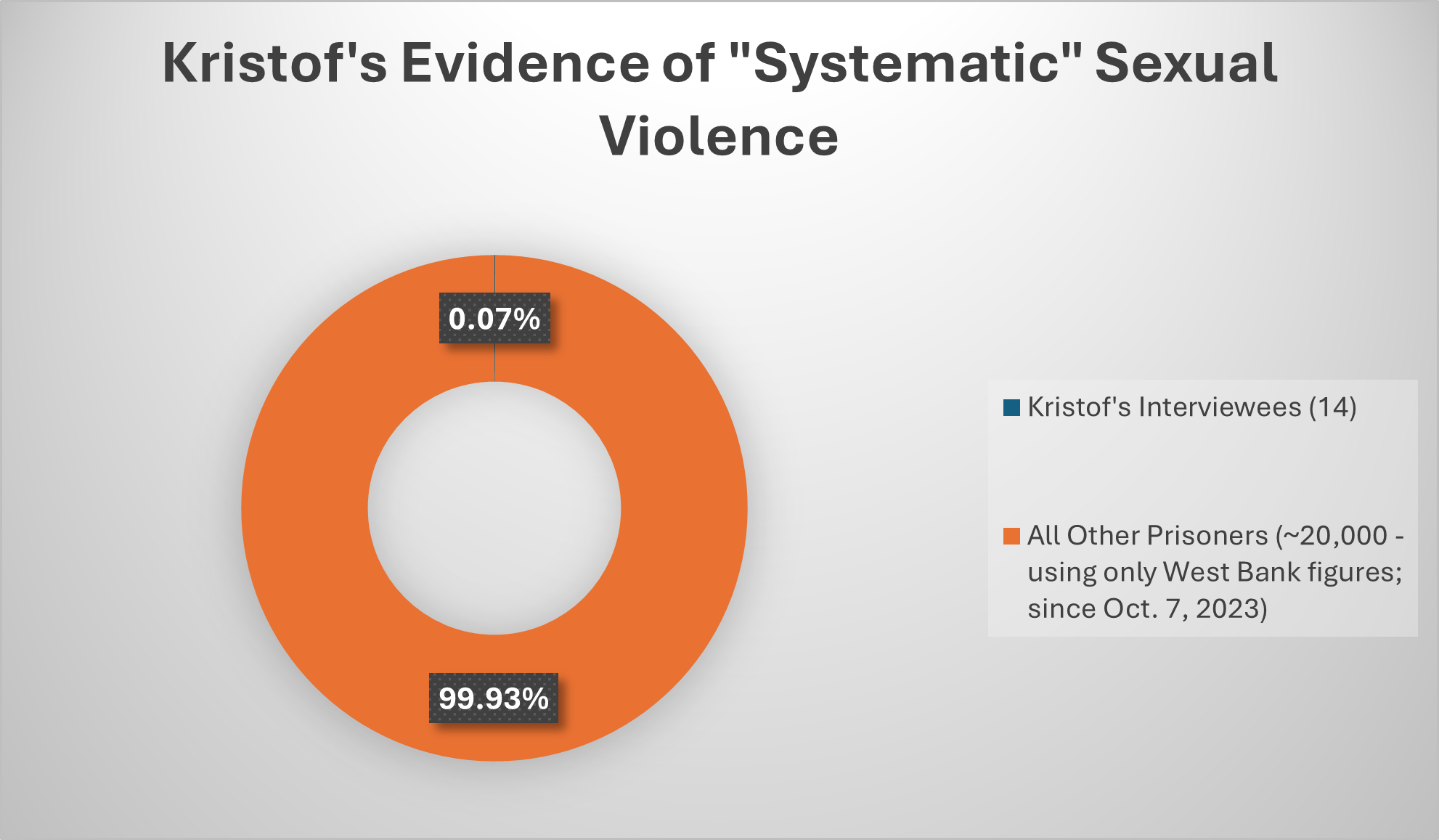
So what evidence does he provide for the allegation that sexual violence is a policy? He cites the COI and Euro-Med reports. What evidence do they provide for this claim? None. They simply repeat the claim that sexual violence is an official policy, as if mere repetition will make it a fact.
The first piece of evidence the COI report provides for the claim that Israel has a policy of sexual violence is that Israeli officials are “referring to Hamas as ‘a rapist regime.’” Seriously. The logic seems to be that it shows a motive for Israel to seek revenge, and therefore Israel must have adopted a policy of sexual violence to effect revenge. It’s a series of assumptions built on each other.
A couple of instances of Israeli soldiers making crude jokes while going through women’s belongings in their abandoned homes are cited. Another piece of evidence: some Palestinian female detainees were allegedly “coerced to sit in front of an Israeli flag.”
A few alleged cases of rape in Israeli prisons are briefly referenced, but again, mostly to the extent of stating that “the Commission received reports,” without elaborating much further.
The bulk of the COI’s evidence boils down to Palestinians being told to strip down to their underwear when taken into custody, a practice that became common following waves of Palestinian suicide bombing attacks. The COI admits these strip searches “are not unlawful per se,” but then asserts—without explaining how it arrived at the conclusion—that “the motivation from the outset appeared to have been retribution and a desire to humiliate.” The evidence is their own imagination projecting thoughts and desires onto others.
The COI also reverses the concept of innocent until proven guilty. The COI, which employs an extremely low standard of proof, treats the absence of convictions in cases it alleges as proof that there is a policy to commit sexual violence. Even if the COI was not composed of unreliable antisemites, it claims to operate under the evidentiary standard of “reasonable grounds,” akin to what a British police officer needs to make an arrest but far short of that needed for a conviction.
What about the Euro-Med report, which Kristof also claimed “conclude[d] that Israel employs ‘systematic sexual violence’ that is ‘widely practiced as part of an organized state policy’”? Euro-Med simply cited the same COI report Kristof did.
According to Euro-Med, the COI report “affirms that these acts…are carried out as part of a policy” and that it has “effectively becom[e] part of work policies and standard operating procedures.” But nowhere in the report does Euro-Med provide any of its own evidence of an official Israeli policy or procedure of sexual violence. It simply repeatedly asserts that such a policy exists without ever showing it.
Kristof’s allegation ultimately relies on the deceptive practice of circular citations. Parties cite each other for a proposition, thereby fabricating a perception of credibility and widespread support, without ever actually proving the proposition in the first place. The tactic often comes in the form of lengthy reports. The length works to shield the reports from scrutiny. How many are willing to slog through so many pages? Surely with that many pages there must be substantive evidence somewhere therein. Kristof himself highlights the “49-page” length of the COI report as if that lends it credibility. But among the nearly 53,000 words between Kristof’s column and the COI and Euro-Med reports, not one establishes the existence of a documented policy or statement evidencing a systematic policy of sexual violence beyond conclusory assertions of its mythical existence.
And, even if every single specific alleged case of wrongdoing identified by Kristof, the COI, and Euro-Med is real, to extrapolate from a handful of instances the existence of an official policy is the kind of logic one finds in forum boards for conspiracy theorists, not a respectable newspaper. Speculation is neither proof nor professional journalism. It is yellow journalism.
Kristof’s Column Debases the Seriousness of Sexual Violence
The use of sexual violence in conflict is among the gravest of crimes committed by man. It should be treated with the seriousness it deserves. Wielding the allegation for partisan ends is to disrespect those who have been victimized.
While Kristof presents himself as a compassionate voice for victims, the dearth and weakness of his evidence betrays either incompetence or the absence of compassion.
Instead of relying on credible organizations who employ credible investigators, Kristof chose to platform hardcore activists known for making outrageous and false accusations against the accused. Instead of employing a rigorous verification process, Kristof simply repeated their unsupported claims. Every decision suggests his column has nothing to do with rigorous journalism and everything to do with partisanship.
Kristof’s editors are equally culpable. In response to the immediate criticism, The New York Times’s communications department argued that his reporting is “backed by independent studies,” suggesting none of his editors nor anyone in the paper’s communications department actually read his sources to verify his claims, either.
Kristof and his editors should have understood why these choices were wrong. They published the column anyway.
On the same day as Kristof’s column, Israel’s Civil Commission published a 298-page report detailing Hamas’s use of sexual violence against Israelis. The report painstakingly details its methodology. It identifies the “principles, guidelines, standards, protocols, and best practices acceptable in the field” that it employed during its investigation. It discusses its fact-finding field visits and how it conducted over 430 interviews and filmed testimonies from victims, witnesses, emergency responders, morgue staff, and medical professionals. The authors explain how they corroborated and verified information. In short, they give extensive information which readers can use to judge for themselves the credibility of the allegations contained therein.
But Kristof and The New York Times skipped over this story, mentioning the Civil Commission’s report only after the paper faced ferocious criticism. This is despite the Civil Commission reportedly having approached the paper months in advance with the report.
That is, the Times knew an extensive, well-researched report on Hamas’s use of sexual violence against Israelis was coming out on May 11 and instead published Kristof’s poorly-sourced, speculative opinion column accusing Israelis of being the criminals. Readers can make of that what they want.
The paper brags it contains “all the news that’s fit to print.” It would seem the paper believes that sexual violence involving Jews is newsworthy only if they are the alleged perpetrators.
This isn’t a justifiable mistake. At every step along the way, Kristof and the Times made a choice to attack Israel, facts and credibility be damned. They made a choice to lob language to appeal to our emotions – “brutalized,” “dehumanization,” “subhuman” – instead of exercising ethical journalism. That’s functionally indistinguishable from propaganda.
The New York Times has published a lot of biased journalism over the years. We at CAMERA know this plenty well. But the egregiousness of Kristof’s column shocks even us. Retracting it is necessary, but far from sufficient. Kristof has demonstrated he has no business being employed in the world of journalism. His editors have similarly demonstrated their complete lack of fitness for their roles.
By publishing Kristof’s column, The New York Times has demonstrated that the storied paper now belongs in the dustbin of history.
For the Hebrew version of this post, see CAMERA Hebrew.