
Israeli settlers are blocking Palestinian children from going to school.
This was the narrative promoted in CNN, Reuters, and Ynet in the week following April 15, 2026.
However, unlike the Reuters and Ynet versions of the story, the segment on Umm al-Khair within CNN’s April 22 report, entitled “Palestinian schoolboy among two killed by Israeli settlers, amid spate of attacks on education in the West Bank,” as well as the associated broadcast and the April 27 Instagram post, entirely failed to include any Israeli perspective.
This omission left viewers unaware of two critical details: the children have a safe, alternative path to school, and the fence itself was erected in response to well-documented threats of violence and infiltration from Umm al-Khair itself.
Each report charged that Israelis from Carmel (incorrectly spelled as Karmiel in the CNN report) erected a barbed-wire fence that blocks the main route for children from the Bedouin village of Umm al-Khair to travel to school. Carmel is a community located near Hebron in Israeli-controlled Area C, a region that makes up 60 percent of the West Bank.
Speaking to Reuters, Khalil Hathaleen, head of the Umm al-Khair village council, claimed the fence blocked the children’s usual route, that the nearby road was dangerous, and accused Jewish settlers of a land grab. Khalil Hathaleen served as the primary source for the CNN and Reuters reports, while Ynet relied on his cousin, Eid Hathaleen.
However, the Israel Defense Forces (IDF) confirmed to CAMERA that while Carmel residents did erect the fence within their municipal boundaries, the children have a safe, alternative route to school that “does not require passing through the community.”
On April 20, 2026, Mount Hebron Regional Council head Eliram Azoulay published a video timing himself driving the unimpeded alternate route. The journey took just one minute and ten seconds. He also accused the Umm al-Khair community of staging the protest in the same post.
Following communication from CAMERA, a council spokesperson provided a map outlining Carmel in blue and the alternate route in green. The map also shows the area of Umm al-Khair next to Carmel, where some permanent homes are located, as well as where the school is located.
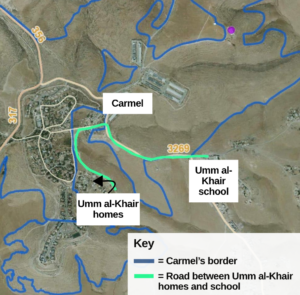
Map provided by the Mount Hebron Regional Council (translated to English) noting Carmel, where some Umm al-Khair homes are and where the Umm al-Khair school is referred to in the article.
Satellite imagery on Google Earth confirms the map’s veracity, clearly showing the road linking the two parts of Umm al-Khair (outlined in red). Al Jazeera also published a map of the same area, showing the same location of the Umm al-Khair homes as the council spokesperson’s map.
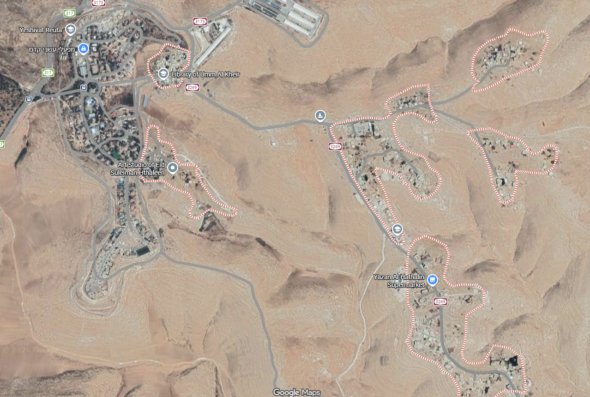
Screenshot of Google Earth map of Carmel and Umm al-Khair (outlined in red).
Furthermore, the spokesperson said that the Umm al-Khair site next to Carmel is illegal and occupies Carmel’s land. Israel’s Civil Administration has issued demolition orders for 13 structures in the Bedouin village.
Before Carmel’s residents erected the fence, some Umm al-Khair residents cut through the valley on foot, which compromised Carmel’s perimeter, according to the council spokesperson. The residents built the fence to prevent infiltration, the spokesperson said.
Carmel’s security threat
To illustrate the security threat, the spokesperson shared an image of a funeral procession that left Umm al-Khair roughly two years ago, warning: “Were it not for the fence, the mob photographed in the picture, equipped with Hamas flags, could enter the settlement without interruption.”
CAMERA confirmed the veracity of the funeral image. Hisham K. K. Abu Shaqra of Anadolu Agency documented the same funeral in a video published to Getty Images.
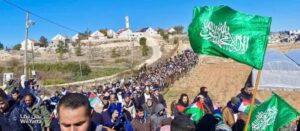
Screenshot of We Yatta Arabic local news station covering funeral of Suleiman Hathaleen, January 18, 2022. (credit: Mount Hebron Regional Council spokesperson)
The video footage, taken on Jan. 18, 2022, shows the funeral for slain community leader Suleiman Hathaleen (uncle of Khalil Hathaleen), who died after an Israeli military vehicle ran him over. The footage shows funeral-goers walking along the very paved road that would lead the children to school, waving Hamas flags and chanting incitement. Specifically, the mourners chanted, “Khaybar Khaybar al Yahud” (The full chant is “Khaybar, Khaybar, ya Yahud, Jaish Muhammad sawfa ya’ud,” translating to “Khaybar, oh Jews, the army of Muhammad will return”). It is an Islamic battle cry invoking the seventh-century defeat and subjugation of the Jewish tribe in Khaybar, in modern day Saudi Arabia, serving as an antisemitic threat of future violence.
CNN ignored this entire security context. Instead, their broadcast cited Khalil Hathaleen to claim children have been protesting the fence daily. The footage featured children holding English-language signs, reading “We miss our school” and “let kids learn” – in an apparent appeal to Western audiences. The footage also showed an 11-year-old girl crying, “They don’t want me to learn because I will grow up to be a lawyer and defend Palestinian land.” CNN credited all pictures and video shown to Khalil Hathaleen.
CNN also omitted vital context regarding Yinon Levy (spelled as Yonin Levi in the CNN report), the man accused of killing Khalil Hathaleen’s brother, Awdah Hathaleen (whom CNN solely described as a “prominent Palestinian activist” known for the documentary No Other Land). While noting that an Israeli court placed Levy under house arrest and then released him three days later, CNN left the impression that Levy is from Carmel. He is actually from Meitarim Farm. The US State Department sanctioned both Levy and the outpost in 2024 for contributing to violence and instability in the West Bank. Carmel has faced no such sanctions.
A quick Google search of the Hathaleen family portrays them as champions of non-violent resistance. Some observers have compared Suleiman Hathaleen to Mahatma Gandhi, having led international media campaigns to prevent their community’s displacement.
While Western media consistently portrays the community through a lens of pure, non-violent resistance, the presence of Hamas flags and antisemitic battle cries at a major community gathering illustrates the complex, hostile security reality that Carmel residents face, a reality CNN erased.
Film producer Robert Evans is famously quoted as saying, “There are three sides to every story: your side, my side, and the truth.” In the conflict between Umm al-Khair and Carmel, these three sides represent the Palestinian villagers who feel restricted, the Israeli residents facing documented security threats, and the undeniable facts on the ground.
By erasing the alternate route, ignoring blatant displays of hostility, and conflating unrelated actors, CNN chose to broadcast only one side instead of even attempting to find the truth.