
The terms of the Israel-Hezbollah ceasefire achieved one year ago are not difficult to parse: Among the demands of both sides is the requirement that Hezbollah, a designated terror organization, disarm.
The document is quite specific on this imperative, detailing:
a. Monitor and enforce against any unauthorized entry of arms and related materiel into and throughout Lebanon, including through all border crossings, and against the unauthorized production of arms and materiel within Lebanon.
b. Starting with the Southern Litani Area, dismantle all existing unauthorized facilities involved in the production of arms and related materiel, and prevent the establishment of such facilities in the future.
c. Starting with the Southern Litani Area, dismantle all infrastructure and military positions, and confiscate all unauthorized arms inconsistent with these commitments.
Why, then, does Associated Press, which boasts of its work “advancing the power of facts,” withhold from news consumers the basic fact that the ceasefire requires Hezbollah to disarm? And why does the leading news agency conceal that that the terror organization has flatly refused to do so, threatening to thwart disarmament with civil war?
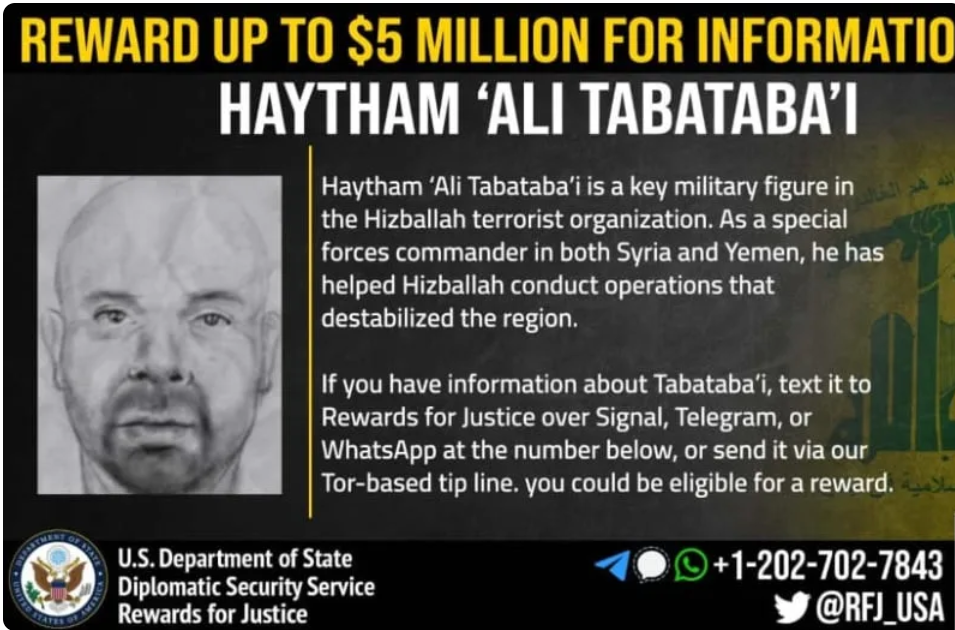
The US State Department’s Rewards for Justice poster for Haytham Tabtabai
Thus, the news agency’s coverage yesterday on Israel’s successful strike on Hezbollah chief of staff Haytham Tabtabai selectively reports: (“Israel says it killed a senior Hezbollah chief in its first strike on Beirut in months“):
Israeli Prime Minister Benjamin Netanyahu accused Tabtabai of leading Hezbollah’s efforts to rearm.
Israeli airstrikes over southern Lebanon have intensified in recent weeks while Israel and the United States have pressured Lebanon to disarm Hezbollah. Israel asserts that the group is trying to rebuild its military capabilities. The Lebanese government, which supports disarming Hezbollah, has denied those claims. It also says troops have deployed to the south but that its cash-strapped army needs more resources.
Hezbollah has not attacked Israel since the ceasefire began. In December, it fired a couple of rockets that landed on open territory near an Israeli military base and called it a “warning.” …
Lebanon’s president last week said the country is ready to enter negotiations with Israel to stop its airstrikes and to withdraw from five hilltop points it occupies on Lebanese territory. He also has said Lebanon is committed to disarming all non-state actors in the country, including Hezbollah.
Hezbollah has said that talk about its military arsenal should come through dialogue with the Lebanese state once Israel stops its attacks.
Though AP’s article is some 1000 words long, it finds no words to say that the ceasefire agreement requires the full disarmament of Hezbollah, starting with south of the Litani.
Second, in both English and Spanish, AP fails to make clear that Hezbollah is blatantly in violation of those terms. Indeed, Hezbollah has been completely transparent that it has no intention whatsoever to disarm and will violently battle any such efforts. As Reuters reported in August:
On Friday, Hezbollah leader Naim Qassem raised the spectre of civil war, warning there would be “no life” in Lebanon should the state attempt to confront or eliminate the group.
And just last month, deputy chairman of Hezbollah’s Executive Council Ali Damoush warned that “whoever confronts us will enter the battle of Karbala,” which is a reference to an ancient battle between opposing Islamic forces.
Agence France Presse, another international news agency, demonstrates that it’s possible to provide a straightforward report on the ceasefire’s requirement for Hezbollah’s disarmament, and the terror organization’s rejection of those clauses. It reports:
According to the agreement, Hezbollah was to pull its forces north of the Litani River, some 30 kilometres (20 miles) north of the border with Israel and have its military infrastructure there dismantled.
Under a government-approved plan, the Lebanese army is to dismantle Hezbollah military infrastructure south of the river by the end of the year, before tackling the rest of the country.
Hezbollah has strongly rejected the move. [Emphases added.]
Third, AP neglects to make clear that Lebanon’s President is not so committed to disarming Hezbollah, having recently opined: “weapons are not the main issue; it is the intention to use them that matters.”
The New York Times’ story on Israel’s strike on Tabtabai manages to be more forthcoming than AP on President Aoun’s hesitation to take on Hezbollah, stating (“Israel Assassinated a Top Hezbollah Commander Near Beirut“):
U.S. and Israeli officials had hoped Mr. Aoun, who assumed the Lebanese presidency earlier this year, would crack down on Hezbollah, and the country’s new government has pledged to disarm all armed groups by the end of 2025.
But so far, Hezbollah has resisted calls to lay down its weapons, and Lebanon’s new government is hesitant to disarm the group by force, fearing it could ignite internal conflict. This has led U.S. officials to express growing frustration with the pace of disarmament.
Assaf Orion, a retired Israeli brigadier general, said Israel appears to hope the Lebanese government took Mr. Tabatabai’s killing as a message: Start cracking down on Hezbollah in earnest, or face more attacks like the one on Sunday.…
“This seems to be a military move aimed at adding more political momentum for the Lebanese government to move ahead with disarmament, as part of the cease-fire,” said Mr. Orion. “But at the same time, it could deteriorate into a wider battle.”
Notably, it’s not simply Israel and the United States which are concerned about Lebanon’s failure to disarm Hezbollah according to the ceasefire requirements. As the Institute for the Study of War reported:
A figure close to Saudi officials told Lebanese media on October 19 that Saudi Arabia has grown frustrated with the Lebanese government’s ”slowness” in implementing its Hezbollah disarmament plan and threatened to pull funding for the LAF, which suggests that Saudi Arabia has concerns about the government’s willingness to disarm Hezbollah on a reasonable timeline.”
Following Associated Press’ smoke and mirrors cover-up job last month, the wire service continues to violate its own self-described commitment to “accurate, unbiased, fact-based reporting” with its ongoing concealment of Hezbollah’s ceasefire violations.
For the Spanish version of this post, see CAMERA Español.