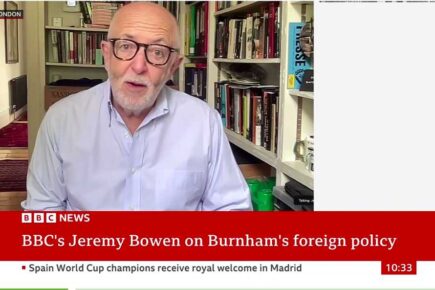
There is a line between analysis and opinion, and on the BBC that line must be iron. Analysis presents facts and shows how those facts connect. On the BBC, it cannot be partisan. It must be entirely factual, accurate and impartial. It must be a tool to allow audiences to reach their own conclusions. Jeremy Bowen is not a journalist, he is a public servant, and BBC radio and television is not a Guardian opinion piece. The BBC is not the right forum for offering heavily politicised, carefully cherry picked, deeply biased conclusions born in a very specific political echo chamber.
NBC's Chantal Da Silva and Matthew Mulligan paint a slanted, one-sided view of the ongoing ceasefire in Gaza, omitting key details surrounding sourcing and obligations under the truce that leave readers with more questions than answers.
Lee Mordechai attempts to position himself as the moral compass for a supposedly amnesiac Israeli public, CAMERA's Shlomi Ben-Meir writes in JNS. However, what Mordechai frames as a “reminder” is, in reality, a masterclass in omission and narrative manipulation.
When covering the killing of FIFA-linked officials and other soccer figures linked to designated terror groups, there's no journalistic "overtime" limit in getting the facts right. Why hasn't Reuters updated readers with new information on soccer players and officials who moonlighted as terror operatives?
What do CNN and the British Museum have in common? Under the guise that ancient history belongs to everyone, both use a site's long history of foreign invasion as an excuse to erase the original indigenous people who built it.
A New York Times Opinion article made erroneous claims regarding the number of civilians killed in Gaza. CAMERA's communication with the outlet led to a correction.
“Reduced U.S. interests in the Middle East” is a fantasy, stemming from the illusion of U.S. oil independence. One would think that rising gas prices would have ended this myth by now after exposing how U.S. prices still reflect global production. On top of that, U.S. allies and partners in Asia and Europe, which Walldorf elevates as priorities, need Middle Eastern oil for their own economies.
In reporting on a pianist's failed lawsuit after his performance was canceled following an on-stage proclamation that Israel was targeting journalists in Gaza, The New York Times cited to the Committee for the Protection of Journalists. The paper failed to acknowledge the organization was conducting a review after Hamas and Palestinian Islamic Jihad claimed many "journalists" as their fighters.
From Colombia repairing diplomatic ties with Israel, to Hamas terrorizing Gazans at aid distribution sites, here are three stories that went underreported this week.