It is time for readers to ask why The New York Times amplified unsubstantiated claims of widespread sexual violence against Palestinian prisoners by Israelis and dogs, but downplayed verifiable claims of sexual assault by women against a Nazi-tattooed Senate candidate.
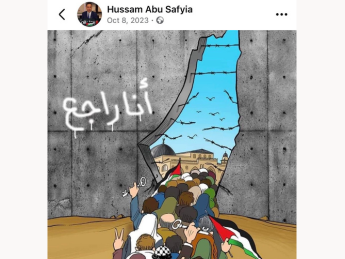
Who is Hussam Abu Safiya, the detained Gaza doctor, behind all of the headlines? What is the media not revealing to its audiences? In fact, under his watch, the Kamal Adwan Hospital was a hub for terrorist activity.
Representative Ro Khanna (D-Calif.) launched an aggressive smear campaign against Israel after manufacturing an “incident” in Area C of the West Bank on July 8, 2026. But had Khanna coordinated with the IDF for smooth passage, there would have been no opportunity for a provocative publicity stunt. CAMERA breaks down the facts here.
Opinio Juris claims to be dedicated to “informed discussion” of international law. But if the law is as “informed” as the “facts” in this Opinio Juris article, then perhaps international law isn’t real law, after all.
A Guardian article on Hebron adheres to an unwritten rule followed by Guardian reporters that once a city in the Land of Israel has been cleansed of its Jewish residents, Jews should never reside there again.
Multiple major news organizations spread Iranian regime propaganda regarding how many mourners participated in former Iranian Supreme Leader Ali Khamenei's funeral procession. News consumers should demand that their providers refuse to spread unverified claims, argues CAMERA's Jennifer Kouzi in JNS.
The New York Times' Executive Editor Joseph Kahn made comments suggesting he is distancing himself and the paper's newsroom from Nicholas Kristof's opinion column that blamed Israel for systematic sexual abuse and rape of Palestinians. Kahn's comments leave some important questions unanswered.
For decades, Trita Parsi has espoused the Iranian regime’s talking points with no pushback. ABC's Linsey Davis recently interviewed the Quincy Institute executive vice president, where that trend continued.
UPDATED: After communications with CAMERA, the Washington Post corrected after publishing a doctored quote attributed to President Trump. The fake quote supported their narrative of blaming Israel for complicating Trump's efforts to make peace with Iran.
The New York Times reported that activists in San Francisco harassed Scott Wiener, a state senator from California, ostensibly over his views on Israel. But the Times barely acknowledged Wiener's Jewishness, downplaying critical context that suggests the plausible conclusion that Wiener was harassed because of his identity—not his views.