
Ali Rogin’s June 12, 2026, PBS News Hour segment, “Gaza’s students strive to learn despite shattered schools,” had all the building blocks of an emotive narrative: children sitting on the ground in a makeshift tent-classroom, an 11-year-old using a solar-charged light to study at night in a shelter after her home was destroyed in an Israeli air strike, and heads of school lamenting they cannot accommodate all of the children in Gaza who wish to learn.
But if comprehensive reporting on the issue of Gazan students and schools was a test, PBS failed. It even flunked “show-and-tell” by cherry-picking what it shared with viewers, failing to disclose Hamas’ abuse of schools before, during and after the Israel-Hamas war.
Following host Amna Nawaz’s brief introduction, Rogin mentioned Hamas exactly once, citing the “ruinous war” that followed “the Hamas attack in October 2023.” The reference was so bare that she explained neither the attack’s location in Israel, nor that Hamas killed more than 1,200, mostly civilians, and kidnapped 251 (including many children). By contrast, PBS referenced Israeli strikes or attacks five times in the six-minute segment.
Before the War – Hamas in UNRWA Schools
By largely omitting mention of Hamas, PBS was able to skip over why schools were caught in the cross-hairs of the war. According to its website, the United Nations Relief Works Agency (UNRWA) operates 183 schools in Gaza. UNRWA was founded in 1949 to help Arab refugees following Israel’s War of Independence. The organization perpetuated the fantasy that Palestinians will return to Israel and so, unlike UNHCR, the U.N. agency which serves all other refugees in the world, UNRWA’s goal has never been to resettle Palestinian refugees. Palestinian refugee status is passed on generationally, irrespective of wealth or citizenship elsewhere.
There is ample evidence that Hamas has infiltrated UNRWA, and that terrorism exists in its schools. The Israeli government claims at least 1,462 UNRWA employees are members of Hamas or other designated terrorist organizations. Recently, UNRWA fired 70 employees over concerns about Hamas affiliation.
Well before Hamas’ Oct. 7 massacre, the U.N. acknowledged Hamas stored and fired rockets from Gaza schools on at least nine occasions between 2014 and 2022, and CAMERA’s David Litman even found one example from 1982. The New York Times recently reported on documents provided by Israel which revealed that top employees (primarily principals or their deputies) at 24 UNRWA schools were registered Hamas or Palestinian Islamic Jihad (PIJ) members. In addition, three UNRWA teachers allegedly held hostages captured on Oct. 7.
You were 100% right: “UNRWA became a subsidiary of Hamas.”
We documented how UNRWA knowingly put Hamas terror chiefs Suhail al-Hindi and Fathi Sharif in charge of thousands of their school teachers & staff: https://t.co/Sd1B7sOrOP
UNRWA teaches terror. We need to shut it down. https://t.co/ABAHRLHY62 pic.twitter.com/nFt0iNde1s
— Hillel Neuer (@HillelNeuer) June 12, 2026
UNRWA schools use materials encouraging jihad, violence, martyrdom, hate, intolerance and antisemitism. Some Gaza educators impart their pro-terror ideology on even the youngest learners. At a kindergarten graduation 10 years ago, the young graduates cosplayed as terrorists.
: —
In May 2016 — seven years before October 7 — a kindergarten… pic.twitter.com/kQRrsuIsV9
— M.A. Rothman (@MichaelARothman) June 14, 2026
One week before PBS’ report aired, USAID published a report indicating that its Office of Inspector General referred for suspension/debarment 101 current or former UNRWA staff, including school principals and teachers. In May, the Washington Free Beacon reported that the U.S. would soon investigate approximately 1,500 UNRWA members suspected of terror ties. None of this was mentioned by PBS.
During the War
Hamas’ use of civilian infrastructure – including schools – is a key component of its human shield strategy. Yet, in a story about education, Rogin ignored Hamas’ documented use of schools and child soldiers during the two-year war.
UNRWA school turned Hamas launch site:
An anti-tank missile was fired from an UNRWA school toward our troops. IDF forces operated in a medical clinic nearby, when an explosive in a booby-trapped tunnel shaft detonated and killed 3 soldiers. During later scans in the school, we… pic.twitter.com/88GR17wh6B
— Israel Defense Forces (@IDF) May 30, 2024
PBS failed to educate its audience about Hamas’ exploitation of schools for terror purposes, including the placement of numerous command centers and the launching of rockets. Likewise, PBS never mentioned that Hamas used schools to hide weapons and provide cover for tunnels directly below them. Without this information, the audience had no context with which to evaluate PBS’ statement that 97 percent of schools were damaged or destroyed in Gaza.

Rogin also reported that Israeli strikes killed 21,000 children. Presumably using UNICEF’s estimate of total children killed during the war, it is incorrect and overbroad for her to claim that 100 percent of those children were killed by Israeli strikes. The death count included children who died from cancer, other illness, accidents and reasons unrelated to war. The death count also includes child soldiers, a harsh reality PBS neither acknowledged nor condemned, and one of the United Nations’ six designated grave violations against children during armed conflict.
Hamas’ Abuse of Children and Use of Schools Post-War
PBS also ignored recent reporting about Hamas’ sexual abuse of boys and its current use of schools as makeshift interrogation rooms and prisons.
Instead of elucidating how Hamas commandeers other schools for their nefarious purposes, it showed viewers children sitting on the ground trying to learn. It showed no functional schools.
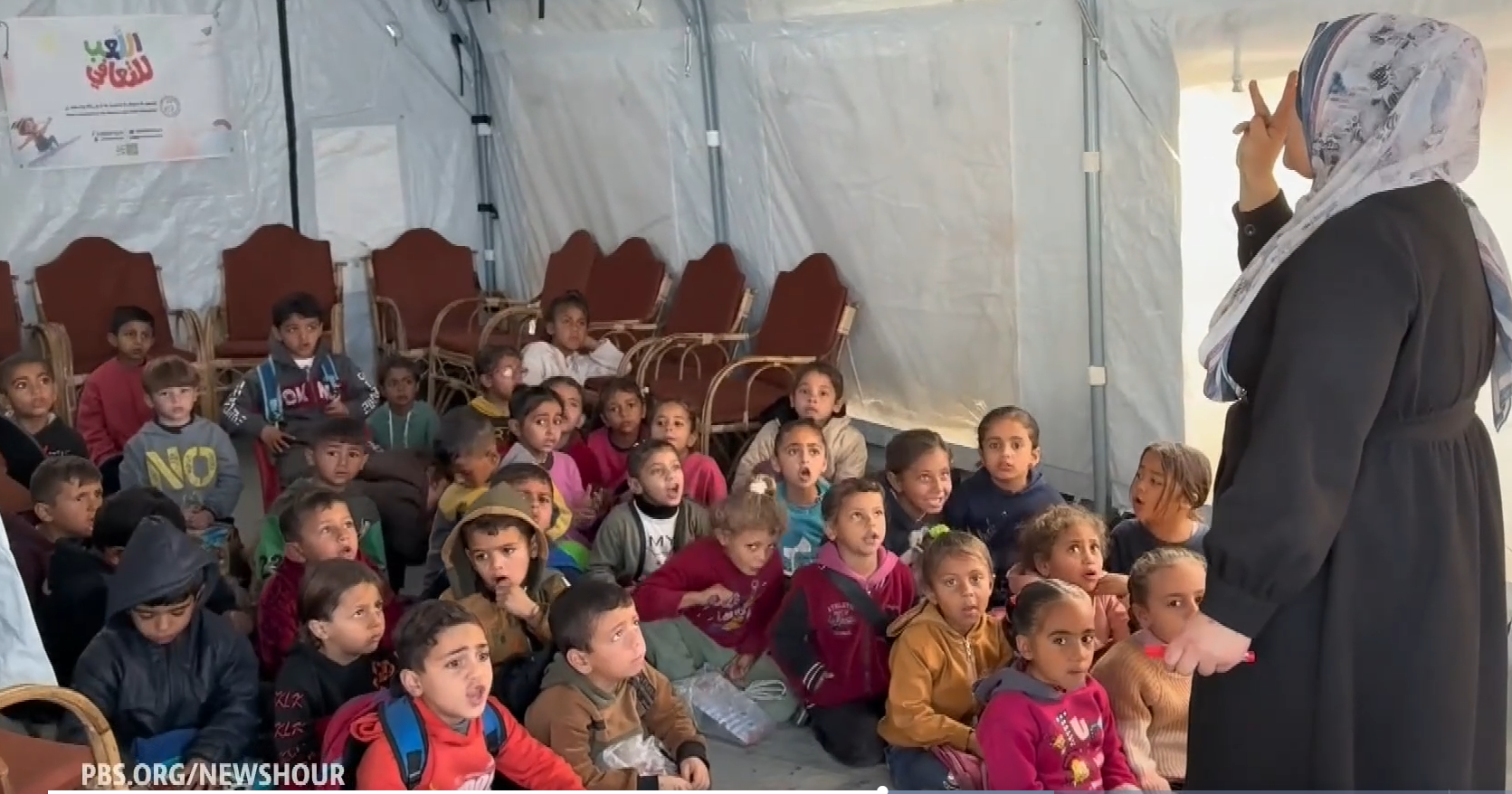
Consider how in the segment, one Gaza City school headmistress spoke in front of a group of children sitting on the ground, on a tarp under a tent. Viewers were left with the unmistakable impression that Gazan children do not have indoor facilities or chairs for school.
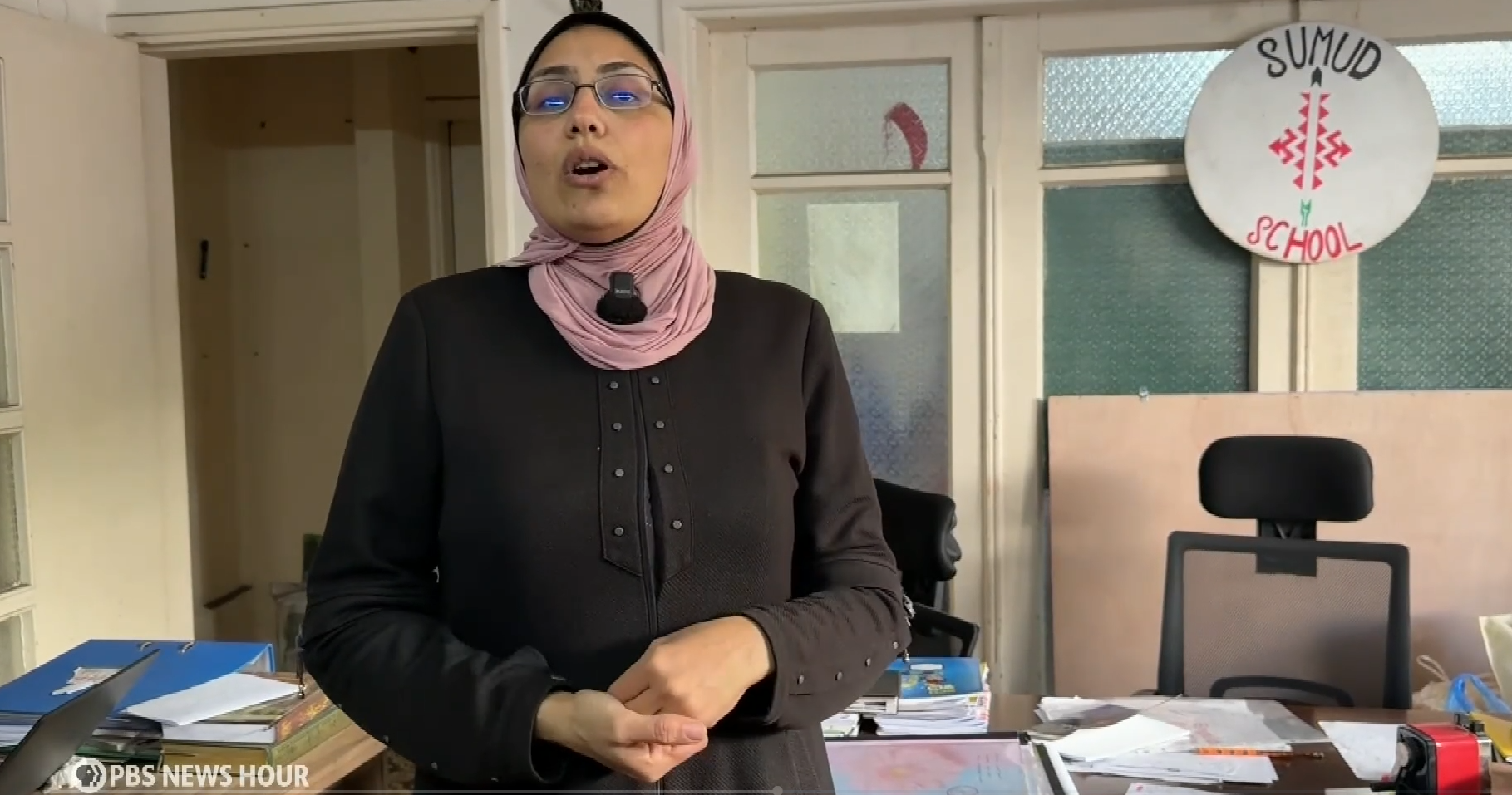
When PBS pivoted to interview a second school director standing in what appeared to be her office at the Sumud School, the network included no footage of students at that school. Instead, following that interview, the segment cut back to the footage of the children on the ground at the first school.
The result was a carefully curated presentation concealing children at the Sumud School, who according to both of the school’s Instagram accounts (one of which proudly posted the PBS segment), had desks and chairs and snack-filled, decorated classrooms. 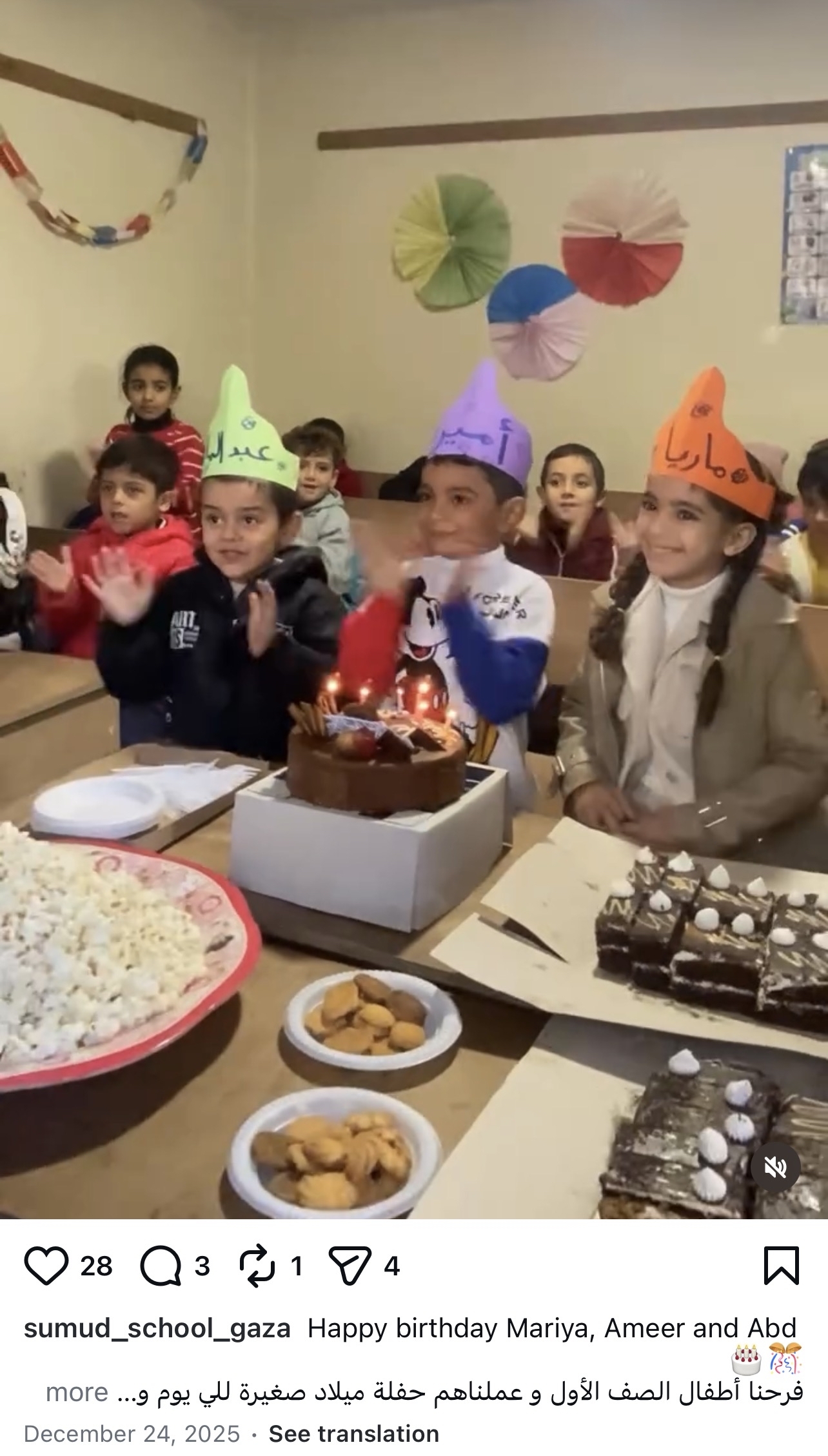
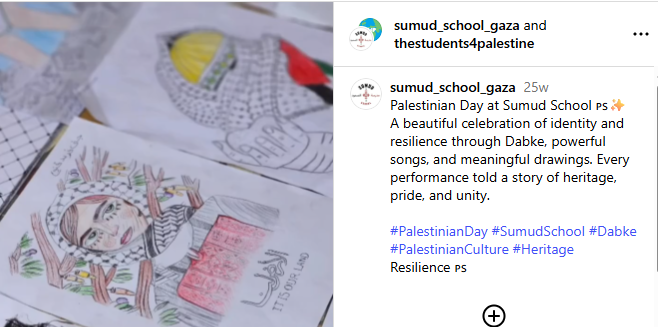 On social media, but not on PBS, there are photos of Sumud children at graduation, and videos of students singing, dancing and displaying art. Some examples of artwork included a kefiyyeh-clad Dome of the Rock on the Temple Mount with the map of Israel as a Palestinian flag and a hand gripping a large rock; a photo of a kefiyyeh-clad woman with “IT IS OUR LAND” written below; and a long banner featuring a key, long known to be a symbol of desiring the imaginary “right of return” to Israel (which would eliminate Israel as a Jewish state).
PBS delivered a deeply skewed report by whitewashing Hamas’ role in destroying Gaza’s schools and deceiving viewers into thinking all students in Gaza are sitting on the ground. In doing so, it misled its audience by violating several of its self-proclaimed standards such as accuracy and fairness.
A human interest story on children is a worthy endeavor. But by actively obscuring the facts in service of a narrative, the segment proved to be less about the impacted children and more about the lengths PBS would go to erase Hamas from the story.