

Dana Bash interviews Brad Lander on CNN, July 10, 2026. (credit: screenshot)
“The 1948 Genocide Convention exists because one man refused to let the slaughter of his people pass without a name. He died in 1959 with almost nothing to his own name except the one he had given to history.”
This is what Raphael Lemkin’s closest living relative and attorney Joseph Lemkin wrote in a July 1, 2026, Jerusalem Post Op-Ed. He was explaining a complaint he filed alongside the European Jewish Association (EJA) with Pennsylvania state authorities against the Lemkin Institute for Genocide Prevention (LIGP) for misappropriating and misrepresenting the Lemkin name.
The complaint underscores a broader trend of historical distortion, recently displayed during CNN anchor Dana Bash’s July 10 interview with New York congressional candidate Brad Lander. During the segment, which was rife with misinformation, Lander cited the LIGP (as well as historian Omer Bartov) to argue that Israel’s war in Gaza constitutes a genocide.
To CAMERA, Joseph Lemkin condemned Lander’s political posturing. “Invoking the Lemkin Institute as though it speaks with special authority on Raphael Lemkin’s legacy is deeply misleading. The Institute has no affiliation with Raphael Lemkin or his family, and my family has repeatedly and publicly objected to its use of his name,” he said.
To counter Lander’s suggestion that the LIGP position represents a consensus, Lemkin pointed to a letter 112 Holocaust and genocide scholars signed who also explicitly rejected labeling the war in Gaza a genocide.
Lemkin noted that his relative was an ardent Zionist who understood the existential vulnerability of the Jewish people. He said Raphael Lemkin also “understood that if the term were untethered from its legal meaning and transformed into a political slogan, it would ultimately lose its force. I believe that is precisely what is happening here.”
According to Lemkin, the LIGP views genocide through a political lens rather than a rigorous legal one.
Dr. Hilly Moodrick-Even Khen, a world-renowned genocide scholar at Ariel University, told CAMERA that both the LIGP and Bartov fail to prove the “special intent” required by international law to establish genocide. “It’s about the intent to destroy an entire group,” she stressed, noting that Israel is fighting a “war against terror.”
EJA Chair Rabbi Menachem Margolin added that LIGP’s branding falsely implies historical alignment. He told CAMERA that naming the group after the man who coined “genocide” to describe the systematic Nazi annihilation of Jews is entirely deceptive. By masquerading as an academic body, Margolin warned, the LIGP provides cover for anti-Israel actors to attack the Jewish state.
Rewriting the Holocaust: Bash defines kapos as Jewish peacekeepers
Lander’s accusations were part of a wider pattern of misinformation in the broadcast. In many cases, Bash failed to challenge his misinformation and even offered her own glaring historical revisionism regarding the Holocaust.
When asking Lander about attacks he has faced from various groups, Bash noted that some in the Jewish community had labeled him a “kapo,” a term from the Holocaust era used to describe Jews who betray their fellow Jews. Astonishingly, Bash defined kapos as “Jews who were helping keep the peace, so to speak, in the Nazi concentration camps.”
In reality, the SS deliberately designed the kapo system to incite conflict. The U.S. Holocaust Memorial Museum notes that beating and punishing subordinate prisoners was a required duty for kapos, with many committing murders to meet SS expectations, a brutal reality Nobel Laureate Elie Wiesel documented in his memoir Night.
Even the Biden administration’s envoy to combat antisemitism, Dr. Deborah Lipstadt, whom Bash quoted authoritatively during the segment, previously signed a letter alongside esteemed Holocaust scholars defining kapos as Jews forced to serve as “unwilling tools of Nazi brutality.”
As of publication, CNN has not corrected the error despite CAMERA’s communication.
Fact-checking Lander: Israel’s democracy, voting rights, and the Declaration of Independence
Beyond the mishandling of Holocaust terminology, the interview also showcased a profound ignorance of Israel and international law. Lander asserted that Israel cannot be a democracy because “half the people under its sovereignty can’t vote.”
Major democratic watchdogs, which measure the democracy, political freedom, and human rights of countries across the globe, flatly disagree with Lander’s assessment. Freedom House and The Economist rank Israel, the West Bank, and the Gaza Strip separately because different entities govern them.
Israel’s citizens, regardless of religion or race, have the right to vote and run for office; Arab politicians have served in the Knesset since the state’s first government in 1949.
Lander argued that Israel is failing its foundational promise iterated in its Declaration of Independence, which, according to him, “says it would be a place for the ingathering of exiles and full civil and political rights for everyone living there.” However, this is not what Israel’s Declaration of Independence actually says.
While the document promises to foster the country for the benefit of all its “inhabitants” and guarantees them civil liberties, it sets conditions for political rights. The text explicitly limits “full social and political equality” to Israel’s citizens and textually binds civic cooperation and peace as prerequisites to citizenship rights.
Palestinians in Gaza and the West Bank cannot vote in Israeli elections because they are not Israeli citizens. The vast majority of West Bank Palestinians (over 90 percent) reside in Areas A and B, governed by the Palestinian Authority (PA). The less than 10 percent living in Area C still do not live under Israeli sovereignty considering Israel’s control over the territory is exercised through a military apparatus. Since Israel has not annexed the territory, it does not exercise formal civil sovereignty, as Lander suggested. The Olso Accords established this system of governance which both the PLO (now the PA) and Israel agreed to.
Israel lacks both sovereignty and occupation status over Gaza because Hamas has maintained exclusive internal political and military control over the territory since 2007. Under traditional international law, an occupation requires a foreign military to exert actual, on-the-ground administrative authority. Therefore, legal scholars and the Israeli Supreme Court argue that Israel’s external management of Gaza’s airspace and maritime perimeters constitutes a security blockade.
Acknowledging these complex governance realities, The Economist’s 2025 rankings gave Israel a democracy score of 7.8 (just above the U.S. score of 7.7).
Bash fails to examine Lander’s largest logical flaw
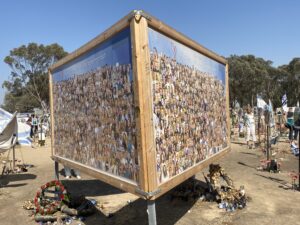
The memorial site for the Nova massacre on Oct. 7, 2023. (credit: Roded Shlomo Pikiwiki Israel, CC BY 2.5, via Wikimedia Commons)
Ultimately, Lander’s view that Israelis will not be safe “until Palestinians are free” entirely ignores what happened on Oct. 7 when Palestinians did break through the security barrier into Israel, and rests on the flawed assumption that the conflict’s roots are solely Israel’s fault. Instead of repeatedly asking Lander why he considers himself a “liberal Zionist,” Bash should have asked a much more pertinent question: What does he believe would happen if Israel’s military withdrew from the West Bank? Reality on the ground speaks for itself.
Public opinion surveys consistently document significant West Bank Palestinian support for Hamas, while PA-run media frequently broadcasts antisemitic tropes and Holocaust denial. The historical record as well as recent reports have shown the PA’s disregard for the Oslo Accord peace agreements.
A Jan. 31, 2024, New York Times article from the West Bank vividly illustrated this environment, noting that not a single Palestinian the Times interviewed would offer an unequivocal condemnation of the Oct. 7 terrorist attack.
Lander’s refusal to acknowledge this reality – and Bash’s failure to press him on it – represents a profound media failure. Demanding an end to the occupation without addressing why the IDF continues to operate in the West Bank, or why a clear majority of Israelis view a unilateral withdrawal as an existential risk, paints an incomplete picture. For any viable peace, political leaders and journalists alike must confront all the uncomfortable drivers of the conflict, not sweep them under the rug.
As CNN’s premier voice on American Jewry and antisemitism, Bash must have the capacity to confront misinformation about the Holocaust and Israel. As exemplified in this interview, the failure to push back aids in amplifying harmful revisionism under the banner of legacy journalism.