
It took four days but eventually the BBC lined up behind The New York Times’ defense of its May 11 publication of an “opinion piece” by Nicholas Kristof alleging that Israel employs “systematic” sexual violence against Palestinians.
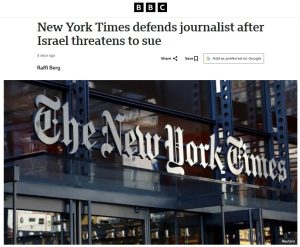 On May 15, the BBC News website published a report by Raffi Berg headlined “New York Times defends journalist after Israel threatens to sue” which opens:
The New York Times has said libel action threatened against it by Israeli Prime Minister Benjamin Netanyahu over an article alleging sexual assaults against Palestinian detainees by Israeli security services is “without merit”.
It responded after Netanyahu and his foreign minister issued a statement saying they had ordered the “initiation of a defamation lawsuit”.
It follows the publication on Monday of the article which claimed there was “a pattern of widespread Israeli sexual violence against men, women and even children” carried out by soldiers, settlers, interrogators and prison guards.
It is not clear how, or if, such a claim by the Israeli state against the US newspaper could be pursued.
On that latter point, readers have to plough down to the closing paragraphs of Berg’s 856-word report before they find comment from two Israeli lawyers.
Lawyers in Israel specialising in defamation told the BBC that while there were ways the state could bring the case to court there, it would be challenging.
“In the State of Israel, filing a civil claim in this context has a low likelihood of success, given that the Defamation Law prevents the bringing of a civil action by a collective, and the legal system does not encourage defamation suits by governmental bodies as a matter of public policy, due to considerations of protection for freedom of speech,” said Liat Bergman Ravid.
“However, the law does allow the Attorney General to file an indictment against the person who made the statement, but this is a rare event, bordering on non-existent.”
Lawyer Idan Seger said that if the claim came to court in Israel, the newspaper would have to defend itself.
“Crucially, the New York Times would face a far more stringent burden of proof in Israel than under the US standard, as a mere lack of malice is insufficient to avoid liability,” he said.
“To prevail, the newspaper must prove the absolute truth of its reporting or demonstrate strict adherence to standards of responsible journalism.”
Another legal opinion on the matter can be found at the National Review:
The Kristof column doesn’t make a vague claim about Israeli conduct in Gaza. It publishes a specific, granular, criminal allegation: that certain personnel used a dog to penetrate a bound and blindfolded prisoner, that a handler encouraged the animal in Hebrew, and that others photographed and laughed. It cites reports about specific prisons during specific times, all of which point to specific people. That is not a political opinion, or editorial commentary about Israeli military policy. That is a factual accusation of sexual torture, localized enough to implicate a finite, identifiable group: a unit, a facility, a handler, a dog.
Under Israeli civil law, the tort of injurious falsehood, codified in section 58 of Israel’s Civil Wrongs Ordinance, doesn’t require a sovereign plaintiff at all. It requires identifiable professional actors harmed by a false statement concerning their trade, occupation, or professional conduct. The members of a specific canine or detention unit — a handler, a commander — are not Israel in the abstract. They are professionals whose careers, assignments, and livelihoods are directly implicated by the allegation. If even a small, identifiable cohort of personnel can plausibly say “this is necessarily about us,” then the plaintiff problem is solved.
Berg, however, chose to amplify the Times’ response:
In response, the New York Times issued a statement saying: “The Israeli Prime Minister has threatened to file a libel lawsuit against The New York Times regarding Nicholas Kristof’s deeply reported opinion column on sexual abuse by Israel’s prison guards, soldiers, settlers and interrogators.
“This threat, similar to one made last year, is part of a well-worn political playbook that aims to undermine independent reporting and stifle journalism that does not fit a specific narrative. Any such legal claim would be without merit.”
Notably, Berg refrained from explaining to his readers that the opaque reference to “one made last year” relates to an episode in the summer of 2025 when the Times published a photograph of a child with a pre-existing medical condition to illustrate an article titled “Young, Old, and Sick Starve to Death in Gaza: ‘There is Nothing.'”
As readers no doubt recall, around the same time the BBC itself made repeated use of the same photograph in order to promote the exact same narrative.
CAMERA’s David Litman and many others have critically analyzed Kristof’s assertions, tearing them apart.
Remarkably, Raffi Berg chose to ignore all such analyses and the issues they raise. Instead, he simply recycled some of Kristof’s allegations, with the following appearing in paragraph 14 of his report: “It also included a claim by an unnamed person who Kristof said was a Gaza journalist that he was raped by a dog on the command of the dog’s handler.”
Moreover, Berg appears to have tried to add wind to the sails of Kristof’s unverified allegations by telling readers:
Last year, two Palestinian men separately told the BBC they were sexually abused while in detention. One of the men said a dog was used to sexually humiliate him.
The BBC report to which Berg links is by Jon Donnison and dates from December 2025. One of the “two Palestinian men” quoted in that report is Sami al-Saei, who also appears in Kristof’s article and who has in the past claimed that he was tortured by the Palestinian intelligence services. As noted by Roy K. Altman at the Free Press:
For months now, Sami al-Sai has repeatedly and publicly claimed, including to major news outlets like NPR and the Times, that he was sexually assaulted while in Israeli detention. There are real problems with al-Sai’s claims. For one thing, soon after his detention, he filed a petition with the Israeli Supreme Court, arguing that he was wrongly detained and asking for his immediate release. In that petition, he complained about the quality of the food he was given and said that he was treated badly, but he notably never mentioned any of the sex allegations he’s now advancing. …
…the Supreme Court’s order denying his petition found credible evidence that he was affiliated with Palestinian terror groups and that he had thus been properly detained—an obvious stain on his reliability as a witness against Israel, the central target of every Palestinian terror group.
Berg writes:
In his 3,700-word article, headlined The Silence that Meets the Rape of Palestinians, Kristof wrote that “there is no evidence that Israeli leaders order rapes. But in recent years they have built a security apparatus where sexual violence has become, as a United Nations report put it last year, one of Israel’s ‘standard operating procedures’ and ‘a major element in the ill treatment of Palestinians’.”
That “United Nations report” was produced by the UNHRC’s Commission of Inquiry in 2025 and was uncritically promoted by the BBC at the time. As regular readers will be aware, since its establishment in 2021, the BBC has had nothing to tell its audiences about that commission’s anti-Israel bias but has regularly – and unquestioningly – amplified its allegations.
Berg also reports that:
Israel’s foreign ministry alleged that the writer, Nicholas Kristof, had based his piece “on unverified sources tied to Hamas-linked networks”.
He does not however inform readers that one of the prime sources behind Kristof’s allegations is an NGO called Euro-Med Human Rights Monitor which, despite its known links to Hamas, has repeatedly featured in BBC reporting since late 2023.
Material from other sources that regularly appear in BBC content – including the NGOs Save the Children and the Norwegian Refugee Council – is also cited in Kristof’s report, along with the professional activist Issa Amro.
When one considers that no small proportion of the sources behind Kristof’s allegations are regularly platformed by the BBC and that narratives promoted by the two media outlets often overlap, Raffi Berg’s failure to address criticisms of The New York Times report and his credulous amplification of the paper’s defensive PR messaging become somewhat less surprising.