
March 24 UPDATE, 4:58 pm ET:
Haaretz Corrects: Palestinian Authority, Not 'Israeli Policy,' At Fault For Lack of Air-Raid Sirens in Bet Awwa
Following publication of this March 24 post, Haaretz commendably corrected the false claim that "Israeli policy" is to deprive Palestinian towns of life-saving air-raid sirens, making clear that under the Oslo Accords, the responsibility is the Palestinian Authority's. See below for a detailed update.
Echoing 2020 false media narratives blaming Israel for failing to provide coronavirus vaccines to Palestinians living areas within the territory of the Palestinian Authority, Haaretz likewise demonizes the Jewish state in falsely charging that "Israeli policy" is withholding life-saving air raid sirens from Palestinian towns in the West Bank.
Following the Iranian missile attack which killed four Palestinian women at a hair salon in the West Bank village of Beit Awwa, Haaretz's English (but not Hebrew) paper grossly misled in the March 20 print edition ("Death toll from missile rises to 4 in West Bank village; Thai agricultural worker killed Wednesday identified," page 2) and online March 19:
Israeli policy in the West Bank deploys sirens only within Jewish settlers communities, meaning no warnings were sounded in Beit Awwa, while nearby Israeli settlers were able to take shelter.
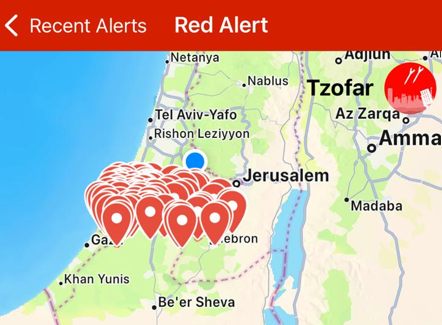
An illustrative example of an Israeli alert depicting communities in range of an Iranian ballistic missile attack
The fact that Israel does not deploy sirens in Palestinian towns under the rule of the Palestinian Authority is not a function of "Israeli policy." Rather, it's a basic principle of the bilateral Oslo Accords wherein the Palestinian Authority holds security and civil responsibility for Area A territory, which includes Beit Awwa. Just like the Palestinian Authority is responsible for vaccines for its population, it is also responsible for providing air-raid sirens and shelters.
Notably, unlike the English edition, the parallel Hebrew article does not falsely attribute the lack of sirens in Palestinian towns to "Israeli policy." The Hebrew edition states: "There are no sirens in the Palestinian towns in the West Banks."
Relatedly, while Haaretz reported a supposed (ie false) asymmetry between Israel's supply of life-saving sirens for Israelis versus Palestinians across the Green Line, a separate Haaretz article ignored a real symmetry between life-saving policies regarding Jerusalem religious sites.
 Thus, the March 21 article, "Israel Police Forcibly Prevent Eid al-Fitr Prayers at Jerusalem's Al-Aqsa Mosque," fuels the false narrative highlighted in the subheadline — namely that the restriction on Muslim prayer gatherings at the holy site was "what some called a politically motivated move" — by ignoring the fact that prayer is also prevented at Christian and Jewish holy sites, such as the Church of the Holy Sepulchre or the Western Wall, respectively.
The article's elliptical reporting further reinforces the false notion that the restrictions on crowds gathering for prayers target the Muslim community exclusively in an act of political persecution:
However, residents of East Jerusalem voiced sharp criticism over the prevention of access to the compound. Some argued that the move was politically motivated, particularly given its timing during the month of Ramadan. In addition, police prevented worshippers at several locations in East Jerusalem from holding alternative prayers. . . .
Eid prayers were also restricted in the West Bank city of Hebron. At the Ibrahimi Mosque in the Cave of the Patriarchs, attendance was limited to about 80 worshippers. Testimonies from the site indicate that most of the mosque's gates were closed, with entry permitted through only one gate and subject to strict inspections.
At no point did the article make clear that these restrictions are not at all unique to the Muslim community.
Other outlets were abundantly clear on the non-discriminatory nature of the restrictions. Agence France Presse, for instance, reported:
Since Israel and the United States started the war with Iran on February 28, Israeli authorities have closed access to Jerusalem's world-renowned holy sites over security concerns -- Al-Aqsa Mosque for Muslims, the Church of the Holy Sepulchre for Christians and the Western Wall for Jews.Moreover, after initial reporting indicated that the prayer restriction applied only to the Muslim site, the Guardian commendably appended this correction to the bottom of its March 20 article, "'The saddest day for Muslim worshippers in Jerusalem': al-Aqsa mosque closed at Eid":
This article was amended on 22 March 2026 to make clear that all holy sites in the Old City were closed to worshippers, not just the the al-Aqsa mosque complex.
In addition, in response to communication from CAMERA UK, Guardian editors commendably added this essential information which was originally omitted:
The closure affected all holy sites within the Old City, including the Church of the Holy Sepulchre for Christians and the Western Wall for Jews.
"Haaretz is covering this lethal contest with first-hand reporting, incisive commentary, and sharp, meticulousreporting [sic]," the Haaretz English Editor-in-Chief wrote in a March 1 marketing missive to subscribers. "We're on the ground where it's happening, writing and publishing amid non-stop missile barrages."
Meanwhile, Haaretz is unmoved by the fact that the Guardian (!) has provided superior coverage on the regulations protecting against those non-stop missile barrages. While CAMERA has shared the Guardian correction with the Israeli media outlet, editors at the Israeli newspaper on the ground have also neglected to clarify this point.
Is it Haaretz policy to provide false coverage discriminating against Israel?
March 24 Update, 4:58 pm ET: Haaretz Corrects: Palestinian Authority, Not Israel, At Fault For Lack of Air-Raid Sirens
Following publication of this post and communication from CAMERA earlier in the week, Haaretz editors commendably corrected the digital article to make clear that the Palestinian Authority, and not "Israeli policy," is at fault for Beit Awwa's lack of air-raid sirens and shelters. The amended text accurately reports:
No warning systems were activated in Beit Awwa. Under the Oslo Accords, the Palestinian Authority is responsible for providing security, including sirens and shelters, in areas under its full control. Nearby Israeli settlements received alerts allowing residents to take shelter.
In addition, an editor's note appended to the bottom of the article alerts readers to the change, stating:
Editor's note: An earlier version of this article incorrectly attributed the lack of warning sirens in Beit Awwa to Israeli policy. Beit Awwa is located in Area A, under the control of the Palestinian Authority, which is responsible for sirens and shelters in that area. The article has been updated accordingly.