
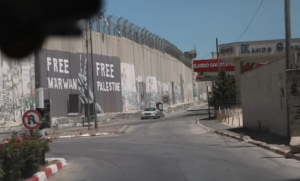
Screenshot of the CNN special as Clarissa Ward and her crew are driving past the West Bank security barrier in Bethlehem. “Free Marwan” is graffitied on the wall, in reference to Marwan Barghouti whom Israeli courts convicted for murder.
In “The quiet erosion of Christian life in the Holy Land,” CNN special, Clarissa Ward crossed the line from reporter to activist.
Rather than exploring why Christians have been leaving Jerusalem and the West Bank, Ward selectively curated her interviews and background to promote a singular narrative that Israel is pushing Christians out, ignoring a far more complex reality.
Ward’s Bias and Manufactured Narratives
Ward’s bias was evident from the moment the clips started rolling. Driving to Bethlehem, she abandoned standard journalistic detachment to shout at an Israeli shepherd on the border of Areas B and C, “This is not your land!”
Passing the security barrier in Bethlehem, Ward described it as a “brutal structure” without explaining that Israelis built the wall to stop the suicide bombings during the Second Intifada.
When the cameras panned to reveal “Free Marwan” graffitied on the wall, Ward failed to note that Israeli courts convicted Marwan Barghouti for directing terror attacks that killed four Israeli civilians and a Greek monk. Uncritically airing this graffiti obscured Palestinian society’s idolization of anti-Christian violence in favor of an undisrupted singular narrative.
In Jerusalem, where Ward began the segment, she used a subtle interviewing tactic to immediately cast suspicion on Israeli society. She opened with footage of an Israeli pushing a nun to the ground in the Old City, noting in her own voiceover that the Israeli government had swiftly condemned the attack. She also showed footage of police arresting the suspect, explicitly stating they suspected a nationalist motive.
Despite this clear condemnation and official transparency, Ward posed a leading question to Father Anthony Giambrone, a scholar who teaches at the victim’s school, floating unsourced speculation that the attacker was merely mentally ill, forcing a priest to refute an unverified claim and creating the unsupported impression that Israelis were sweeping a hate crime under the rug.
Ward’s interview choices further exposed this editorial bias. For example, she featured Rev. Munther Isaac, who attributed declining Christian populations to the “Nakba,” but ignored his Oct. 8, 2023, sermon justifying the Hamas massacres as a natural response to the Gaza “siege.” Of the two Palestinian Christians Ward interviewed, both were part of the Latin Patriarchate of Jerusalem, seemingly the sole source of Christians in the West Bank for international news media.
Palestinian and Islamic Pressure
To understand the reality Ward ignored, CAMERA attempted, through extensive international Christian networks, to speak with other Christians in the same places she visited. In the end, only one Christian in the West Bank would go on the record.
Philos Project Director and ordained Southern Baptist Minister Luke Moon told CAMERA that while he has a good relationship with some pastors in Bethlehem, their relationship with him could hurt them since anyone he meets with will be seen as a potential “collaborator with Zionists.”
Explaining the dynamic, Minister Moon said, “When Palestinian Christians are in a group, they will never tell you how things really are. When you get them alone and talking, they will tell you horror stories about how they’re treated by Muslims, people around them, discrimination, fear, their daughters being forced to marry a Muslim…”
He compared the situation for Christians under Palestinian Authority rule to the relationship between an abused spouse and the abusive partner: “The spouse will tell you how amazing the relationship is, but you can see the black eye under the make-up.”
Underscoring this climate of fear, Minister Moon recalled a striking conversation from a year earlier with Cardinal Pierbattista Pizzaballa, the Latin Patriarch of Jerusalem. When Moon suggested evacuating Christians from Gaza for their safety, the Cardinal candidly warned him that if church leadership were seen as favoring Christians, “all the churches in the Middle East would burn.” CAMERA reached out to the Latin Patriarch to corroborate the statement.
This underlying pressure was evident when CAMERA asked Elias Baboun, a politically active Catholic from Bethlehem, about his relationship to Palestinian society at large. He alluded to experiencing pressure to convert to Islam, saying, “Most of the radical Muslims think they have to make other people Muslims. They try to advise you to bring you back to Islam.”
While a 2020 survey by the Palestinian Center for Policy and Survey Research (PCPSR) found that a minority (23 percent) of West Bank Christians have been directly urged to convert by Muslim acquaintances, 70 percent of Christian respondents reported hearing Muslims assert that Christians are bound for hellfire.
According to Moon, about 20 percent of Palestinian Christians are involved in terrorism, specifically noting that the founder of the PFLP was a Christian. Another 50 percent are Palestinian nationalists who are Christian “in name only.” This means, he explained, that in the Middle East, being Christian is more tribal and tied to family lineage than a set of beliefs. He said that Ward’s interviewees – Rev. Munther and Taybeh’s Father Bashar Fawadleh – fall into the Palestinian nationalist bucket.
The Situation in Taybeh
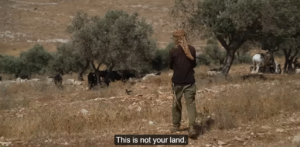
Screenshot of the CNN segment outside of Taybeh in which Clarissa Ward shouts at an Israeli “This is not your land!”
While ignoring this Palestinian intimidation, in a voiceover, Ward accused Israel of enabling Israeli violence against Christians while driving to Taybeh after speaking with the new Israeli envoy to the Christian world, Ambassador George Deek.
Her accusation of Israeli inaction in Taybeh is demonstrably false. On July 23, 2026, Maj.-Gen. Avi Bluth signed a year-long military order barring Israelis and all non-residents from entering Taybeh without permission to stop both Jewish and Muslim attackers. The order grants permission to soldiers and police to remove unauthorized persons by force.
Furthering efforts to address local friction, Ambassador Deek met on Aug. 5 with local Christian activist Elias Zarina to navigate pressures facing Taybeh. Addressing settler friction, Minister Moon attributed attacks on Taybeh to Israeli youth at an at-risk farm center near Rimonim. While CAMERA could not identify such a facility, a July 2026 Ministry document cited by the Times of Israel showed that roughly 225 Israeli youths, often school dropouts living in illegal outposts in the Benjamin region near Rimonim, frequently and deliberately clash with local Palestinians. Furthermore, it is possible that this group has not been targeting Christian Palestinians specifically. The Detroit Catholic reported on July 15, 2025 that a separate incident involving these youth began “when Palestinians threw stones at Israelis near the village,” citing the Israeli military.
Cherry-Picking and Distorting Data
Beyond anecdotal omissions, Ward and other outlets have relied on selective data to paint a misleading picture of systemic Israeli hostility. After dismissing Jewish volunteers working against anti-Christian ignorance with the vague assertion that it “will take more than good intentions,” Ward cites a 2025 Rossing Center for Education and Dialogue (RCED) survey showing roughly half of Israeli Christians under 45 are considering emigration.
In actuality, a 2025 Israel Democracy Institute survey reveals emigration desires are a broad trend across all demographics, affecting 28 percent of Arab Israelis and 36 percent of Israeli Jews aged 18–34. Furthermore, RCED’s own report notes that Arab Christian emigration is primarily driven by foreign opportunities and existing diaspora family ties, not Israeli hostility. As CAMERA analyst AJ Rodriquez pointed out, the RCED report misleads by grouping incidents of vastly different severity into a single narrative while ignoring official state responses.
The Wall Street Journal mirrored this flawed approach in an Aug. 2 report (“Spitting Attacks Show Rise of Anti-Christian Hate in Israel”) claiming “around half of Israelis believed that entering a church is forbidden, up from 10 percent in 2008.” This misquotes the RCED report, which noted a 10-percentage point increase, not a leap from 10 to 50 percent, and mischaracterizes standard Halachah (Jewish law) as bigotry. This increase reflects demographic growth in Israel’s religious population (rising from 25.5 percent to over 33 percent) and Halachic literacy, not a surge in anti-Christian prejudice.
Christian Emigration
Ultimately, the narrative of Christian emigration is far more complex than Ward presents. While Baboun did note that part of the reason Palestinian Christians are emigrating is due to a lack of economic opportunity as a result of restrictions on entering Israel, Moon argued Israel is within its rights to secure its borders, especially after the Oct. 7 attacks when Palestinians used intelligence they had obtained while working in Israel with permits.
Minister Moon summarized that the Muslim world uses stories of Israeli settler attacks to use Christians as pawns, noting that Christians in sovereign Israel are fully integrated and successful (a claim that official data backs up). CAMERA has already written extensively about this repeated media narrative.
In terms of emigration, Moon concluded, “Christians are stuck. They don’t have a lot of good options. The constant discrimination and prejudice and lack of safety … Everyone treats them with suspicion.”
The fundamental failure of Ward’s report is one that plagues much of the international press: a failure to recognize the coercive environment in which Middle Eastern minorities, like Christians in the West Bank, exist. Journalists must be fiercely wary when interviewing vulnerable populations in areas devoid of free speech. As Minister Moon noted, survival often requires these communities to mask their reality.
Likewise, reporters must be equally wary of institutional voices who have chosen to align with local radical powers to protect themselves or advance a political agenda.
Good reporting means holding radical voices accountable on camera while understanding why average people may be too terrified to speak even when the cameras are not rolling.
By failing on both counts, CNN simply broadcast the acceptable West Bank Christian narrative while burying the side of reality hardly anyone is willing to voice out loud.
For the Hebrew version of this post, please see CAMERA Hebrew.